For general-purpose manufacturing in India, the C-frame hydraulic press is the most widely used. It’s compact, versatile, and suited for a wide range of light to medium-duty applications.

- by Rjm_rajkot
- Blog
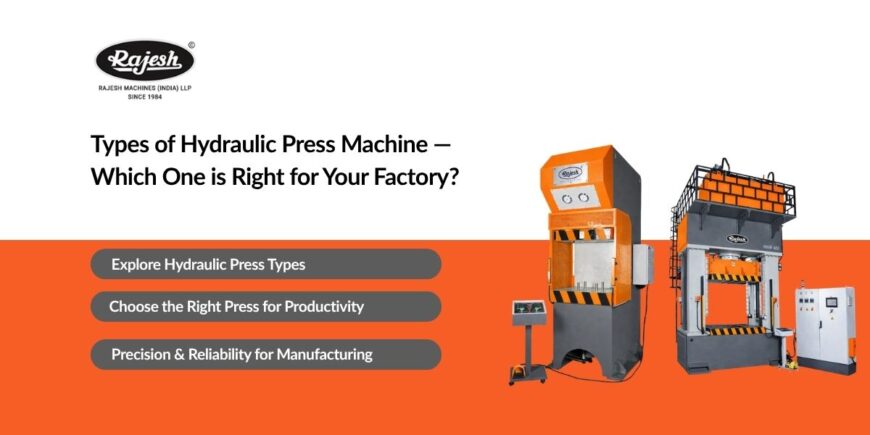
Types of Hydraulic Press Machine — Which One is Right for Your Factory?
Choosing the right hydraulic press isn’t about knowing all the types — it’s about selecting the one that actually fits your production, your budget, and where your factory is headed.
Here’s something most buyers find out the hard way: factories don’t lose money because they bought a bad machine. They lose money because they bought the wrong type of machine for their job. A press that’s too small limits your output. One that’s oversized for your application means you’ve overpaid and overspent on maintenance. Both situations hurt your bottom line.
This guide is written specifically for factory owners, production managers, and purchase teams in India who are either buying their first hydraulic press or upgrading from an older machine. We’ll walk through each type, explain what it actually does well, and tell you which applications it suits best — so you can make the decision confidently.
First, Why Hydraulic Over Mechanical?
Before jumping into types, it’s worth quickly answering this — especially if you’re still running mechanical presses in your shop.
Hydraulic presses work on Pascal’s Law: a small force applied to a fluid in a closed system creates a proportionally larger force at the output cylinder. What this gives you in practice is smooth, consistent, controllable force — all the way through the stroke. Unlike mechanical presses that deliver peak force only at the bottom of the stroke, hydraulic presses maintain full tonnage throughout. That matters a lot when you’re doing deep drawing, forming, or any job where uniform pressure is critical.
They’re also quieter, easier to set up, and far more adaptable. You can adjust pressure, speed, and stroke length to suit different jobs — something a fixed mechanical press simply can’t do.
Related Read: What is the difference between Mechanical and Hydraulic Press?
Types of Hydraulic Press Machines (And What Each One is Actually Good For)
1. C-Frame Hydraulic Press
Also called: Gap Frame Press, C-Type Hydraulic Press
The C-frame hydraulic press is probably the most common type you’ll find in small to mid-size workshops across India. The frame is shaped like the letter “C,” which opens up three sides of the machine — giving operators easy access from the front and sides.
What it’s good for: – Punching and blanking operations – Light to medium forming jobs – Assembly and fitting work – Electrical component manufacturing – Small part fabrication
Why factories love it: It doesn’t eat up your floor space the way an H-frame or four-column press does. If your shop handles a mix of jobs — different parts, different dies, changing requirements through the week — a C-frame lets you stay nimble without dedicating half the floor to one machine.
What to watch for: That open “C” shape is also its weak point under very high loads — the frame can flex, even if only slightly. In practical terms, C-frame presses work best up to 200–300 tons. Push past that, or try holding very tight tolerances on large workpieces, and you’ll start running into the frame’s limits.
Related Read: All you need to know about C Frame Power Press Machines
2. H-Frame Hydraulic Press
Also called: H-Type Press, Pillar-Type Hydraulic Press, H-Frame Power Press
If the C-frame is the go-to for smaller shops, the H-frame hydraulic press is what serious production floors are built around. All four sides of the frame are fully enclosed and braced — which is what makes it so much more stable when you’re pushing high tonnages.
What it’s good for: – Heavy-duty forming and stamping – Deep drawing applications – Press-fit assembly of large components – Bearing and bushing press-in jobs – Automotive and structural parts manufacturing
Why factories choose it: The H-frame’s symmetrical build means load gets distributed evenly across the frame — so even when you’re running at peak capacity, the press stays steady and consistent. Die alignment is also easier because the frame doesn’t shift.
The honest truth: H-frame presses are bigger machines. They need more floor space and generally cost more than C-frame equivalents at the same tonnage. But if you’re doing high-volume, heavy-duty work, that investment pays off quickly in reliability and reduced downtime.
Related Read: H-frame Hydraulic Press Machines: Everything You Need to Know
3. Four Column (Four Pillar) Hydraulic Press
Also called: Four Post Hydraulic Press, Four Pillar Press
When you need the highest level of precision and absolutely uniform pressure distribution across the entire bed, the four-column hydraulic press is the answer. Four vertical pillars (or columns) guide the ram perfectly parallel to the bed throughout the entire stroke — there’s no tilting, no deflection, no uneven pressure.
What it’s good for: –
What it’s good for:
- Deep drawing of complex shapes
- Rubber moulding and compression work
- Powder metallurgy and sintering processes
- SMC and composite material forming
- Precision blanking and forming of large parts
- Automotive panel production
Why it matters for precision work: In jobs like deep drawing or rubber moulding, even a small misalignment in the ram can cause problems. You might start seeing uneven thickness, cracks in the material, or even damage to the die over time.
Four-column presses eliminate this risk. The ram is guided on all four corners, ensuring perfect perpendicularity every single stroke.
Who needs this: If your factory produces components where dimensional accuracy is critical and rejections are costly, a four-column press is not an overhead — it’s a quality investment. Automotive component manufacturers, precision engineering shops, and exporters working to international quality standards will find this especially valuable.
Related Read: Four Pillar Hydraulic Press Machine Working Principle Guide
4. Hydraulic Workshop Press
Also called: Bench Press, Shop Press, Garage Hydraulic Press
This is the most basic and compact type. You’ll typically find hydraulic workshop presses in maintenance shops, small fabrication units, motor rewinding workshops, and toolrooms. They’re used for light pressing, bearing removal, shaft straightening, and general repair work.
What it’s good for: – Bearing press-in and removal – Shaft alignment and straightening – Bushing installation – Light punching and forming jobs – General maintenance work
Who uses it: Toolrooms, maintenance departments, small workshops, automobile service centres. If you need a reliable press for light-duty tasks and don’t want to invest in a full-scale production press, a workshop press does the job without the footprint or cost.
5. C-Type Hydraulic Power Press (I-Ram Type)
This is a specialized variant of the C-frame
design, built specifically with an I-Ram (inline ram) configuration. The I-Ram type offers better rigidity compared to a standard C-frame, making it suitable for precision stamping, punching, and certain forming operations where the C-frame’s natural frame flex would be a concern.
What it’s good for: – Punching sheet metal components – Precision blanking operations – Electrical enclosure manufacturing – Components where flatness and accuracy are critical
View Product: C-Type Hydraulic Power Press (I-Ram Type)
Comparison at a Glance
Type | Best For | Typical Tonnage Range | Precision | Space Needed |
|---|---|---|---|---|
C-Frame Hydraulic | Light-medium forming, punching, assembly | Up to 200–300 tons | Medium | Low |
H-Frame Hydraulic | Heavy forming, deep draw, high-volume | 100–1000+ tons | Medium-High | Medium-High |
Four Column Hydraulic | Deep draw, moulding, precision forming | 100–1000+ tons | Very High | High |
Workshop Press | Maintenance, light pressing, repair | Up to 30–50 tons | Basic | Very Low |
C-Type I-Ram | Precision stamping, punching | Up to 200 tons | High | Low |
“Which Hydraulic Press Should I Buy?” — A Practical Decision Guide
Here’s the most direct way to think about this. Ask yourself these three questions:
- What is the primary job this press will do?
- Punching holes or light blanking in sheet metal → C-Frame Hydraulic Press
- Heavy forming, deep drawing, large part stamping → H-Frame or Four Column
- Rubber or plastic moulding, composite forming → Four Column Hydraulic Press
- General maintenance and repair in a workshop → Hydraulic Workshop Press
- Precision punching with tight tolerances → C-Type I-Ram Press
- What tonnage do you actually need?
This is where many buyers make mistakes — they either underestimate or overestimate. Undersizing means the press struggles, heats up faster, and wears out sooner. Oversizing means you’ve spent more than you needed to. A good rule of thumb: calculate your actual process force requirement first, then add 20–25% headroom. Don’t just guess.
Related Read: Maximize Productivity by Selecting Right Hydraulic Press Tonnage
- How will your production needs change in the next 3–5 years?
It’s worth thinking a bit ahead here. If you expect to take on bigger jobs, expand your product range, or simply increase output, it makes sense to consider that now rather than upgrading again later.
What Most Buyers Overlook (But Shouldn’t)
Apart from frame type and tonnage, there are a few practical factors that often get ignored and they usually matter more in day-to-day operations than people expect.
Bed Size Your job’s workpiece size determines the minimum bed area you need. Many buyers check tonnage but forget to verify that the working bed is large enough for their tooling and components.
Stroke Length Deep drawing jobs need longer strokes. Make sure the press stroke is sufficient for your deepest draw depth — with some margin.
Cylinder Speed (Approach + Working + Return) In production environments, cycle time matters. Slow approach and return speeds add up to significant lost time. Check both the working speed and the rapid traverse speed.
Control System Older presses are manually operated. Modern hydraulic presses come with PLC-based controls that allow programmable pressure profiles, stroke settings, and dwell time. If you’re running a production line, this level of control is not a luxury — it’s a productivity tool.
Oil Quality and Maintenance Hydraulic presses are only as reliable as the hydraulic system behind them. Clean oil, properly maintained filters, and regular checks on cylinder seals will determine how long your press performs at full capacity.
Related Read: Key Components of a Hydraulic Press Machine
Industries That Typically Use Each Type
Automotive components: H-Frame, Four Column
Sheet metal fabrication: C-Frame, C-Type I-Ram
Electrical panel & enclosure manufacturing: C-Frame
Rubber and gasket manufacturing: Four Column
Die casting & forging support: H-Frame, Four Column
Toolrooms and maintenance: Workshop Press
Composite and SMC manufacturing: Four Column
Small-scale and MSME workshops: C-Frame, Workshop Press
Related Read: What are the types of Press machines?
What About Hydraulic Press vs. Other Presses?
If you’re still comparing hydraulic presses against mechanical or pneumatic options, here’s the short version:
- Hydraulic vs. Mechanical: Hydraulic gives full tonnage throughout the stroke, is quieter, and far more flexible for varied jobs. Mechanical presses are faster for high-speed blanking and punching. Read the full comparison here.
- Hydraulic vs. Electric Press: Electric presses (servo-driven) are more energy efficient and precise for very specific applications. Hydraulic presses are more cost-effective for high-force applications and generally easier to maintain in Indian conditions. Compare them here.
- Hydraulic vs. Pneumatic: Pneumatic presses are fast and clean, ideal for light assembly work. Hydraulic presses handle far higher tonnages. Learn about pneumatic presses.
Why Rajesh Machines for Hydraulic Presses?
Rajesh Power Press India has been manufacturing hydraulic press machines from Rajkot, Gujarat — one of India’s leading industrial hubs for machine tools. Every machine is built with the realities of Indian manufacturing in mind: variable power supply, semi-skilled operators, demanding production schedules, and the need for low-maintenance reliability.
Our hydraulic press range covers everything from compact workshop presses to heavy-duty four-column machines — with customization available for tonnage, bed size, stroke, and control systems.
Products: – C-Frame Hydraulic Press – H-Frame Hydraulic Press – Four Column Hydraulic Press – Hydraulic Workshop Press – C-Type Hydraulic Power Press (I-Ram Type)
Frequently Asked Questions
-
What is the most commonly used type of hydraulic press machine?
-
Which hydraulic press is best for deep drawing?Four-column hydraulic presses are the preferred choice for deep drawing because they provide perfectly uniform pressure distribution and eliminate ram deflection.
-
What is an H-type hydraulic press machine used for?H-frame hydraulic presses are used for heavy-duty forming, stamping, assembly of large components, and any application requiring high tonnage and structural rigidity.
-
What is a C-type hydraulic press machine?A C-type hydraulic press (also called a gap frame press) has a C-shaped open frame that provides three-sided access. It’s widely used for punching, blanking, forming, and assembly work in small to mid-size workshops.
-
How much does a hydraulic press machine cost in India?The cost varies significantly depending on type, tonnage, and features. Workshop presses start at a much lower price point, while four-column production presses for high tonnage are a larger investment. Contact us for a specific quote based on your requirements.
-
How do I choose the right tonnage for a hydraulic press?Calculate the force required for your specific process (based on material, thickness, and operation type), then add 20–25% capacity margin. Undersizing causes strain and premature wear; oversizing increases cost unnecessarily.
The Right Machine Changes Everything
Buying a hydraulic press is not just a capital expenditure — it’s a production decision. The right press reduces cycle times, improves part quality, and runs reliably for years. The wrong one creates bottlenecks, quality rejections, and maintenance headaches.
Take the time to match the machine to your actual job. If you’re not sure which type suits your production best, our team at Rajesh Power Press India will help you evaluate your requirements and recommend the right configuration.