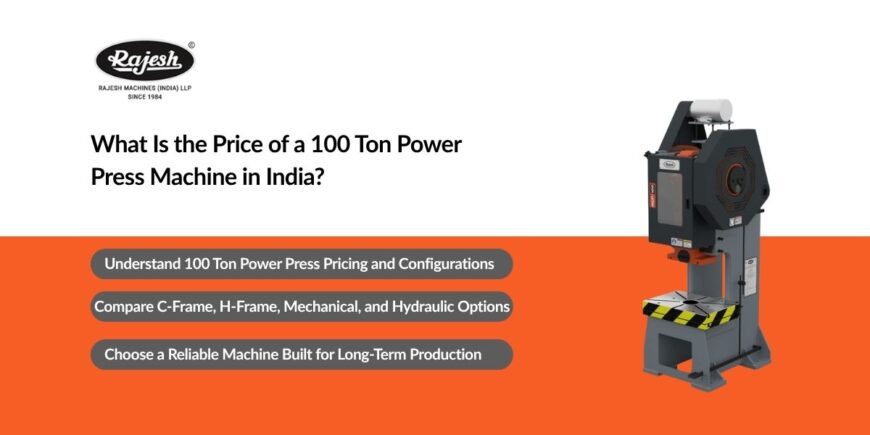
The price ranges from approximately ₹1,20,000 for a basic local mechanical machine to ₹12,00,000 or more for a high-performance branded machine. The variation comes down to frame type, drive mechanism, motor specs, and automation level. Our RCP-100T starts from ₹11,00,000 and is built for manufacturers who need consistent output over years, not just months.

- by Rjm_rajkot
- Blog
What Is the Price of a 100 Ton Power Press Machine in India?
If you are searching for a 100 ton power press machine price, you have probably already figured out that the answers online are vague at best. Some websites say ₹80,000, others quote ₹15 lakh — and you are left wondering what you actually get for that money.
This blog is not just about giving you a number. It is about helping you understand what that number means — so you can make a smarter buying decision for your factory or workshop.
We have been manufacturing power press machines in India for decades, and we know that a 100 ton press machine is one of the most important investments a mid-scale manufacturer can make. So let us break this down properly.
First, What Does 100 Ton Actually Mean?
A 100 ton power press machine means exactly what it says — the machine delivers 100 metric tons of pressing force onto your workpiece. That is it. No tricks in the number. That is approximately 980 kN of force, which is enough to punch, blank, bend, or form a wide variety of sheet metal components.
This capacity is not for light work. A 100 ton press is the machine you reach for when:
- Sheet thickness goes above 3mm in mild steel
- You are blanking or deep drawing larger components
- Your production volumes are high and consistency matters
- You are working with harder materials like stainless steel or high-tensile steel
If you are currently running a smaller machine and finding it underpowered, our blog on how to choose the right power press machine for your production line will help you understand if 100 ton is the right upgrade.
100 Ton Power Press Machine Price in India — The Real Breakdown
Here is the real answer — price varies a lot, and for good reason. Frame type, drive system, brand, automation level — all of it moves the number. This is how the Indian market actually looks in 2026:
Machine Type | Frame Configuration | Approximate Price Range | Best Suited For |
|---|---|---|---|
Basic / Local Unbranded | C-Frame Mechanical | ₹80,000 – ₹1,80,000 | Starter workshops, limited volume |
Mid-Range Industrial | C-Frame / H-Frame Mechanical | ₹1,80,000 – ₹5,00,000 | Regular production, moderate duty |
High-Performance Branded | H-Frame / Hydraulic / Pneumatic | ₹5,00,000 – ₹12,00,000+ | Heavy-duty, high-volume, precision work |
At Rajesh Power Press India, our 100 ton machines are positioned in the high-performance bracket — built for manufacturers who cannot afford downtime, tool damage, or inconsistent output.
C-Frame vs H-Frame: Which 100 Ton Press Should You Buy?
This is one of the most common questions buyers ask — and it directly affects the price. If you want a deeper dive on this, read our blog on C Frame Power Press Machines.
Feature | C-Frame | H-Frame |
|---|---|---|
Frame Type | C-Frame (Gap Frame) | H-Frame (Pillar Type) |
Access | Three-sided open access | Front access only |
Rigidity | Good for light-to-mid loads | Superior rigidity under heavy load |
Ideal Use | Blanking, piercing, forming | Deep drawing, heavy blanking |
Typical Price | ₹1,80,000 – ₹6,00,000 | ₹3,50,000 – ₹12,00,000+ |
Footprint | Compact | Larger |
At 100 ton capacity, most serious buyers end up going with the H-Frame. Why? Because at this tonnage, even a small amount of frame deflection shows up in your parts. The H-Frame design offers significantly better rigidity.
Mechanical vs Hydraulic 100 Ton Press — What Costs More and Why?
Not all 100 ton presses are built the same way. The drive mechanism — mechanical or hydraulic — changes not just the price, but also the entire way the machine performs. We have covered this in detail in our comparison blog: What is the difference between Mechanical and Hydraulic Press?
Mechanical 100 Ton Power Press
A mechanical press runs on a flywheel, crankshaft, and clutch — the same basic principle that has worked in factories for over a century. It is fast, it is consistent, and if your work is repetitive blanking or punching at volume, it is hard to beat.
- Price range: ₹1,20,000 – ₹6,00,000
- Strokes per minute: 40 to 90+ SPM depending on configuration
- Best for: Blanking, punching, piercing, progressive die work
- Running cost: Lower — simpler to maintain
Hydraulic 100 Ton Power Press
A hydraulic press works differently — instead of a flywheel, it uses oil pressure to push the ram down. Slower than mechanical, yes. But you get something mechanical presses cannot give you: real control over stroke depth, speed, and dwell time. For deep drawing or forming complex shapes, that control matters a lot. Learn more in our complete guide on Hydraulic Power Press Machines.
- Price range: ₹3,50,000 – ₹12,00,000+
- Speed: Slower than mechanical, but variable and programmable
- Best for: Deep drawing, rubber pressing, forming complex shapes
- Running cost: Slightly higher — hydraulic system requires oil management
What Factors Affect the 100 Ton Power Press Machine Price?
Two buyers can look at the same “100 ton press machine” and get quotes that differ by 5 lakh rupees. Here is why:
1. Frame Type and Build Quality
Cast iron vs fabricated steel frame, the grade of raw material used, and the quality of machining all affect the price — and more importantly, the machine’s life. A cheaper frame might cost less today but crack under continuous load within a few years.
2. Motor Power and Electrical Components
A 100 ton press typically runs on a 5 HP to 15 HP motor depending on the application. Higher HP means the machine can maintain its performance even under continuous load — it does not slow down mid-shift. And the motor brand matters more than people admit. A reputed motor with a proper starter panel and safety controls adds to the price, but skimping here is where workshops quietly lose money over three to five years.
3. Stroke Length and Bed Size
A machine with a larger bed size and longer stroke is inherently more expensive to manufacture. If your components require a 200mm or longer stroke, or a wider bed, expect the price to reflect that.
4. Automation and Control Features
A standard mechanical press with manual control is the most affordable. Add a PLC controller, stroke counter, variable speed drive, or safety sensors — and the price goes up accordingly. But so does productivity and safety.
5. Brand and After-Sales Support
Here is something most buyers underestimate. A branded machine from a reputed Indian manufacturer may cost 20–30% more than a local unbranded press. But when your machine goes down at peak production time, that after-sales support becomes invaluable. We have written about this in detail — how Rajesh Machine Tools stands out as a power press manufacturer.
6. Single Point vs Double Point Configuration
A single point 100 ton press concentrates force at the center of the bed. A double point press distributes that force across two connection points, which is better for wide dies. Double point machines are priced higher.
Hidden Costs Buyers Usually Forget
The sticker price is not your actual investment. Every single buyer who has been through this process knows there are costs that do not show up in the quotation and forgetting them is how budgets get blown. Here is what to plan for:
- Transportation and installation: This is not a machine you put in a tempo and drive home. A 100 ton press needs a crane or hydraulic trolley for unloading, and proper alignment during installation. Budget ₹20,000 to ₹80,000 just for this — more if you are in a remote location.
- Tooling and dies: The press is nothing without the right die set. Custom dies for your specific component can cost ₹10,000 to ₹5,00,000+ depending on complexity.
- Electrical connection: A 100 ton press requires proper three-phase connection. If your workshop needs upgrading, budget for it.
- Foundation work: Heavier presses often require a reinforced concrete pit or pad. This is especially true for H-Frame machines.
- Annual maintenance: Oil changes, clutch inspection, brake lining checks, electrical — this is not optional, it is what keeps a press running for 15 years instead of five. A branded machine with spare parts availability makes this far less painful.
Who Actually Buys a 100 Ton Power Press in India?
This capacity sits right in the sweet spot for mid-scale Indian manufacturers. Our buyers in this segment typically include:
- Automotive component manufacturers — brackets, stampings, frame parts, and chassis components
- Sheet metal fabrication units — enclosures, panels, covers, and structural parts
- Kitchen appliance manufacturers — cooker bodies, pressure vessels, and utensil blanks
- Electrical panel manufacturers — bus bar punching, sheet metal enclosures
- Export-oriented manufacturers — companies producing for international buyers who demand precision and consistency
If you are in the automotive parts segment specifically, our blog on power press stamping in automotive goes into detail about which press capacity is right for which application.
How to Evaluate a 100 Ton Power Press Before You Buy
Whether you are buying from us or any other manufacturer, here are the key specifications you must check:
- Nominal Capacity: Confirm it is rated at 100 tons at the bottom of the stroke — not mid-stroke.
- Stroke Length: Match it to your die height requirements. Common: 130mm to 200mm for this capacity.
- Shut Height (Closed Height): The distance from bed to slide at the lowest position. Must accommodate your die set.
- Bed Size: The working area of the press — left-to-right and front-to-back. Your largest die needs to fit comfortably here. If you are guessing, you are buying the wrong machine.
- Motor HP: Anywhere from 5 HP to 15 HP at this capacity. Higher HP keeps the machine from struggling during sustained production runs — especially important if you are running two or three shifts.
- SPM (Strokes Per Minute): For high-volume work, higher SPM matters. Mechanical presses deliver more SPM than hydraulic.
- Frame Material: Heavy-duty cast iron or fabricated steel. Ask for thickness and grade.
- Clutch and Brake System: Key-type, pneumatic friction, or hydraulic clutch — each has different performance and maintenance implications.
For a full guide on what to check before buying, see our blog: Tips for Choosing the Right Power Press Machine.
How Does the 100 Ton Press Compare to Other Capacities?
If you are still deciding on the right tonnage, here is a quick perspective. We have detailed pricing guides for other capacities too — check our blog on the 10 Ton Power Press Machine Price for a comparison at the entry-level end.
Capacity | Typical Application | Price Range |
|---|---|---|
10 Ton | Light punching, small stampings, thin sheet metal | ₹35,000 – ₹1,20,000 |
30 Ton | Small-to-mid components, blanking, forming | ₹60,000 – ₹2,50,000 |
50 Ton | Mid-scale production, heavier blanking | ₹90,000 – ₹4,00,000 |
100 Ton | Heavy blanking, deep drawing, automotive parts | ₹1,20,000 – ₹12,00,000+ |
150 Ton+ | Large structural parts, heavy-duty forming | ₹8,00,000 – ₹20,00,000+ |
Why the Cheapest 100 Ton Press Is Usually the Most Expensive in the Long Run
We understand the pressure of budget. Every rupee counts when you are running a workshop. But we have seen too many buyers go for the cheapest 100 ton press available — and then spend the next two years dealing with breakdowns, poor part quality, and tooling damage caused by frame deflection and inconsistent force delivery.
A power press machine is not a consumable. It is a long-term asset. A machine that runs reliably for 15 to 20 years at full capacity is far more economical than one that needs constant repairs or replacement within five years.
Stop asking “What is the cheapest 100 ton press available?” That is the wrong question. The right one is: “Which 100 ton press will give me the lowest cost per good part over the next decade?” Those two questions lead to very different machines.
Read more on this: How Power Press Machines Improve Manufacturing Efficiency.
Rajesh Power Press India — Our 100 Ton Range
At Rajesh Power Press India, we manufacture both C-Frame and H-Frame Power Press Machines at 100 ton capacity, along with hydraulic configurations. Every machine is:
- Manufactured at our Rajkot facility with strict quality checks
- Built with heavy-duty cast iron / fabricated steel frames for longevity
- Tested under load before dispatch
- Backed by after-sales service and spare parts support across India
- Exportable to international markets with CE-compatible configurations
We are not just a machine supplier. We are a manufacturing partner and that distinction matters when you are making a decision of this size.
Our RCP-100T — Full Specifications
If you want to skip the comparison shopping and see exactly what our 100 ton machine delivers, here are the complete specs for our RCP-100T C-Frame Power Press:
Specification | Details |
Model No. | RCP-100T |
Tonnage | 100 Ton |
Crank Shaft Diameter | 200 mm |
Stroke Length | 250 mm |
Stroke Adjustment | 100 – 250 mm |
Bed Size | 1200 × 800 mm |
Distance Bed to Ram | 800 mm |
Hole in Ram | 150 mm |
Hole in Bed | 300 mm |
Flywheel Diameter | 1400 mm |
Motor HP Required | 50 HP |
Machine Dimensions (L×W×H) | 2500 × 2200 × 3200 mm |
Starting Price | ₹11,00,000 onwards |
View Full Product Page & Send Inquiry
Get the Right 100 Ton Press for Your Workshop
Every factory has different requirements — sheet thickness, component size, production volume, and budget. Our team will help you find the right configuration at the right price.
Contact us today for a custom quote based on your exact production needs.
Browse our full range of Power Press Machines or if you want to know more about how we work and what sets us apart, start here: Top Power Press Machine Manufacturers in India.
Frequently Asked Questions
-
What is the price of a 100 ton power press machine in India?
-
What is the price of a 100 ton hydraulic press machine in India?A 100 ton hydraulic press typically falls between ₹3,50,000 and ₹12,00,000 or beyond. The higher cost reflects the hydraulic system components — pumps, cylinders, oil circuits, and control valves — which give you variable stroke control and dwell time that a mechanical press cannot offer. If your work involves deep drawing or complex forming, that premium is usually worth it.
-
What is the difference between C-Frame and H-Frame at 100 ton capacity?At lower tonnages, the choice between C-Frame and H-Frame is mainly about convenience. At 100 ton, it becomes a performance decision. The C-Frame gives you three-sided open access — useful for feeding large or awkward blanks. The H-Frame offers significantly better rigidity under heavy load, which means less frame deflection and more consistent part quality. For buyers doing deep drawing or heavy blanking at volume, the H-Frame is almost always the right call.
-
How long does it take to get a 100 ton power press delivered after ordering?For standard configurations, lead time is typically 4 to 6 weeks from order confirmation. Custom specifications — non-standard bed sizes, special stroke lengths, PLC controls, or export-ready configurations — may require 6 to 10 weeks. Always confirm lead time before committing, especially if you are planning around a production ramp-up. Our team at Rajesh Power Press India will give you a confirmed dispatch date at the time of order.
-
What ongoing maintenance does a 100 ton power press require?A 100 ton mechanical press needs scheduled clutch inspection, brake lining checks, flywheel bearing lubrication, and gearbox oil changes — typically on a quarterly and annual cycle. A hydraulic press additionally requires oil quality checks and hydraulic seal inspection. Skipping maintenance is how a machine that should last 20 years becomes a liability in five. A reputed manufacturer with spare parts availability makes this process significantly easier and cheaper over the machine's life.
-
Can I run a 100 ton press on single-phase power?No. A 100 ton power press requires a three-phase electrical connection. The motor requirement for this capacity typically ranges from 15 HP to 50 HP depending on the configuration — that rules out single-phase entirely. If your workshop does not currently have a three-phase connection, budget for the electrical upgrade as part of your total investment.
-
Is a 100 ton press suitable for progressive die work?Yes, but with conditions. A mechanical 100 ton press can absolutely run progressive dies — the key factors are stroke rate, shut height compatibility with your die set, and the precision of the ram guide system. If you are running progressive dies at high SPM, you need a machine with a robust clutch-brake system and a ram guide that maintains alignment under continuous load. Discuss your die specifications with the manufacturer before ordering.