Shearing machine prices in India range from ₹80,000 for basic manual/treadle models to ₹50 lakh+ for heavy-duty CNC hydraulic machines. The most common hydraulic shearing machines for industrial use are priced between ₹6 lakh and ₹15 lakh.

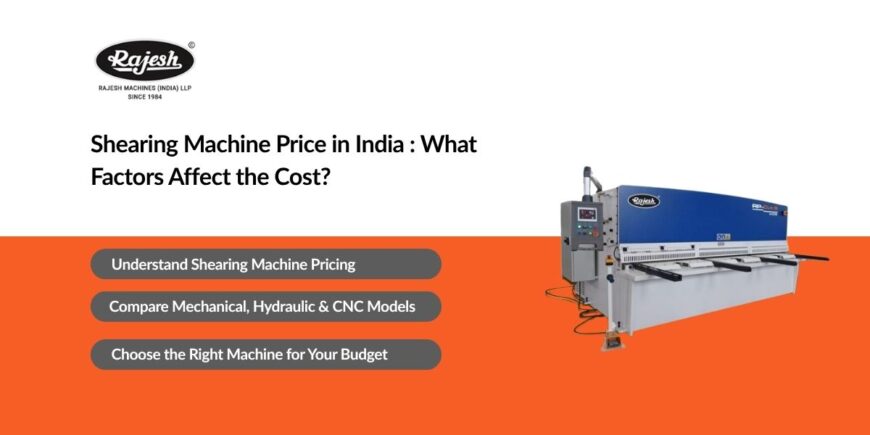
- by Rjm_rajkot
- Blog
Shearing Machine Price in India : What Factors Affect the Cost?
A shearing machine in India can cost anywhere from ₹80,000 to ₹50 lakh+ — and that’s not a typo.
Walk into one supplier’s shop and you’ll find a decent mechanical shearing machine for ₹2.5 lakh. Walk into another and a hydraulic CNC model is quoted at ₹35 lakh. Both are called “shearing machines.” Both cut metal. So why is the price gap so enormous?
The answer lies in understanding exactly what you’re paying for at each price point — machine type, cutting capacity, control system, build quality, brand, and a handful of other factors that most buyers don’t know to ask about.
This guide breaks it all down. Whether you’re a fabrication shop owner in Rajkot, a procurement manager in Pune, or a first-time buyer setting up a new workshop, by the end of this article you’ll know how to evaluate any shearing machine quote with confidence — and never overpay or underbuy again.
What is a Shearing Machine? (Quick Context)
A shearing machine is an industrial cutting machine used to cut sheet metal, plates, and bars by applying shear force using two sharp blades — one fixed and one moving. It works similarly to a pair of scissors, but with enormous precision and force.
Shearing machines are used widely across:
- Metal fabrication workshops
- Automotive component manufacturing
- Construction and infrastructure
- HVAC and electrical panel manufacturing
- Steel furniture and appliance industries
Shearing machines come in different types from simple manual machines to fully automated CNC systems. That’s why the price range of them varies so much.
If you want to understand how shearing machines actually work, you can check our detailed guide: What is a Shearing Machine?
Shearing Machine Price in India: Quick Snapshot
Before diving into the factors, here’s a realistic price overview by machine type as of 2025–26:
Machine Type | Typical Price Range (INR) | Best For |
Manual / Treadle Shearing Machine | ₹80,000 – ₹1,75,000 | Light-duty, low-volume cutting |
Mechanical Power Shearing Machine | ₹2,50,000 – ₹6,50,000 | Small to mid workshops, Mild Steel/Stainless Steel up to 4–6mm |
Hydraulic Shearing Machine | ₹6,00,000 – ₹15,00,000+ | Heavy-duty industrial use, higher thickness |
NC Hydraulic Shearing Machine | ₹12,00,000 – ₹25,00,000 | High precision, programmable production |
CNC Hydraulic Shearing Machine | ₹20,00,000 – ₹50,00,000+ | Fully automated, high-volume manufacturing |
Disclaimer: Prices mentioned are approximate and may vary based on specifications, brand, customization, and location.
Market rates also change over time, so it’s always better to get a fresh quote.
Above price ranges are just a starting point. To know if a machine is fairly priced, you need to understand the pricing factors below.
8 Factors That Influence Shearing Machine Price in India
1. Machine Type: The Biggest Price Driver
The single biggest factor affecting price is the type of shearing machine. There are three main categories in the Indian market:
Manual / Treadle Machines:
These are hand or foot-operated machines with very simple construction and no motor. They are suitable for cutting thin sheets (up to 1–2mm MS) and are the most affordable option, typically used by small job shops or for low-volume work.
Mechanical Shearing Machines:
These machines use a motor-driven crank mechanism, making them strong and reliable. They are ideal for cutting MS sheets up to 4–6mm and are widely used for medium production. The Mechanical Under Crank Shearing Machine is the most common choice among Indian fabricators.
Hydraulic Shearing Machines:
Hydraulic shearing machines utilize hydraulic power to provide smoother and more accurate cuts. They are capable of processing thicker materials and are built for heavy-duty industrial applications. Hydraulic Guillotine Shearing machines are widely used in large-scale production and come at a higher price range.
2. Cutting Capacity: Thickness and Length
After machine type, cutting capacity is the second-biggest pricing factor and it affects cost in two dimensions:
- Thickness (mm): Higher thickness = stronger machine = higher cost (each level can add ₹1–3 lakh).
- Length (mm): Bigger size (1500 → 2500 → 3200 mm) = higher price due to larger frame and blades.
For example, a hydraulic shearing machine rated at 2500mm x 6mm MS will be priced notably higher than one rated at 1500mm x 4mm, even from the same manufacturer.
Practical tip: Only buy the capacity you actually need. Many buyers over-spec their machine “just in case” and end up paying ₹3–5 lakh more than necessary.
3. Control System: Manual vs. NC vs. CNC
The control system is a key factor in pricing, as higher automation increases both efficiency and cost.
Manual / Mechanical Control:
These machines have basic operation with foot pedal control, manual back gauge, and blade adjustment. There is no digital interface, making them the most affordable option. They work well for repetitive cutting jobs where consistency matters more than manual effort.
NC (Numerical Control):
With NC, you can set cutting length, stroke count, and back gauge position on a digital panel — no need to adjust every time. For shops cutting the same sizes repeatedly in large batches, this saves time and keeps output consistent.
For example, the NC Swing Beam Shearing Machine offers programmable control and improved repeatability for production work.
CNC (Computer Numerical Control):
CNC takes it a step further with touchscreen controls, stored job programs, automatic blade and back gauge adjustments, and in some setups, full integration with the production line. Once programmed, the machine largely runs itself, making it the right fit for high-volume operations where consistency and tight tolerances actually matter.
Take a look at how CNC Shearing Machines are transforming the metal fabrication industry to understand their real impact on modern production.
Price Impact:
Upgrading from a manual machine to an NC model can increase the price by around ₹3–6 lakh. Moving further to CNC can add another ₹8–15 lakh, depending on features and configuration.
4. Blade Material and Blade Configuration
The quality of blades fitted to a shearing machine directly affects both cutting performance and machine price.
Standard machines come fitted with HCHCr (High Carbon, High Chromium) blades, ground on all four sides. One edge dulls, you flip the blade and carry on — four usable edges before it needs regrinding, which keeps blade running costs manageable for everyday MS cutting.
Premium machines use D2 or H13 tool steel blades, last longer, stay sharper, and give cleaner cuts, especially for stainless steel. These blades are more expensive to manufacture and therefore increase the machine cost.
Also, bigger machines need longer and thicker blades, which further adds to the price.
5. Build Quality and Frame Construction
Two machines may look similar on paper, but build quality makes a real difference in performance and long-term cost.
Key build quality indicators to check:
- Frame Material: Heavy-duty, stress-relieved steel frames are stronger and maintain alignment better than lighter constructions.
- MIG Welded Structure: Fully MIG welded frames improve structural strength and reduce vibration during cutting.
- Hold-down & Back Gauge: Precision clamping and positioning systems ensure accurate and repeatable cuts.
- Hydraulic Components: Branded pumps, valves, and cylinders offer better performance, reliability, and longer service life.
- Paint & Finish: Epoxy powder coating provides superior protection against rust, wear, and industrial conditions.
A machine that’s cheaper by ₹1–2 lakh might look like a good deal, but weaker construction can lead to higher maintenance and downtime later.
6. Brand: Indian vs. Imported
This is one of the most overlooked factors in shearing machine pricing. In India, shearing machines mainly come from three sources:
Indian Manufacturers:
Gujarat, especially Rajkot, is a major hub for shearing machine manufacturing. Machines made here offer a good balance of price, performance, and service, with easily available spare parts. In fact, a Rajkot-made hydraulic shearing machine can cost 30–50% less than imported machines while being better suited for Indian conditions.
Chinese Imported Machines:
These machines are usually cheaper at the time of purchase, but can create issues later with spare parts, service, and compatibility with Indian power conditions. Some CNC models with Siemens or Schneider controllers are available in the ₹15–25 lakh range, making them attractive — but support can be a concern.
European / Japanese Brands:
Known for premium quality and long life, these machines come at a much higher cost — typically ₹40 lakh to ₹1 crore+. They are mostly used in large-scale industries like automotive and aerospace.
For most Indian fabricators, an Indian-made machine, especially from an experienced Rajkot manufacturer like Rajesh Machines offers the best mix of cost, reliability, and long-term value.
7. Automation Grade and Additional Features
Beyond the control system, several add-on features affect the final price:
- Programmable back gauge with digital readout: Adds ₹50,000–₹2,00,000 depending on type
- Ball screw back gauge vs. rack & pinion: Ball screw offers higher precision, higher cost
- Variable rake angle: Adjustable blade angle for different material thicknesses; adds to cost but improves versatility
- Sheet support arms and front gauge: Convenience features that improve productivity
- Safety features: Safety curtains, emergency stop systems, blade guards — mandatory in modern machines but add to base price
- Stroke counter: Basic but useful for maintenance scheduling
Each of these features adds to the overall machine price. A stripped-down hydraulic machine at ₹6 lakh and a fully loaded one at ₹12 lakh might have the exact same cutting capacity — the difference is entirely in features and control sophistication.
8. After-Sales Support, Warranty, and Spare Parts Availability
This is something many buyers ignore while comparing prices — but it can become the most expensive factor in the long run.
A machine that’s ₹1 lakh cheaper might look like a good deal, but if it has no proper service support, it can cost you much more in downtime and repairs. On the other hand, a machine with a 2-year warranty, quick spare parts availability, and local service support gives real peace of mind.
Before you buy, ask yourself:
- What warranty do I get? (1–2 years is standard)
- Are spare parts easily available in my area?
- Is there a service engineer nearby?
- What happens if the machine stops during peak work?
Reality Check:
Because in reality, every hour your machine is down means lost production.
That’s why manufacturers from industrial hubs like Rajkot, Gujarat, Punjab, and Maharashtra usually offer better service networks across India — making them a safer long-term choice.
Which Shearing Machine is Right for You?
Buyer Profile | Recommended Machine | Budget Range |
Small job shop, thin sheet cutting | Manual / Treadle | ₹80,000 – ₹1,75,000 |
Small fabrication workshop, MS up to 4mm | Mechanical Under Crank | ₹2,50,000 – ₹4,50,000 |
Mid-size workshop, MS up to 6mm, moderate volume | Mechanical / Entry Hydraulic | ₹4,00,000 – ₹8,00,000 |
Production unit, SS and MS cutting, precision needed | Hydraulic Guillotine | ₹8,00,000 – ₹15,00,000 |
High-volume production, repeat cuts, programmable | NC Hydraulic | ₹12,00,000 – ₹25,00,000 |
Automotive / large-scale manufacturing | CNC Hydraulic | ₹20,00,000 – ₹50,00,000+ |
Red Flags When Buying a Cheap Shearing Machine in India
A low price can be tempting, but these warning signs should make you pause:
- Missing Technical Details: A reliable manufacturer will always clearly mention key details like frame construction and blade material. If these are missing in the quote, don’t ignore it, ask for clarity or consider it a warning sign.
- Very Short Warranty : Most reputable manufacturers offer 1–2 years warranty. If the warranty is less than 1 year, it’s a red flag. A short warranty often means low confidence in the machine’s quality.
- No local service network: If the manufacturer has no service presence in your region, a breakdown could mean weeks of downtime.
- Spec sheet doesn’t mention cutting capacity in both MS and SS: A properly rated machine always specifies capacity separately for mild steel and stainless steel. If only one figure is given, the machine may be underrated.
- Price is more than 30% below market average for the same spec: It’s either a quality compromise or a hidden-cost model where you’ll pay more in spare parts and repairs within 2 years.
Shearing Machine vs. Other Cutting Options: Is It Worth It?
If you’re comparing shearing machines against laser cutting machines or plasma cutters, the decision comes down to volume, material thickness, and budget.
Shearing machines offer lower cost per cut, zero consumable cost (no gas, no laser source), and faster throughput for straight cuts on sheet metal. For factories that need to cut hundreds of sheets per day in standard sizes, a shearing machine delivers the best ROI.
For complex profiles, curves, or precision cutting of exotic materials, a laser cutter makes more sense but at a much higher capital investment.
Read our full comparison: Shearing Machine vs. Laser Cutting Machines: A Comparative Guide
Final Checklist Before You Buy a Shearing Machine in India
Before you finalize any purchase, go through this checklist:
- [ ] Have you defined your maximum cutting thickness (MS and SS separately)?
- [ ] Have you confirmed the cutting length you need (1500mm / 2500mm / 3200mm)?
- [ ] Do you need programmable control (NC/CNC) or is manual sufficient?
- [ ] Have you compared at least 3 manufacturers for the same spec?
- [ ] Have you asked about warranty, spare parts availability, and service network?
- [ ] Have you factored in power consumption and electrical infrastructure requirements?
- [ ] Have you calculated the total cost of ownership (not just purchase price)?
Still confused? That’s completely normal
Choosing the right shearing machine isn’t easy with too many specs, too many options. At Rajesh Machines, just share your requirements and we’ll suggest the perfect machine for your work and budget.
Right machine. Right price. Zero confusion.
Conclusion
Shearing machine pricing in India is not arbitrary, every rupee in the price tag reflects a specific decision about machine type, cutting capacity, control system, build quality, brand, and after-sales support.
The best shearing machine for your business is not necessarily the cheapest one, nor the most expensive one — it’s the one that matches your production requirements, your budget, and comes backed by a manufacturer you can trust.
If you’re ready to explore options, Rajesh Machines offers a full range of shearing machines from Mechanical Under Crank to NC Swing Beam and Hydraulic Guillotine models manufactured in Rajkot with over four decades of experience in the Indian market. Contact our team for a customized quote based on your exact cutting requirements.
Frequently Asked Questions (FAQ)
-
What is the price of a shearing machine in India?
-
What is the price of a hydraulic shearing machine in India?A standard hydraulic shearing machine in India typically costs between ₹6,00,000 and ₹15,00,000 depending on cutting length, cutting thickness capacity, and control system. NC hydraulic models range from ₹12–25 lakh.
-
How does tonnage / cutting capacity affect the price?Higher cutting capacity (thicker and longer cuts) requires a heavier frame, stronger hydraulic system, and longer blades — all of which increase the machine price. Each step up in capacity can add ₹1–5 lakh to the base price.
-
What is the difference between a mechanical and hydraulic shearing machine?Mechanical shearing machines use a crank mechanism and are suited for lighter cutting tasks (up to 4–6mm MS) at lower cost. Hydraulic shearing machines use fluid power for smoother, more precise cuts on heavier materials (up to 25mm+) and offer greater versatility — but at a higher price point.
-
Is a used shearing machine worth buying?Used machines can offer savings of 30–50% vs. new, but come with risks — unknown wear history, no warranty, and potential difficulty sourcing parts for older models. If buying used, always inspect blade condition, hydraulic system integrity, and frame straightness before purchasing.
-
What is the GST on shearing machines in India?Shearing machines typically fall under HSN Code 8462 and attract 18% GST. Always confirm the applicable HSN code with your manufacturer at the time of purchase.