Multiply the strength of your material by its thickness, and then the length of the perimeter of your cut. Consider adding 20-30% to the security factor to accommodate for variations in material and wear on the tool.

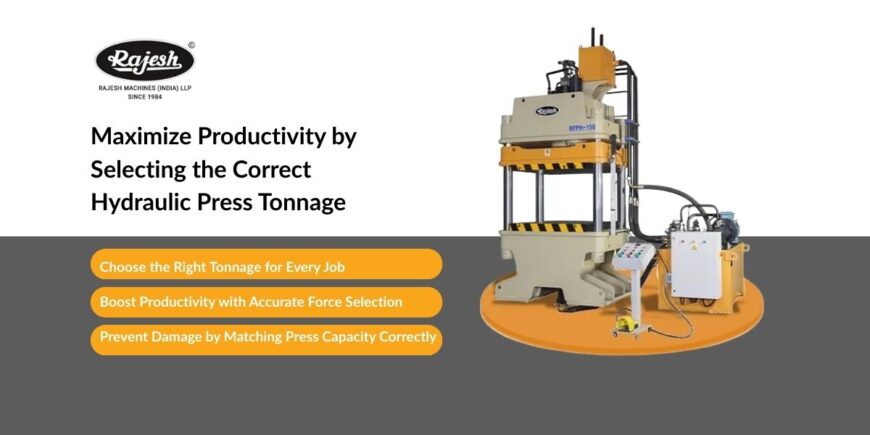
Maximize Productivity by Selecting the Correct Hydraulic Press Tonnage
Introduction
Selecting the appropriate hydraulic press tonnage is among the top crucial choices you’ll need to make when establishing or expanding the manufacturing plant you operate. A wrong decision can result in damaged workpieces, equipment failure delay in production and lots of unneeded costs. Finding out the most effective way to estimate and choose the appropriate amount of tonnage will help your business go from struggling to one that is thriving.
Understanding Hydraulic Press Tonnage
Hydraulic press tonnage refers to the force your machine applies during pressing operations. This measurement, expressed in tons, determines what tasks your hydraulic presses can accomplish. A press with insufficient tonnage fails to complete forming operations properly, while excessive tonnage wastes energy and increases your initial investment unnecessarily.
The required tonnage varies drastically according to the particular application. Bending a small bracket made of metal will require less force than drawing a huge automobile component. The type of material, the thickness, as well as the complexity of your process are all crucial in determining your ideal tonnage specifications.
Key Factors That Influence Tonnage Requirements
Material Properties
Different materials demand different pressing forces. Mild steel is more flexible than stainless steel, or alloys that are hardened. The strength of the material’s tensile force directly determines how much force you must apply for a successful punching, forming or stamping.
Thicker materials naturally require more tonnage. A 3mm steel sheet needs significantly less force than a 10mm plate for the same operation. Material hardness also matters—heat-treated metals resist deformation more than annealed materials.
Type of Operation
Your specific manufacturing process determines tonnage needs dramatically. Blanking and punching operations typically require less tonnage than deep drawing or embossing. Bending operations fall somewhere in the middle, depending on the bend angle and material thickness.
Compression molding applications need sustained, even pressure across the entire workpiece. Assembly operations require precise force control. Each operation type demands careful tonnage calculation to achieve optimal results.
Die and Tool Configuration
Your tooling setup affects the tonnage requirement significantly. Sharp punches require less force than blunt ones. The clearance between punch and die influences the cutting force needed. Well-maintained, properly aligned tools reduce the force requirement compared to worn or misaligned equipment.
The contact area of the tool with the workpiece has a huge impact on. Greater contact areas distribute the force across greater areas, requiring greater tonnage total, even though that pressure per square inch stays the same.
Calculating Required Tonnage
The correct calculation of tonnage will prevent costly equipment mismatches and make sure that your hydraulic press machine is operating optimally for your particular needs.
- Multiply the material shear strength by thickness and length of perimeter for calculating the baseline tonnage, then include a 20-30% safety factor.
- Calculate the bending force in a separate manner with the help of material thickness and die opening width and tensile force to avoid breaking or bending.
- For deep drawing, compute drawing force, blank holder force, and forming force, as drawing ratios significantly affect tonnage.
- Consider material flow characteristics, including work-hardening and grain direction, as they increase force requirements during forming.
- Validate all calculated tonnage with real-world testing to account for friction, material variations, and tool behavior.
Common Mistakes in Tonnage Selection
By avoiding these common mistakes, you can save you from costly adjustments, delays in production and equipment malfunctions which can compromise your manufacturing processes.
- Inadequately estimating the tonnage can lead to inefficient manufacturing, broken parts, excessive wear on tools and long-term productivity loss.
- Overspecifying press capacity wastes capital, increases energy usage, and occupies more floor space than necessary.
- In the absence of future production requirements, you risk the need for equipment replacement in the event of the thickness of the component or material increases.
- By not allowing safety margins, you eliminate the buffer that is needed to deal with material variations as well as tool wear and small errors in calculations.
- Overlooking application-specific requirements results in choosing the wrong press type, especially for operations like deep drawing vs. punching.
Choosing the Right Hydraulic Press Type for Your Tonnage Needs
C Frame Hydraulic Press
This C Frame Hydraulic Press provides an excellent access point for tasks that require fast load-out and deloading of workpieces. The open-front design permits operators to efficiently position their materials and efficiently, which makes this design perfect for medium-sized tonnage.
This press type excels in punching, stamping, and assembly operations where side access proves essential. Available in various tonnage ratings, C Frame presses suit applications from light-duty fabrication to medium-intensity production work. The compact footprint maximizes your floor space utilization while delivering reliable pressing force.
Hydraulic Workshop Press
A Hydraulic Workshop Press offers versatility across diverse tonnage requirements in maintenance and repair environments. These units handle everything from bearing installation and gear pulling to straightening bent components and general pressing tasks.
Workshop presses typically feature adjustable bed heights and movable rams, accommodating workpieces of various sizes. The tonnage range varies to match different workshop needs, from small repair shops requiring moderate force to large maintenance facilities handling heavy-duty components.
Workshop presses usually have adjustable bed heights and moving rams, which can be used to accommodate pieces of different dimensions. The range of tonnages is varied depending on the requirements of each workshop from small repair shops that require moderate force to large-scale maintenance facilities handling large-scale components.
H-Frame Hydraulic Press
The H-Frame Hydraulic Press delivers exceptional stability for drawing deep and forming heavy-duty. The H-shaped frame design offers the highest rigidity while maintaining an exact alignment even when under the most demanding tonnage load
This configuration proves ideal for applications requiring consistent force distribution across large work areas. Deep drawing operations benefit tremendously from the H-Frame’s structural integrity, which prevents frame deflection during high-pressure forming cycles. Available in higher tonnage ratings, these presses tackle demanding production requirements with ease.
Four Column Hydraulic Press
When your operations demand absolute precision and even force distribution, the Four Column Hydraulic Press stands as the optimal choice. Four guided columns ensure perfect parallelism between the ram and bed throughout the entire stroke.
This press type excels in applications requiring tight tolerances and uniform pressure across the workpiece. The four-column design accommodates larger work areas while maintaining exceptional accuracy. Industries requiring consistent quality in high-volume production rely on this configuration for critical forming, molding, and assembly operations across various tonnage capacities.
C Type Hydraulic Power Press
The C Type Hydraulic Power Press combines the accessibility advantages of C Frame design with enhanced power capabilities. This press configuration handles higher tonnage requirements while maintaining the open-front convenience that speeds production workflows.
Perfect for applications that require massive force and frequent die change, C Type presses are used in industries ranging from automobile components to appliance manufacturing. The sturdy construction allows for long-lasting high-tonnage operations, while the ergonomic design helps to improve operators’ efficiency and security.
Shop Hydraulic Power Press Machines from Rajesh Machine India
Finding a reliable manufacturing partner makes all the difference in your production success. Rajesh Machine India brings decades of experience in hydraulic power press manufacturing for operation. We understand the nuances of tonnage selection to help you choose equipment that matches your exact requirements.
Our extensive range of products covers everything from small workshop units to high-performance production presses. Every machine is subject to rigorous quality tests to ensure its performance is reliable in the most demanding of conditions. We don’t sell just equipment, we work with you to optimize the manufacturing process.
Visit our complete guide on hydraulic power press machines to deepen your understanding of these versatile tools and learn how to maximize their potential in your facility.
Ready to Find Your Perfect Hydraulic Press?
Let our experts help you calculate the exact tonnage requirements for your operations and recommend the ideal machine configuration.
Conclusion
Making the right choice for hydraulic press tonnage directly affects your manufacturing success as well as productivity and profitability. Knowing the calculation techniques along with the material’s properties and operating types allows you to make informed choices that will benefit your company for many years. Avoid costly mistakes by assessing your current needs and taking into account realistic growth projections. Be sure to choose trustworthy manufacturers who can help you through the selection process of the right product using complete understanding and integrity. A good choice in tonnage can transform your hydraulic presses being a simple tool into an efficient powerhouse that increases performance and competitive ability.
Frequently Asked Questions
-
How Do I Calculate The Tonnage Needed For My Specific Application?
-
Can I Use A Higher Tonnage Press For Lighter Applications?Yes, but it's inefficient. Higher tonnage machines consume more energy and cost more upfront. Size your equipment appropriately to optimize both performance and operating costs.
-
What Happens If I Use Insufficient Tonnage?You'll experience incomplete forming, cracked workpieces, excessive tool wear, and potential equipment damage. Insufficient tonnage compromises both quality and productivity while increasing maintenance requirements.
-
How Does Material Type Affect Tonnage Requirements?The more brittle materials, such as stainless steel need greater force than mild steel. Tensile strength of the material directly influences the force required for successful making, punching or bending.
-
Should I Consider Future Production Needs When Selecting Tonnage?Yes, but balance future requirements against present costs. If you anticipate working with thicker materials within two years, factor those needs into your selection now.