A pneumatic press uses compressed air to generate force. It is fast, simple, and clean — suited to light to medium operations like assembly pressing, light punching, marking, and riveting. A hydraulic press uses pressurised hydraulic oil to generate force. It delivers higher tonnage, full force control throughout the stroke, and is suited to heavy forming, deep drawing, moulding, and operations requiring precise, sustained pressure. The core trade-off is speed (pneumatic advantage) versus power and stroke control (hydraulic advantage).

- by Rjm_rajkot
- Blog
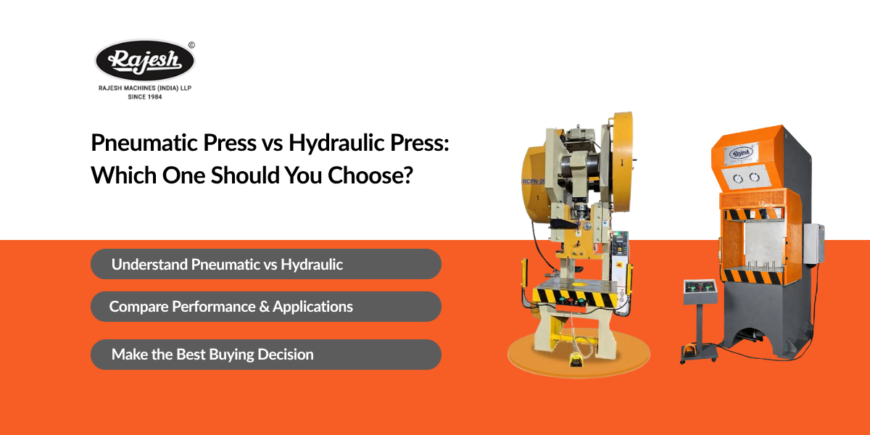
Pneumatic Press vs Hydraulic Press: Which One Should You Choose?
We get this question more often than you might think. A workshop owner calls us — or walks into our facility in Rajkot — and says something like: ‘I need a press, but not the same mechanical press I already have. My work needs something different. What should I be looking at?’ And almost always, the answer comes down to one question: pneumatic or hydraulic?
On the surface it can seem complicated. Both machines press. Both use force to shape, form, or assemble materials. But the way they generate that force is completely different, and that difference determines what each machine is actually good at. Getting it right means a press that earns its keep every shift. Getting it wrong means a machine that underperforms, costs more to run than expected, or simply cannot handle the jobs you bought it for.
We manufacture both types from our Rajkot facility — the full range of pneumatic presses and the complete hydraulic press line. So we have no reason to push you toward one or the other. What follows is as honest a comparison as we can give.
How Each Machine Actually Works — Without the Textbook Version
A pneumatic press runs on compressed air. An air compressor pushes pressurised air through valves into a cylinder, which drives a piston downward to press, punch, or form the workpiece. When the cycle is done, the air is released and the ram returns. Simple system. Fast. The air moves quickly, which is why pneumatic presses complete cycles at a speed that hydraulic machines simply cannot match.
A hydraulic press works differently. It uses pressurised oil — hydraulic fluid — rather than air. Because oil cannot be compressed the way air can, the force it generates is smooth, consistent, and fully controllable at every point in the stroke. You can stop the ram halfway through a stroke and hold exactly that amount of force. You can run a slow, precise downstroke. You can generate considerably more raw tonnage than a pneumatic system of comparable size. That control and that power are what make the hydraulic press the right machine for demanding, heavy, or precision-sensitive work.
The trade-off is speed. Moving oil takes more time than moving air. Hydraulic presses are slower. For some production work, that is fine. For high-volume repetitive output, it becomes a real constraint.
The Pneumatic Press: Speed, Cleanliness, and Simplicity
If your work involves fast, repetitive pressing operations on lighter materials, the pneumatic press is usually the right choice. It is the faster machine by a wide margin, it requires less infrastructure to run, and day-to-day maintenance is simpler than with a hydraulic system.
The clean operation is also worth mentioning. Compressed air does not contaminate. If a seal wears and air escapes, you hear a hiss and get it fixed. There is no oil on the floor, no cleanup, and no contamination risk to components. For workshops producing parts for the electrical, electronics, or food-adjacent sectors — or for precision assembly work where cleanliness matters — this is a genuine practical advantage.
What Operations Suit the Pneumatic Press?
- Precision assembly pressing — inserting pins, bushings, bearings, or fasteners into components with controlled, repeatable force
- Light punching and blanking — thin mild steel, aluminium, plastics, and composites where heavy tonnage is not required
- Embossing and marking — part number stamping, logo embossing, surface impressions on finished components
- Riveting and crimping — joining or forming operations on light components in high volume
- Aeronautical and automobile assembly — where controlled, repeatable force on sensitive components is critical
- High-volume repetitive runs — wherever cycle speed directly drives output and the job does not need high tonnage
The Rajesh Pneumatic Press Range
We manufacture three pneumatic press models from our Rajkot facility, each designed for different workshop requirements:
- C-Frame Pneumatic Press — compact, open three-side access, ideal for precision assembly, light punching, and jobs that change frequently. Easy to load and unload from multiple sides.
- H-Frame (Pillar) Pneumatic Press — twin-column construction for heavier pneumatic work. More rigidity under load than the C-frame, suited for larger components where precision alignment is critical. Built from IS-2062 stress-relieved steel with zero weld failures at load support points.
- Single Crank Double Point Pneumatic Press — designed for wider bed operations where the load needs to be supported at two points across the ram. Suitable for larger dies and longer component production runs.
See the full pneumatic press range on our website!
The Hydraulic Press: Power, Precision, and Versatility for Heavy Work
When your production demands more than compressed air can deliver — deeper draws, thicker materials, higher tonnage, more precise force control throughout the stroke — the hydraulic press is the right machine. It is not a replacement for the pneumatic press. It is a different tool, built for different work.
The most important characteristic of a hydraulic press is full-stroke force control. Unlike a pneumatic press, where the force is delivered quickly at the end of the stroke, a hydraulic press can deliver full tonnage at any point in the ram travel. This matters enormously for operations like deep drawing, where the material is being shaped progressively and the force needs to be consistent and controllable throughout the forming process.
Hydraulic presses are also considerably more versatile across different operations. By adjusting pressure and stroke settings, the same machine can handle blanking one shift and rubber moulding or powder compaction the next. That flexibility is particularly valuable for job shops and contract manufacturers handling a variety of product types.
What Operations Suit the Hydraulic Press?
- Deep drawing — forming cup, box, or complex shapes from sheet metal where the ram must travel deep with controlled, sustained force throughout
- Heavy blanking and forming — processing thicker steel plate, high-strength alloys, and structural components that require high sustained tonnage
- Rubber and plastic moulding — compression moulding where consistent, controllable pressure over the full stroke is essential
- Powder compaction — pressing ceramic, metal, or chemical powders into uniform shapes
- Broaching, trimming, and sizing — finishing operations that require smooth, sustained force over an extended stroke
- Large bearing and gear pressing — insertion or removal work where high force and precise control protect expensive components
- OEM-level precision forming — where dimensional consistency across thousands of components is non-negotiable
The Rajesh Hydraulic Press Range
Our hydraulic press range covers the full spectrum of production requirements — from compact workshop presses to heavy multi-column industrial machines:
- C-Frame Hydraulic Press — open-frame design with three-side access, ideal for forming, blanking, and assembly pressing in light to medium hydraulic applications. Compact footprint.
- H-Frame Hydraulic Press — twin-column construction for heavier hydraulic work. Superior rigidity for high-tonnage forming and blanking where the frame must not deflect under load.
- Four Column Hydraulic Press — four-pillar construction for large-bed, high-tonnage operations. Ideal for deep drawing, rubber moulding, powder compaction, and large component forming where balanced force distribution across the full bed is essential.
- Hydraulic Workshop Press — a versatile, practical hydraulic press for general workshop use, maintenance pressing, and medium-duty forming applications.
- C-Type Hydraulic Power Press (Ram Type) — ram-type hydraulic configuration for specific deep drawing and forming applications where a longer, controlled power stroke is the primary requirement.
Browse the full hydraulic press range here!
Pneumatic Press vs Hydraulic Press: Side-by-Side
Here is the full comparison in one place:
Factor | Pneumatic Press | Hydraulic Press | Selection Tip |
|---|---|---|---|
Power source | Compressed air | Hydraulic oil (Pascal’s Law) | Air vs fluid — speed vs power |
Force range | Low to medium | Medium to very high tonnage | Hydraulic for heavy jobs |
Speed | Fast — high cycle rate | Slower, steady pressure | Pneumatic for bulk output |
Force control | Limited — air compresses | Excellent — full stroke control | Hydraulic for precision work |
Maintenance | Simple — filter, seals, air | Oil level, seals, pump checks | Pneumatic easier day-to-day |
Cleanliness | Clean — air leaks harmless | Oil leaks need immediate attention | Pneumatic better in clean areas |
Floor space | Compact | Larger footprint | Pneumatic for tight shops |
Best operations | Assembly, light punching, marking, aeronautical parts | Deep draw, heavy forming, blanking, moulding | Match to your dominant job |
Rajesh models | C-Frame, H-Frame, Single Crank Double Point Pneumatic | C-Frame, H-Frame, Four Column, Workshop, Ram Type Hydraulic | Both ranges made in Rajkot |
Four Questions That Will Tell You Which Machine You Need
Forget the specs for a minute. Work through these four questions based on your actual production situation. The answer usually becomes obvious quite quickly.
Question 1 — What material are you pressing and how thick is it?
Thin mild steel, aluminium, copper, brass, or plastics up to 2–3 mm? Pneumatic handles that well. Light to medium assembly pressing on standard components? Pneumatic is the right and more cost-effective choice. If you are regularly working with steel plate above 3–4 mm, high-strength alloys, structural components, or any material that resists forming — hydraulic is where you need to be.
Question 2 — Do you need to control the force throughout the stroke, or just at the end?
This is the most important technical question and most buyers never ask it. Pneumatic presses deliver force like a quick, powerful punch — the force is applied and the cycle completes fast. If your job is assembly, light punching, or marking, that is fine. Hydraulic presses deliver force smoothly and consistently across the entire stroke — you can stop at any point and hold that pressure. If your job involves deep drawing, moulding, or forming a shape progressively, that stroke control is not optional. Hydraulic is the only right answer.
Question 3 — How important is cycle speed to your production economics?
If your revenue per shift depends on the number of cycles you complete, the pneumatic press’s speed advantage is a real and meaningful difference. Pneumatic presses cycle significantly faster than hydraulic machines. For high-volume, repetitive output — assembly lines, light stamping runs, marking operations — the pneumatic press’s higher cycle rate directly improves your production output and ROI. Hydraulic presses are slower. For heavy forming work, that is acceptable because each cycle is doing more work. For light, fast jobs, the slower cycle speed of hydraulic is an unnecessary cost.
Question 4 — Where does your production work sit in the Indian manufacturing economy?
Making automobile assembly components, electrical fittings, hardware, or aeronautical sub-assemblies where precision and cleanliness matter? Pneumatic is built for that sector. Supplying tractor parts, heavy automotive structural components, rubber moulded industrial products, or OEM-level precision deep drawn parts? Hydraulic is what those buyers’ quality requirements effectively demand, whether they spell it out or not. If your answer genuinely covers both — job shop with a mix of light and heavy work — the Rajesh Machines team can help you evaluate whether one machine handles both, or whether your work mix justifies two separate machines.
Who Actually Buys Which Machine — Across Indian Industry
Workshops That Typically Choose the Pneumatic Press
- Automobile sub-assembly units pressing bearings, pins, and fasteners into engine and chassis components — fast, controlled, repetitive work that pneumatic handles perfectly
- Electrical and electronics manufacturers assembly pressing of connectors, terminals, and fittings where cleanliness and precision matter more than tonnage
- Aeronautical and defence sub-contractors precision assembly operations on sensitive components where controlled, repeatable force and clean operation are essential
- Hardware and fastener units high-volume marking, embossing, and light punching on small components — pneumatic’s speed and repetitive consistency suit this perfectly
- Packaging and plastic component producers light forming and assembly on plastics and composites where hydraulic power is far beyond what the job requires
If you’ve got a job list and a rough idea of volume, send it our way. We’ll give you a price that’s actually attached to your requirement, not a number pulled from a general price list.
Reach us through our contact page, or call us directly — we’d rather talk through your actual numbers than have you guess!
Workshops That Typically Choose the Hydraulic Press
- Automotive OEM Tier-2 suppliers deep drawing body panels, structural brackets, and chassis components — hydraulic’s force control and high tonnage are the only viable option for this work
- Rubber product manufacturers compression moulding of gaskets, seals, industrial rubber components — requires controlled, sustained pressure across the stroke, which only hydraulic delivers
- Tractor and farm implement makers pressing heavy bodies, frames, and structural components from thick plate — tonnage requirements well beyond pneumatic range
- Powder metallurgy and ceramics units compacting metal or ceramic powders into uniform forms at high pressure — hydraulic’s precise pressure holding is essential
- Heavy engineering job shops contract manufacturing serving heavy-sector OEMs where machine quality and forming precision directly underpin the shop’s reputation
A few workshops genuinely need both — pneumatic for their assembly work and hydraulic for their forming work. This is more common than you might think, and buying from a manufacturer who makes both means a single service team, compatible support, and no gaps between suppliers.
Why Buying Both from Rajesh Machines Makes Practical Sense
Most press machine suppliers in India specialise in one type — either pneumatic or hydraulic. When you buy your pneumatic press from one supplier and your hydraulic from another, you end up with two separate service relationships, two different spare parts stocks to manage, and potentially two different quality standards across your production floor.
Rajesh Machines manufactures the complete range — pneumatic and hydraulic presses in multiple configurations — from our Rajkot, Gujarat facility. Every machine is built to the same material and engineering standards: IS-2062 graded steel where structural integrity is critical, precision-machined components, and quality-controlled assembly. Our after-sales service covers both machine types and reaches the major manufacturing hubs across India.
We have been building both types for over 30 years. That experience means we understand the production requirements of Indian workshops in a way that imported-spec-sheet machines and generic global content simply cannot replicate. When you call us about a pneumatic press and your actual work turns out to need hydraulic, we will tell you — clearly, and without trying to sell you the more expensive machine if it is not what your production requires.
Browse the full power press range.
The Answer Depends Entirely on What Your Workshop Actually Produces
There is no universal winner between pneumatic and hydraulic. The pneumatic press is the right machine for fast, repetitive, light-to-medium work where cycle speed matters and cleanliness is important. The hydraulic press is the right machine for heavy forming, deep drawing, moulding, and any operation where you need full force control throughout the stroke.
Both have their place in Indian manufacturing. Both are available from Rajesh Machines in Rajkot. And if you are still not sure which one fits your specific production situation after reading this guide, the fastest way to find out is to talk to us.
Describe your work — the materials, the operations, the volumes, the sectors you supply — and we will tell you plainly which machine earns its place on your shop floor. And if your work needs both, we will tell you that too.
Contact the Rajesh Machines team for a free consultation:
Frequently Asked Questions
-
What is the main difference between a pneumatic press and a hydraulic press?
-
Which press is better for Indian manufacturing workshops — pneumatic or hydraulic?Neither is universally better. The right choice depends on your specific production. For automobile assembly, electrical component pressing, aeronautical sub-assembly, and high-volume light operations, pneumatic is the practical choice. For deep drawing, heavy forming, rubber moulding, tractor part manufacturing, and OEM precision supply, hydraulic is the right machine. Rajesh Machines manufactures both and can advise which suits your actual work.
-
Can a pneumatic press do the same work as a hydraulic press?For some operations, yes — light blanking, punching, and assembly work can often be done on either type. But a pneumatic press cannot replicate the force control, sustained pressure, or high tonnage of a hydraulic press. Deep drawing, rubber moulding, and heavy forming require hydraulic. And a hydraulic press cannot match the cycle speed of a pneumatic press for high-volume light operations. They are complementary machines, not substitutes.
-
Which press requires more maintenance — pneumatic or hydraulic?Day-to-day, pneumatic presses are simpler to maintain. The main requirements are keeping the air supply clean and dry (using filters and dryers), checking seals, and monitoring the compressor. Hydraulic presses require regular oil level checks, seal inspection, pump maintenance, and immediate attention to any oil leaks. Both are manageable with a good maintenance schedule. Rajesh Machines provides commissioning support and maintenance guidance for all models we supply.
-
What Rajesh Machines pneumatic press models are available?Rajesh Machines manufactures three pneumatic press models: the C-Frame Pneumatic Press (compact, three-side access, for precision assembly and light punching), the H-Frame (Pillar) Pneumatic Press (twin-column, IS-2062 stress-relieved frame, zero weld at load support points, for heavier pneumatic work), and the Single Crank Double Point Pneumatic Press (wide bed, two-point ram support, for larger dies and longer component runs). All models are manufactured at our Rajkot, Gujarat facility.
-
What Rajesh Machines hydraulic press models are available?Our hydraulic press range includes: C-Frame Hydraulic Press (open frame, compact, forming and assembly pressing), H-Frame Hydraulic Press (twin-column, heavy-duty hydraulic forming and blanking), Four Column Hydraulic Press (four-pillar, large-bed, deep drawing, rubber moulding, powder compaction), Hydraulic Workshop Press (versatile general workshop hydraulic press), and the C-Type Hydraulic Power Press Ram Type (ram configuration for deep drawing and controlled power stroke applications).
-
Is a hydraulic press suitable for a small or medium-scale Indian workshop?Yes — several of our hydraulic press models are well-suited to small and medium-scale workshops. The C-Frame Hydraulic Press and the Hydraulic Workshop Press are compact, practical machines for workshops that need hydraulic capability without a large footprint or heavy infrastructure. The right model depends on the specific operations you need to perform. Contact the Rajesh Machines team to discuss your floor space, production requirements, and budget.
-
Does Rajesh Machines provide after-sales service for both pneumatic and hydraulic presses?Yes. Rajesh Machines maintains after-sales service coverage across India for both our pneumatic and hydraulic press ranges. We keep spare parts available for all models — seals, valves, hydraulic components, pneumatic cylinders, and more. Our commissioning team provides full installation support and operator training on delivery. Fast service response is important to us because we understand that press downtime is production hours lost.