Not necessarily, but it's worth checking your actual tonnage requirement before committing. Most small workshops doing light to medium sheet metal work are well served by 50-100 ton. 150 ton makes sense once you're regularly working thicker plate, structural components, or heavy forming — or you know that's where your work is heading soon.

- by Rjm_rajkot
- Blog
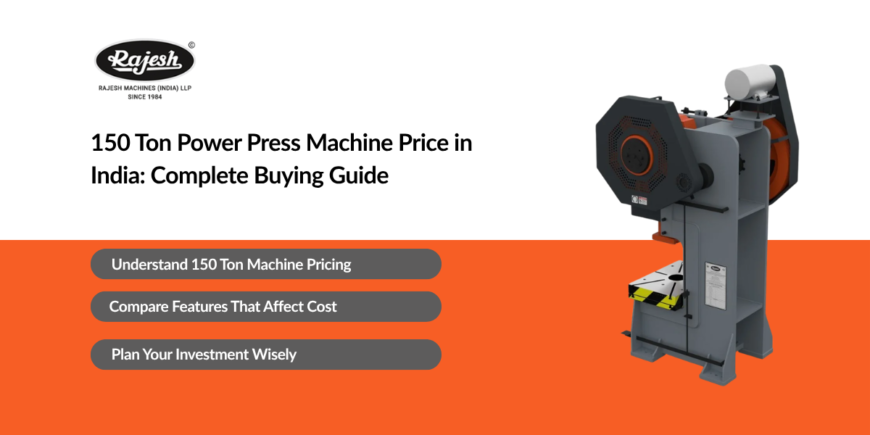
150 Ton Power Press Machine Price in India: Complete Buying Guide
A 150 ton press call usually starts the same way. Someone rings us up, sometimes it’s the owner, sometimes it’s a purchase manager who’s clearly been told “just get me a number,” and the first question is some version of “What’s the price of a 150 ton power press machine?” And honestly? We can’t answer that in one line, even though everybody wants us to.
Here’s the thing nobody tells you upfront — 150 ton isn’t really a beginner’s tonnage. Almost nobody buys this as their first machine. By the time a workshop is shopping for 150 ton, they’ve usually already run a 50 or 75 ton for a few years and outgrown it, or they’ve landed a contract that demands it. So this guide is written for that buyer. Not the absolute first-timer.
We’ll get to numbers. But let’s be upfront about something first — and this matters more than the number itself.
Why You Can't Get One Straight Price for 150 Ton Power Press
We looked around at what’s listed online for “150 ton power press” before writing this, partly out of curiosity, partly because we wanted to know what our buyers are seeing before they call us. The spread is honestly a bit wild. Some listings sit around ₹3-4 lakh. Others are sitting at ₹9-10 lakh. There’s even one stainless steel variant we saw priced near ₹95 lakh, though that’s clearly not a standard mechanical press for general sheet metal work — that’s an outlier built for something specific.
So which number is “right”? None of them, on their own. They’re each right for what they’re describing, which is exactly the problem — you can’t compare them unless you know what’s hiding inside that number.
A 150 ton press is not one product. It’s at least four or five different products that all happen to share the same tonnage rating:
- C frame mechanical — open front, faster cycles, fine for most stamping and forming work up to this tonnage
- H frame (pillar) mechanical — closed twin-column frame, holds rigidity better under heavy or sustained load
- Hydraulic versions of either — slower, but built for deep draw and thicker material control
- Pneumatic clutch variants — for shops running heavier cycles all day without wanting to babysit a mechanical clutch
- Used or imported secondhand machines — which is honestly where a chunk of those ₹3 lakh listings are probably coming from, though that’s not always stated clearly
Each of these carries a completely different price tag, and a completely different lifespan. Comparing a used import at ₹3.5 lakh to a new factory-built H frame at ₹9 lakh like they’re the same product is where buyers go wrong. Not because the cheap one is fake — it might run fine for years but because you’re not buying the same thing.
We’ll say this plainly: if a number looks too good for 150 ton, ask what frame type it is, ask if it’s new, and ask where the steel came from. Don’t ask us to just confirm if it’s a “good deal.” We don’t know that without knowing what’s underneath the number.
What Actually Moves the Price of 150 Ton Power Press
1. Frame type — C frame or H frame
At 150 ton, you’re at the upper edge of where a C frame still makes sense, and right in the comfortable zone for an H frame. We actually build both — the RCP-150T (C frame) and RHP-150T (H frame) — and they are priced differently because they’re built differently. The H frame’s twin-column construction takes more steel, more machining time, and resists deflection better under full load. The C frame is lighter, opens from three sides, and tends to suit shops doing varied small-batch work rather than one heavy job day after day.
If you genuinely don’t know which frame fits your work yet, we wrote a full comparison between C frame and H frame power presses that walks through this — worth five minutes before you fix a budget number in your head.
2. Mechanical vs hydraulic
Mechanical presses at 150 ton are generally the more economical route for repetitive stamping, blanking, and punching at speed. Hydraulic costs more upfront but gives you finer control for deep drawing and thicker material — and at 150 ton, you’re often in the range where deep drawing actually starts to matter.
3. New build vs used
We’re not going to pretend used machines don’t exist in this market, because they clearly do — some of those low listings are secondhand units, possibly imported. A used 150 ton press might save you 40-50% of the new price. It might also come with worn bushings, a flywheel that’s been rebalanced badly once already, or a frame that’s been through more stress cycles than the seller is telling you. We’ve seen both outcomes. There’s no shortcut here except asking for service history and ideally getting someone to physically inspect it before money changes hands.
4. Automation level
Manual feed vs semi-automatic vs fully automatic with stroke counters and pneumatic safety curtains — each step up adds cost, but also reduces operator fatigue and risk on a machine running this much tonnage. We wouldn’t tell a high-volume OEM supplier to skip automation just to save money here. That’s the wrong place to cut.
5. Motor HP and stroke specs
Our RCP-150T runs on a 15 HP motor with stroke length around 152mm. The RHP-150T sits in a similar HP range too. Higher HP, larger bolster size, and bigger flywheel diameter all push price up — but they also extend what kind of work the machine can actually take on. Buying underpowered to save a lakh now is the kind of decision that costs more later, when the press can’t handle the job you actually land six months in.
6. After-sales and spare parts support
This one’s invisible at the time of purchase and very visible eighteen months later when a crankshaft bush wears out and you’re waiting three weeks for a part because the manufacturer doesn’t stock spares for older models. Ask about this before you ask about the price. We mean that.
What a New 150 Ton Press Actually Costs
We were going to resist giving you a number at all, but that’s not much use to someone trying to plan a budget. So, roughly — a new mechanical 150 ton press from a proper manufacturer, C frame or H frame, generally lands somewhere in the ₹6–12 lakh range, depending on frame type, automation, and motor specs. Hydraulic variants and heavily automated builds can run above that. Used or secondhand machines can come in well under it, with the tradeoffs already covered above.
Take that range as a starting orientation, not a quote. Anyone who hands you an exact figure for “150 ton power press” without asking what frame type, mechanical or hydraulic, new or used, and what automation level — that figure isn’t worth much yet. It’s a placeholder, not a price. The honest way to get a real one is to send your actual requirement — material, thickness, operation type, volume per shift — and get a quote built around that. We do this for every enquiry that comes in, and we’d rather spend twenty minutes understanding your job than send you a number that falls apart the moment you ask a follow-up question.
A Few Things Buyers Forget to Budget For
Foundation and floor work. A 150 ton press, especially H frame, isn’t light — we’re talking somewhere in the 5,000-6,500 kg range depending on build. That needs a proper foundation, not just a flat floor. If your shed wasn’t built with this in mind, budget for civil work.
Transport and installation. Moving a machine this size isn’t a courier job. Factor in crane hire, transport, and on-site installation, particularly if you’re outside Gujarat and the machine’s coming from Rajkot.
Electrical load. 15 HP and above changes your power requirement conversation with the local supply board. Worth checking before the machine arrives, not after.
Die sets. Nobody tells first-time 150-ton buyers this, but the press is only half the cost of getting into production. Dies for heavy stamping or forming work aren’t cheap, and they’re a separate line item entirely from the machine price.
We mention these not to scare you off the number, but because a buyer who’s budgeted ₹8 lakh for “the machine” and gets blindsided by another lakh and a half in foundation, transport, and dies is not a happy buyer. We’d rather you walk in knowing the full picture.
Who's Actually Buying 150 Ton Presses
From what we see across our customer base, 150 ton buyers tend to fall into a few groups: automotive Tier-2 suppliers stepping up from 75 or 100 ton because a new OEM contract demands heavier tonnage, tractor and farm implement makers pressing thicker structural components, and job-shop owners who’ve been turning down heavy work for two years and finally decided to stop doing that.
There’s also a smaller group — shops that genuinely don’t need 150 ton yet but buy it anyway, reasoning that it’s better to have headroom than to upgrade again in three years. We don’t discourage this thinking. Buying once for where you’re headed, not just where you are, is a legitimate strategy, provided the rest of your shop (power supply, floor, die budget) can actually support it.
If You're Still Deciding Between 100 and 150 Ton
Worth a five-minute gut check before you commit. If your heaviest job today comfortably sits under 100 tons and you don’t have a specific reason to expect heavier work soon, our 100 ton power press might be more machine than you need right now — and that extra tonnage isn’t free, in price or in floor space. But if you’re already pushing a 100 ton press close to its limit, or you’ve got a contract on the table that explicitly calls for 150, then this is the right tonnage and the question becomes frame type and build quality, not whether to go bigger.
Talk to Us Before You Finalize Anything
We’ve been building power presses in Rajkot since 1984, both C frame and H frame, mechanical and pneumatic, in the 150 ton range and well above it. We’re not going to pretend every buyer who calls us ends up buying from us — sometimes the right fit for someone’s job is genuinely a different manufacturer, or a used machine, or even a smaller tonnage than they walked in asking for. We’d rather tell you that than sell you something oversized just to close the call.
If you’ve got a job list and a rough idea of volume, send it our way. We’ll give you a price that’s actually attached to your requirement, not a number pulled from a general price list.
Reach us through our contact page, or call us directly — we’d rather talk through your actual numbers than have you guess!
FAQs
-
Is 150 ton too much for a small workshop?
-
Should I buy C frame or H frame at 150 ton?Depends on your job mix more than the tonnage itself. C frame suits faster cycles and frequent die changes; H frame suits sustained heavy load and tighter dimensional consistency. We've written a full comparison if you want to work through this properly.
-
Why do used 150 ton presses cost so much less than new ones?Partly depreciation, partly because you're not paying for fresh steel, current machining tolerances, or a warranty. Sometimes it's a genuinely good deal. Sometimes it's a machine nearing the end of its useful accuracy. Ask for service history and inspect before buying.
-
Does the price include installation and foundation work?Generally no — machine price and installation/foundation costs are usually separate. Always confirm what's included in any quote before treating it as the full cost of getting the press running.
-
What's the lead time on a new 150 ton press?Varies by manufacturer and current order load. Worth asking directly when you enquire, since it affects production planning on your end too.