The main difference is the control system. A hydraulic press brake relies more on the operator's skill to achieve accurate bends, while a CNC press brake uses computer-controlled programming to automatically manage bend angles, ram depth, and back gauge positioning for greater precision and repeatability.

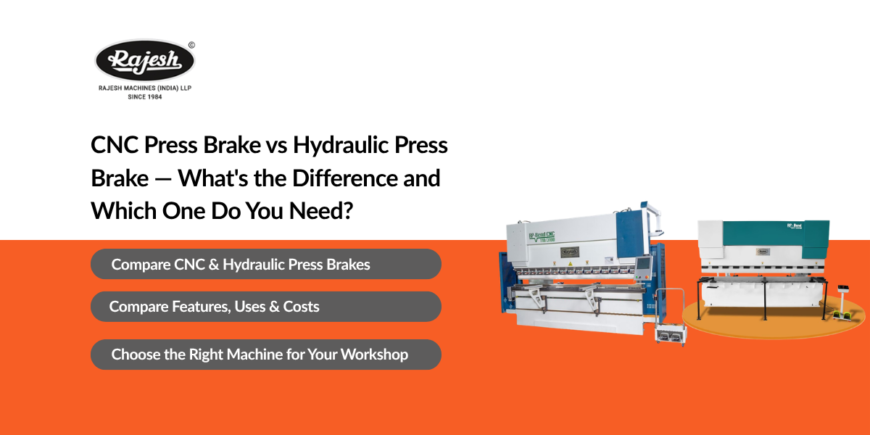
- by Rjm_rajkot
- Blog
CNC Press Brake vs Hydraulic Press Brake — What’s the Difference and Which One Do You Need?
If you are looking for a press brake for your workshop, you have probably come across two terms again and again — CNC press brake and hydraulic press brake. And if you are wondering what the real difference is, you are not alone.
Let’s break it down in simple language.
What Is a Hydraulic Press Brake?
A hydraulic press brake is a sheet metal bending machine that uses hydraulic pressure — basically oil pushed through cylinders — to move the ram up and down and bend the metal. It is powerful, reliable, and has been the backbone of metal fabrication workshops across India for decades.
The operator controls the machine manually or through a basic controller. The skill of the operator plays a big role in how accurate the bends come out.
How it works — simply put: The machine clamps your sheet metal between a punch (top tool) and a die (bottom tool). When the ram comes down, the metal bends. The angle, depth, and position are set by the operator.
Where hydraulic press brake bending machines are used:
- General fabrication workshops
- Gate and grill manufacturing
- Structural steel bending
- Agricultural equipment parts
- Furniture and rack manufacturing
Advantages of a hydraulic press brake:
- Lower purchase price — easier on the budget
- Simple to operate and maintain
- Strong and durable for heavy-duty bending
- Works well for varied, one-off jobs
What Is a CNC Press Brake?
A CNC press brake machine is also hydraulic at its core — the same hydraulic power drives the ram. The big difference is the control system on top of it. CNC stands for Computer Numerical Control, which means a computer controls and manages every movement of the machine — the ram depth, the bending angle, the back gauge position, and the full sequence of bends.
You program the job once. After that, the machine repeats it exactly — every single time.
How it works — simply put: The operator (or programmer) enters the job details into the CNC controller — material type, thickness, bend angles, sequence. The machine calculates everything automatically and guides the operator step by step. The back gauge moves on its own. The ram stops at the exact right depth.
Where CNC press brake machines are used:
- Electrical panel and enclosure manufacturing
- Automotive and auto ancillary components
- Precision brackets and structural parts
- Export-quality fabrication
- Any production where the same part is made in high volumes
Advantages of a CNC press brake:
- Very high bending accuracy (±0.1° or better)
- Once a job is programmed, any operator can run it
- Faster setup for repeat orders
- Handles complex multi-bend profiles easily
- Consistent quality across hundreds or thousands of parts
CNC Press Brake vs Hydraulic Press Brake — The Key Differences
The simplest way to understand the difference between a CNC press brake and a hydraulic press brake machine:
A hydraulic press brake depends on the operator’s experience for accuracy. A CNC press brake depends on the program — the machine controls the accuracy itself.
Here is what that means in practice:
Accuracy: A standard hydraulic press brake gives you around ±0.5° to ±1° accuracy depending on the operator. A CNC press brake consistently delivers ±0.1° or better, regardless of who is running it.
Repeat jobs: On a hydraulic machine, every time you come back to the same job, the operator has to set it up again from scratch. On a CNC machine, you just load the saved program and you are ready in minutes.
Complex parts: If a part has 5 or 6 bends at different angles, a hydraulic machine requires a very skilled operator to get it right consistently. A CNC press brake handles this automatically — the back gauge moves, the ram depth changes, all by itself.
Operator dependency: With a hydraulic press brake, your output quality depends heavily on having a skilled, experienced operator. With a CNC press brake machine, a trained operator can produce accurate parts without needing years of hands-on experience.
CNC Press Brake vs Hydraulic Press Brake Price — What to Expect in India
Price is always a real consideration, so here is a general idea:
A standard hydraulic press brake typically starts from around ₹4 lakh to ₹8 lakh depending on tonnage and size. An NC press brake (basic controller) falls in the ₹7 lakh to ₹14 lakh range. A CNC press brake machine generally starts from ₹14 lakh and goes up to ₹30 lakh or more for heavy-duty models.
The price gap is real — but so is the productivity gap on the right type of work. A CNC hydraulic press brake pays for itself faster when you are running repeat orders in volume.
So Which One Should You Buy?
Go with a hydraulic press brake if:
- Your work changes constantly — different parts, different customers every week
- You have experienced operators who know their craft
- Budget is a genuine constraint right now
- Your volumes are low to medium and tolerances are forgiving
Go with a CNC press brake machine if:
- You make the same parts repeatedly in decent volumes
- Your parts have multiple bends or tight angle tolerances
- You cannot afford to rely on one skilled operator for quality
- Your buyers or export customers expect consistent, documented quality
- You want your business to scale without quality becoming a bottleneck
Both machines use hydraulic force — that part is the same. What you are really choosing is how that force is controlled, and how much of your output depends on human skill versus machine precision.
Rajesh Power Press India — Press Brakes Built for Indian Fabrication
We manufacture the full range — from standard hydraulic press brake bending machines for job shops to full CNC press brake machines configured for high-volume precision work. Every machine is built to your specifications — bending length, tonnage, controller type.
If you are not sure which machine fits your production, share your details with us — material type, thickness, part complexity, monthly volume — and we will help you find the right fit.
Frequently Asked Questions
-
What is the main difference between a CNC press brake and a hydraulic press brake?
-
2. Is a CNC press brake more accurate than a hydraulic press brake?Yes. A CNC press brake can typically achieve bending accuracy of ±0.1° or better, while a conventional hydraulic press brake generally provides accuracy in the range of ±0.5° to ±1°, depending on operator experience and setup.
-
3. Which press brake is better for high-volume production?A CNC press brake is the better choice for high-volume production because it can save programs, automate setup, and produce identical parts repeatedly with minimal variation, reducing production time and human error.
-
4. Is a hydraulic press brake cheaper than a CNC press brake?Yes. Hydraulic press brakes have a lower initial investment and simpler controls, making them more affordable for small workshops and job shops. CNC press brakes cost more upfront but can offer higher productivity and lower operating costs per part for repeat production.
-
5. How do I choose between a CNC press brake and a hydraulic press brake?Choose a hydraulic press brake if you handle low-volume, varied jobs and have skilled operators. Choose a CNC press brake if you manufacture repeat parts, require tight tolerances, produce complex multi-bend components, or want to improve consistency and production efficiency.