If your work mainly involves straight-line cutting and blank preparation, a hydraulic shearing machine is usually the better choice because it is faster, more economical, and has lower operating costs than a laser cutting machine.
- by Rjm_rajkot
- Blog
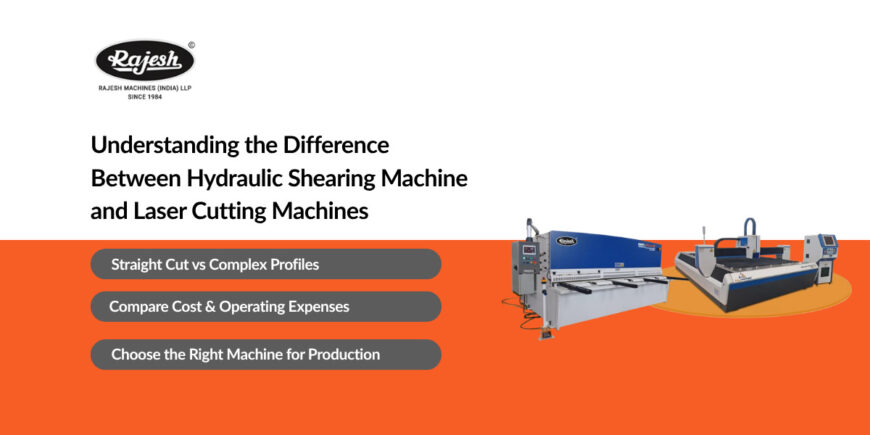
Understanding the Difference Between Hydraulic Shearing Machine and Laser Cutting Machines
A fabricator in Rajkot recently asked us a question we hear often: “We are cutting mild steel sheets up to 4mm, should we buy a hydraulic shearing machine or go straight to laser cutting?”
It is a fair question and the answer is not as obvious as the laser cutting industry would have you believe.
Both machines cut sheet metal, but everything else about them is different, how they cut, their cost, how they operate, the materials they can handle, and the types of jobs they are best suited for. Choosing the wrong machine can lead to unnecessary costs or limit your production for years.
This guide breaks down every meaningful difference between a hydraulic shearing machine and a laser cutting machine so you can make that decision with full information.
What Does a Hydraulic Shearing Machine Actually Do?
A hydraulic shearing machine uses a strong steel blade powered by hydraulic pressure to cut sheet metal in a straight line. It works like a large pair of scissors, but instead of hand power, it uses oil pressure.
It cuts in one smooth motion, giving a clean straight edge every time.
There is no heat, no sparks, and no gas. The metal is simply cut by force, not melted or burned. The result is a flat sheet ready for the next process.
For a full technical breakdown: What is a Hydraulic Shearing Machine? | Types of Shear Used in Sheet Metal
What Does a Laser Cutting Machine Actually Do?
A laser cutting machine uses a focused beam of light to cut metal by melting it along a programmed path. It follows a digital file and can move in any direction on the sheet.
It can cut straight lines, curves, holes, slots, and complex shapes — even text. If it can be designed on a computer, it can usually be cut by a laser.
There is no blade involved. Instead, a gas like nitrogen or oxygen blows away the melted metal, leaving a clean edge.
For a complete explanation: What is a Laser Cutting Machine? | Understanding CNC Laser Cutting Machines
The One Difference That Decides Everything
A hydraulic shearing machine can only make straight cuts. It is fast, low-cost, and reliable, but it cannot cut anything other than straight lines.
A laser cutting machine can cut almost any shape from a digital file, including curves, holes, slots, and text. However, it costs more to buy and run.
If you only need to cut sheets into straight blanks, a shearing machine is the better choice. If you need complex shapes or detailed cuts, only a laser machine can do the job.
Hydraulic Shearing Machine vs Laser Cutting Machine: Full Comparison
Performance & Capability
Factor | Hydraulic Shearing Machine | Laser Cutting Machine |
Cut Type | Straight lines only | Any shape — curves, holes, profiles |
Cut Quality | Clean blade-cut edge, slight burr | Very clean edge on thin sheet |
Heat on Material | None — cold mechanical cut | Edge gets hot; affects material near cut |
Material Thickness | Up to 20mm MS, 16mm SS | Best on thin to medium sheet |
Speed | Very fast on straight cuts | Slower for basic straight cuts |
Programming | Minimal — operator adjusts manually | Digital file (DXF) required for every job |
Operator Skill | Moderate | Higher — CNC programming knowledge needed |
Best For | Blanking, sizing, high-volume straight cuts | Complex profiles, holes, prototypes |
Cost & Running Expenses
Factor | Hydraulic Shearing Machine | Laser Cutting Machine |
Machine Purchase Price | ₹4 lakh – ₹18 lakh | ₹25 lakh – ₹1 crore+ |
Monthly Running Cost | Very low — electricity + occasional blade wear | High — assist gas used continuously |
Consumables | Blade sharpening or replacement | Nozzles, lenses, assist gas (ongoing) |
Maintenance | Hydraulic oil, blade clearance checks | Laser source, optics, cooling system |
Material Waste | Minimal — no kerf loss | Small kerf (~0.1–0.3mm per cut) |
Noise | Moderate | Relatively quiet |
Where a Hydraulic Shearing Machine Is the Right Choice
High-Volume Blanking Operations
If your production involves taking large sheets and cutting them into blanks for further processing, punching, bending, forming, a hydraulic shearing machine is faster and cheaper than any laser for that job. Cycle times are measured in seconds, not minutes.
Thick Plate Cutting
Laser cutting becomes progressively more expensive and slower as material thickness increases. A heavy-duty hydraulic guillotine shearing machine handles 10mm, 12mm, or 16mm mild steel plate efficiently. Cutting the same thickness on a laser requires a high-powered machine with significantly more assist gas consumption.
Operations With No Profile Cutting Requirement
Many workshops only need straight-cut blanks. Auto component pressings start as rectangular or trapezoidal blanks. Electrical enclosure panels start as flat sheets cut to size. If the shape is always straight, the laser’s capability to cut curves is something you are paying for and never using.
Budget-Conscious Investment
The entry point for a reliable hydraulic shearing machine is a fraction of even a basic fiber laser. For a workshop focused on straight-cut blanking, the return on a shearing machine investment is far faster.
Explore the advantages in detail: Advantages of Shearing Machine | Avoid Common Defects in Sheet Metal Shearing
Where a Laser Cutting Machine Is the Right Choice
Complex Profile Cutting
If your parts have internal holes, slots, irregular contours, or curved profiles, a laser cutting machine is the only practical option without secondary punching operations. What would take a shear plus a punch press plus a nibbler might be one laser cut operation.
Thin Sheet Precision Work
Laser cutting on thin mild steel, stainless steel, or aluminium below 6mm produces very clean edges with tight tolerances. For precision components in electronics enclosures, architectural panels, or decorative metalwork, laser edge quality is difficult to match mechanically.
Prototype and Short-Run Production
A laser cutter needs only a DXF file to start cutting. No tooling, no setup dies, no blade adjustment. For prototypes and short runs with constantly changing profiles, this flexibility is a genuine operational advantage.
No-Tooling Flexibility
Every time a profile changes on a shearing machine, the operator adjusts the back gauge and re-sets. For complex shapes, you would need additional punching tooling. A laser follows the new file without any physical tooling change. For high-mix, low-volume production, that matters.
Compare with another thermal cutting method: Fiber Laser Cutting Machines vs. Plasma Cutting Machines
What About Cut Edge Quality?
This is a point that deserves its own discussion because it affects downstream operations significantly.
A hydraulic shearing machine produces a mechanical shear edge. The blade cuts through the material cleanly, typically 60–70% of the edge is a smooth cut face, and the rest shows a natural fracture zone where the metal separated. There is usually a slight burr on the bottom edge. For most blanking work that goes into pressing or bending afterward, this is completely fine and requires no special treatment.
A laser cutting machine produces a heat-cut edge. On thin sheet, the result is very smooth and clean. On thicker material, the edge gets hot during cutting, the metal near the cut line is briefly exposed to intense heat, which changes its properties in a narrow zone right at the edge. (In plain terms: the metal at the cut edge becomes slightly harder and more brittle than the rest of the sheet.) For most fabrication work this causes no problem. But if the cut edge will be welded close to the line, or if you are cutting hardened steel, it is worth factoring in.
For parts with very tight edge finish requirements, some deburring may be needed regardless of which machine you use, this depends on the application, not just the machine.
Can Both Machines Coexist in One Workshop?
Yes and in many well-equipped fabrication shops, they do. The workflow often looks like this:
Hydraulic shearing machine → cuts large coil or plate into sized blanks (fast, low cost)
Laser cutting machine → cuts profiles, holes, and shapes from those blanks (precise, flexible)
Press brake → bends the cut parts to final form
This combination avoids using the laser for simple straight cuts (which wastes laser time and assist gas) while giving the shop full profile cutting capability for complex parts. If your volume justifies both machines, this is the most efficient production floor setup.
For the bending stage of this workflow: What is a Sheet Metal Bending Machine? | Press Brakes: Overview of Types, Uses and Advantages
Hydraulic Shearing Machine vs Laser: The Cost Reality
Let’s put real numbers to this comparison.
A mid-range hydraulic guillotine shearing machine — say 3200mm x 10mm capacity, costs roughly ₹10–15 lakh. After that, running costs are low: electricity, occasional blade sharpening, and hydraulic oil top-ups. That is about it.
A mid-range fiber laser cutting machine — 1500W to 3000W, standard bed — starts around ₹35–50 lakh. The purchase price is just the beginning. Every month, you are buying assist gas (nitrogen or oxygen runs continuously while cutting). The laser source itself, the component that generates the beam, has a working lifespan and needs replacement or servicing after extended use, which is a significant cost. Add optics cleaning, nozzle replacements, and chiller maintenance on top.
For a workshop that only does straight cuts: a laser is a buying capability you will never use, while paying monthly running costs for it.
For a workshop that needs profile cutting: the shearing machine cannot do the job at all, no matter how low the price.
Which Machine Do You Actually Need?
Work through this honestly:
Do your parts require holes, slots, curves, or complex profiles cut directly in the sheet? → You need a laser cutting machine (and possibly a shearing machine for blanking)
Are all your cuts straight lines — sizing sheets into blanks for further processing? → A hydraulic shearing machine will handle this faster and at lower cost
Do you cut a mix of simple blanks and complex profiles? → Both machines in sequence is the most efficient setup
Is your material consistently thick plate (8mm+)? → A hydraulic shearing machine is far more cost-effective than laser for thick straight cuts
Are you processing thin stainless or aluminium with tight edge requirements and varied profiles? → Laser cutting is the right tool
For help understanding what machine fits your full production setup: Metalworking Machinery for Industrial Cutting and Shaping | Rajesh Machines: Full Range of Sheet Metal Machine Tools
What Rajesh Power Press India Manufactures
Rajesh Power Press India manufactures hydraulic shearing machines across a range of capacities from light-duty workshop models to heavy-duty guillotine shearing machines for thick plate cutting. As a manufacturer, we configure machines to the specific cutting length and material thickness your production requires.
If you are evaluating a hydraulic shearing machine for your workshop, our team can help you determine the right capacity based on your material, volume, and downstream operations.
Contact Us with your material thickness, sheet size, and approximate volume per shift and we will recommend the right configuration.
Frequently Asked Questions
-
Which is better for straight sheet metal cutting: a hydraulic shearing machine or a laser cutting machine?
-
2. Can a hydraulic shearing machine cut curves, holes, or complex shapes?No. A hydraulic shearing machine is designed only for straight-line cuts. For curves, slots, holes, intricate profiles, or custom designs, a laser cutting machine is required.
-
3. Is laser cutting more expensive than hydraulic shearing?Yes. Laser cutting machines have a significantly higher initial investment and ongoing operating costs due to assist gases, optics maintenance, nozzles, cooling systems, and laser source servicing. Hydraulic shearing machines are generally more affordable to purchase and maintain.
-
4. Which machine provides better edge quality?Both provide good edge quality but in different ways. Hydraulic shearing creates a clean mechanical cut without heat, while laser cutting produces a smooth, precise edge and can handle complex profiles. The best option depends on the application and material thickness.
-
5. Can a workshop use both a hydraulic shearing machine and a laser cutting machine?Yes. Many fabrication shops use both machines together. A hydraulic shearing machine is used to quickly cut large sheets into blanks, while a laser cutting machine is used afterward for detailed profiles, holes, and precision features, improving overall production efficiency.