Yes, demand continues to grow across industries such as automotive, electrical panels, HVAC, furniture, infrastructure, and industrial equipment. Profitability depends on production efficiency, machine utilization, and securing consistent customer orders.

- by Rjm_rajkot
- Blog
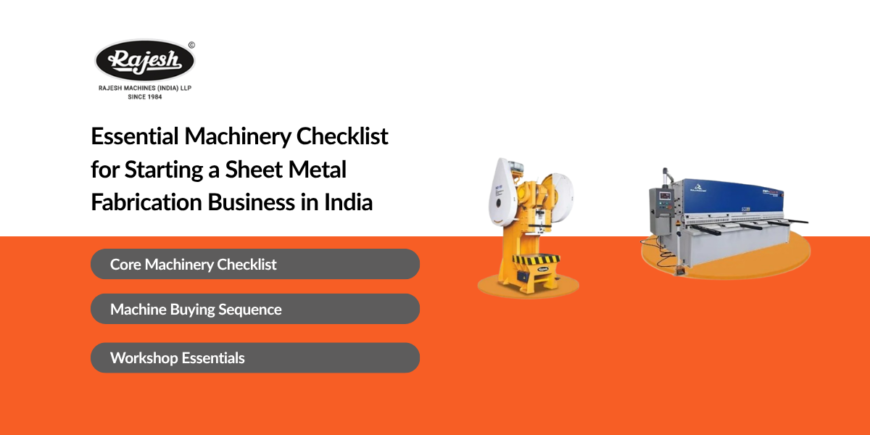
Essential Machinery Checklist for Starting a Sheet Metal Fabrication Business in India
Every year, hundreds of first-time entrepreneurs and job-workers across India decide to set up their own sheet metal fabrication unit. Most of them ask the same question first: which machines do I actually need to start — and in what order should I buy them?
It’s a fair question, because sheet metal fabrication isn’t one machine, it’s a chain of processes — cutting, punching, bending, shearing, and sometimes rolling — and getting the sequence wrong means either overspending on day one or getting stuck outsourcing operations you could have done in-house.
This checklist breaks down what each machine does, why it matters, and roughly when in your growth journey you should buy it — so you can plan your purchases with confidence instead of guesswork.
Step 1: Understand Your Core Fabrication Process
Before buying anything, map out the process a sheet actually goes through in your shop:
- Cutting/Shearing — sizing the raw sheet
- Punching/Pressing — creating holes, cutouts, or shapes
- Bending — forming the flat sheet into the final profile
- Rolling (if applicable) — curving sheets into cylindrical or radius shapes
- Finishing — deburring, cleaning, assembly
Your machine list should mirror this sequence. Buying a high-end machine for step 4 before you’ve solved step 1 is one of the most common mistakes new units make.
Step 2: The Core Machine List
1. Shearing Machine — Your Starting Point
Lorem ipsum dolor sit amet, consectetur adipiscing elit. Ut elit tellus, luctus nec ullamcorper mattis, pulvinar dapibus leo.
Every job starts with cutting the sheet to size. A shearing machine is usually the very first purchase for a new unit because almost nothing downstream can happen without it.
- NC Swing Beam Shearing Machine — good balance of speed and precision for growing shops
- Hydraulic Guillotine Shearing Machine — heavier-duty, ideal for thicker gauge material
- Mechanical Under Crank Shearing — budget-friendly entry point for very small operations
2. Power Press Machine — The Workhorse of Any Fabrication Unit
Once your sheet is sized, most fabrication work — punching, blanking, forming — runs through a power press. This is typically the second and most-used machine on your floor.
There are two main frame types, and choosing correctly matters more than most new owners realize:
- C-Frame Power Press / C-Frame Pneumatic Press — compact, easier access from three sides, well suited to small and medium components
- H-Frame (Pillar) Power Press / H-Frame (Pillar) Pneumatic Press — higher rigidity and load-bearing capacity, better for heavier or higher-tonnage work
- Single Crank Double Point Pneumatic Press — for units running larger sheet widths that need dual-point support
If you’re unsure which frame suits your product mix, our detailed C-Frame vs H-Frame Power Press comparison breaks down tonnage, rigidity, and application differences in depth — it’s worth reading before you finalize this purchase.
3. Press Brake — For Precision Bending
Once holes and shapes are punched, most sheet metal parts need bending to their final profile. This is where a press brake earns its place as one of the highest-ROI machines in the shop.
- Hydraulic Press Brake (Rear Cylinder) — the standard sheet metal bending machine for general fabrication
- Hydraulic NC Press Brake — adds programmable back-gauge control for repeat-accuracy work
- CNC Press Brake / CNC Press Brake (HD Series) — for shops taking on precision, high-volume, or export-quality bending work
Most new units start with a standard hydraulic press brake and upgrade to NC or CNC as order volumes and tolerance requirements increase.
4. Hydraulic Press Machine — For Heavier Forming Work
If your product line involves deep drawing, embossing, or heavier-gauge forming, a hydraulic press machine complements your power press rather than replacing it.
- C-Frame Hydraulic Press / H-Frame Hydraulic Press — mirror the same frame logic as power presses, chosen based on job size and rigidity needs
- Four Column Hydraulic Press — for larger components needing even pressure distribution
- Hydraulic Workshop Press — smaller-scale, useful for maintenance and lower-volume forming
- C-Type Hydraulic Power Press (Ram Type) — specialized ram-action forming for specific die work
5. Rolling Machines — Only If Your Products Need Curves
Not every fabrication unit needs a rolling machine on day one — this is typically a stage-two purchase once you have confirmed demand for cylindrical or curved components like tanks, pipes, or drums.
- 3 Roll Hydraulic Rolling Machine — general-purpose curving and cylinder forming
- 4 Roll Hydraulic Rolling Machine — better repeatability and pre-bending control for tighter tolerances
6. Hydraulic Punching and Iron Worker — For Versatility on a Budget
If your shop budget is tight in the early months, a combination machine can delay the need for separate dedicated equipment:
- Hydraulic Punching Machine — dedicated hole-punching for structural sections and plates
- 5-in-1 Hydraulic Iron Worker Machine — combines punching, shearing, notching, and bending capacity in a single compact unit, genuinely useful for small and medium units that can’t yet justify five separate machines
Step 3: Sequence Your Purchases by Business Stage
A realistic buying order for a new Indian fabrication unit generally looks like this:
Starting Out (Stage 1): Shearing machine + C-Frame Power Press + Hydraulic Press Brake (Rear Cylinder). This trio covers cutting, punching, and bending — the three processes almost every job needs.
Scaling Up (Stage 2): Add an H-Frame Power Press for heavier tonnage work, upgrade to an NC Press Brake, and bring in a Hydraulic Punching Machine or 5-in-1 Iron Worker for versatility.
Growth & Specialization (Stage 3): CNC Press Brake for precision/export work, rolling machines if your product mix demands curved components, and additional hydraulic presses for higher-volume forming.
There’s no fixed rule here — your product mix decides the exact order — but starting with the shearing–pressing–bending core and expanding outward has worked reliably for most units we’ve supplied over the years.
Step 4: Don't Overlook the Non-Machine Essentials
A machine checklist isn’t complete without the operational basics that determine whether those machines actually run:
- 3-phase power supply sized for your heaviest machine’s load
- Material handling — even a basic hoist or trolley system for sheet and coil movement
- Udyam (MSME) registration, GST registration, and, depending on your state, a pollution control NOC before commissioning heavier equipment
- Skilled operators — a press or press brake is only as precise as the person running it
Choosing the Right Manufacturer
Machine specifications matter, but so does who you’re buying from. Look for a manufacturer with a genuine manufacturing track record — not just a trading or reselling setup — because after-sales support, spare parts availability, and die/tooling compatibility all depend on it.
Rajkot has long been one of India’s manufacturing hubs for power press and sheet metal machinery, and Rajesh Machines has been part of that ecosystem with decades of hands-on production experience — the kind that comes from actually manufacturing power press, hydraulic press, press brake, and shearing machines on-site, not just trading them. That experience is what lets us guide customers on tonnage, frame rigidity, and duty-cycle requirements with real shop-floor context. You can read more about our manufacturing background on our About Us.
Ready to Plan Your Machine List?
Every fabrication unit’s ideal machine list looks a little different depending on your product mix, budget, and floor space. If you’d like a machinery recommendation tailored to what you’re planning to manufacture, get in touch with Rajesh Machines for a free consultation — our team will help you sequence your purchases so your budget goes exactly where it needs to first.
Frequently Asked Questions
-
1. Is sheet metal fabrication a profitable business in India?
-
2. Can I start a sheet metal fabrication business with a limited budget?Yes. Many businesses begin with essential machines like a shearing machine, power press, and press brake, then add CNC machines, rolling machines, or hydraulic presses as production and revenue increase.
-
3. Which industries require sheet metal fabrication services?Sheet metal fabrication is widely used in automotive, electrical and control panels, agricultural equipment, construction, HVAC systems, telecom cabinets, stainless steel furniture, and industrial machinery manufacturing.
-
4. What factors should I consider before buying sheet metal fabrication machines?Besides your budget, consider material thickness, production volume, available floor space, power requirements, tooling compatibility, after-sales service, and spare parts availability.
-
5. Should I buy new or used sheet metal fabrication machines?New machines offer better reliability, warranty, and manufacturer support, while used machines can reduce initial investment. Evaluate the machine's condition, maintenance history, and spare parts availability before making a decision.
-
6. How do I reduce the cost of setting up a sheet metal fabrication workshop?Start with machines that support your current production needs, optimize workshop layout, invest in quality tooling, train operators properly, and expand your machinery only when demand justifies the investment.