Rolling machines are commonly used for mild steel, stainless steel, aluminum, copper, galvanized steel, and other ductile metals. The machine capacity determines the maximum material thickness and width it can handle.

- by Rjm_rajkot
- Blog
How to Use a Rolling Machine Like a Pro
A rolling machine looks simple from the outside — feed a flat sheet or plate in, roll it into a curve or cylinder. In practice, the difference between an operator who “gets by” and one who works like a pro comes down to a handful of habits: how the sheet is aligned before rolling starts, how roller pressure is adjusted, and how consistently pre-bending and calibration are checked before a full production run begins.
This guide walks through rolling machine operation from setup to finished cylinder, covering the techniques that separate accurate, repeatable work from guesswork.
Understanding How a Rolling Machine Works
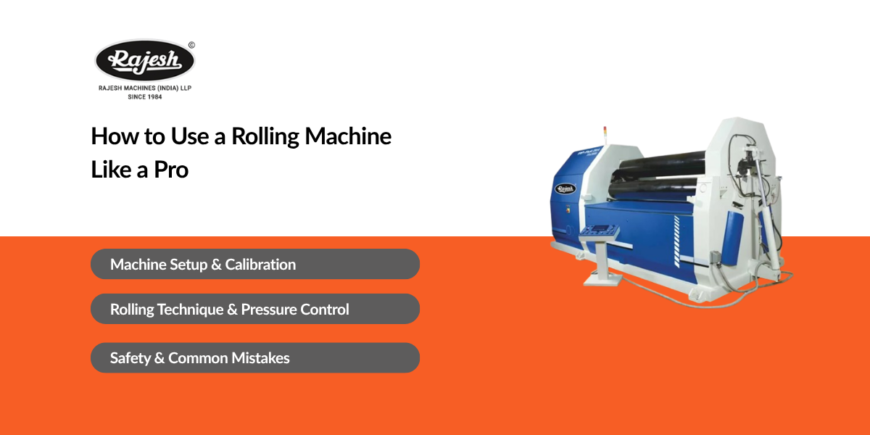
Before getting into technique, it helps to understand the working process itself. A plate or sheet rolling machine uses a set of rollers — typically three or four — to progressively bend a flat sheet into a curved or cylindrical shape. The sheet passes between the rollers multiple times, with roller position adjusted at each pass, gradually increasing the curve until the target radius is reached.
3-roller machines use two lower rollers and one adjustable top roller. They’re the common choice for general cylinder and curved-panel work. 4-roller machines add a fourth roller that pre-bends the leading edge automatically, so you don’t need to flip or reposition the sheet by hand. This gives better edge accuracy, with less of the flat, unrolled section you often see at the start and end of a pass on 3-roll machines. Neither type is better overall — the right choice depends on your material thickness, cylinder diameter, and how much edge accuracy the job needs.
Setting Up Before You Start Rolling
Most rolling machine mistakes don’t happen during rolling itself — they happen during setup. A rushed setup usually shows up later — as an out-of-round cylinder or an uneven seam.
- Check machine calibration first. Before feeding any material, verify the rollers are level and parallel to each other. Even a slight misalignment compounds across multiple passes and results in a cylinder that tapers instead of forming a true circle.
- Confirm material specifications. Know your sheet’s thickness, width, and material type (mild steel, stainless steel, aluminum) before setting roller pressure — each behaves differently under load, and aluminum in particular requires noticeably less pressure than steel of the same gauge to avoid surface marking.
- Set the target radius. Know the finished diameter you’re rolling to before you start adjusting rollers. Working backward from a known target keeps your incremental roller adjustments consistent, rather than guessing pass by pass.
- Run a test piece if the job is unfamiliar. If you’re rolling a new material, thickness, or diameter for the first time, a short test piece before committing your full sheet saves far more material than it costs.
Feeding and Aligning the Sheet
Aligning sheet metal correctly before rolling begins is one of the most underrated skills in this process.
- Center the sheet squarely against the rollers before starting the first pass — even a small skew at the start carries through the entire roll and is difficult to correct later.
- Feed the sheet at a steady, even pace. Feeding too fast for the roller speed setting increases the risk of slippage and uneven curvature; feeding too slow can cause localized marking, especially on softer metals.
- Keep your hands and body clear of the roller nip point at all times during feeding — this is one of the most common places operator injuries occur on rolling equipment.
Adjusting Roller Pressure the Right Way
Roller adjustment technique is where experienced operators separate themselves from beginners. If the curve isn’t tight enough, the instinct is to crank up pressure and force it in fewer passes. That’s usually the wrong move.
- Increase pressure gradually across multiple passes rather than trying to achieve the final radius in one or two aggressive adjustments. Gradual forming produces a more uniform curve and puts less strain on both the material and the machine.
- Check the curve after every pass, not just at the end. Catching an uneven radius two passes in is a five-minute fix; catching it after ten passes can mean starting over.
- Account for material springback. Most metals relax slightly after rolling pressure is released, so the in-machine radius needs to be marginally tighter than your final target — how much depends on material type and thickness, and is worth logging once you’ve dialed it in for a given job so you’re not recalculating from scratch next time.
Pre-Bending: The Step Beginners Often Skip
One of the most common rolling machine mistakes is skipping pre-bending on the leading and trailing edges of the sheet. Without pre-bending, the ends of a rolled cylinder stay flatter than the rest of the curve, since the rollers can’t fully act on material right at the edge.
On a 4-roll machine, the extra roller largely handles this automatically. On a 3-roll machine, pre-bending usually needs to be done manually — running the edge through a tighter partial pass, or pre-forming it with a press brake before rolling — to avoid a visibly flat section once the cylinder is complete.
Rolling Machine Safety Checklist
Safe operation matters as much as technique, especially given the pinch points involved in this kind of equipment:
- Never place hands near the roller nip point while the machine is running, even briefly.
- Confirm emergency stop controls are functional before starting any job, not just during scheduled safety checks.
- Use the correct roller speed setting for your material and thickness — running heavier plate at a speed set for a thin sheet increases slippage risk and strain on the drive system.
- Keep the work area around the machine clear — rolled cylinders and sheet stock can roll or shift unexpectedly if not properly supported after coming off the machine.
- Never attempt to manually straighten or adjust a sheet mid-roll while the rollers are engaged.
Common Mistakes That Hurt Accuracy
A few habits consistently show up when rolling machine accuracy problems get traced back to their cause:
- Skipping the calibration check at the start of a shift, assuming yesterday’s settings still hold
- Forcing the target radius in too few passes instead of building it gradually
- Not accounting for springback differences between material types
- Uneven feeding speed, especially on longer sheets where operator fatigue creeps in partway through
- Ignoring roller wear until it visibly affects the finish — by which point accuracy has already been drifting for a while
Keeping the Machine Performing Like New
Good technique only gets you so far if the machine itself isn’t maintained. Roller wear, inadequate lubrication, and pressure calibration drift all degrade rolling accuracy over time, independent of operator skill. Building a basic maintenance rhythm — checking roller surfaces for wear, keeping lubrication points serviced, and re-verifying calibration periodically — keeps the machine performing at the level your technique is capable of.
Ready to Upgrade Your Rolling Setup?
Whether you’re running a 3-roll machine and outgrowing its capacity, or evaluating a 4-roll machine for tighter edge accuracy on your next job, the right equipment makes consistent, professional results a lot easier to achieve. Request a quote for a new rolling machine from our team, and we’ll help you find the right configuration for your material range and production volume.
Frequently Asked Questions
-
1. What materials can be rolled using a sheet metal rolling machine?
-
2. What is the difference between a 3-roll and a 4-roll rolling machine?A 3-roll rolling machine is suitable for general bending applications and is often more economical. A 4-roll rolling machine offers easier operation, improved pre-bending, higher accuracy, and faster production for complex or high-volume jobs.
-
3. How do I select the right rolling machine for my workshop?Choose a rolling machine based on the material type, maximum sheet thickness, sheet width, required rolling diameter, production volume, and the level of accuracy your applications demand.
-
4. Why does sheet metal spring back after rolling?Springback is a natural property of metal where it partially returns toward its original shape after the rolling force is removed. The amount of springback varies depending on the material type, thickness, and bending radius.
-
5. Which industries commonly use rolling machines?Rolling machines are widely used in sheet metal fabrication, pressure vessel manufacturing, HVAC duct production, structural steel fabrication, storage tank manufacturing, shipbuilding, and industrial equipment manufacturing.
-
6. How often should a rolling machine be serviced?The maintenance schedule depends on machine usage and operating conditions. Regular lubrication, roller inspection, calibration checks, and drive system maintenance help maintain rolling accuracy and extend machine life.