
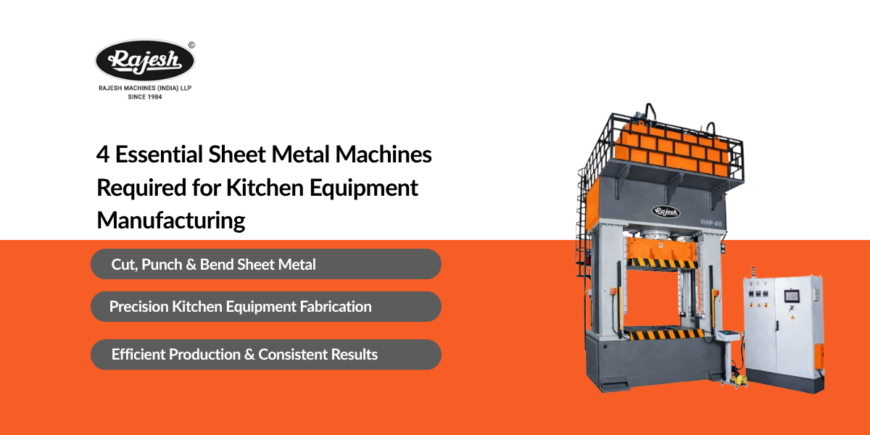
4 Essential Sheet Metal Machines Required for Kitchen Equipment Manufacturing
Kitchen equipment manufacturing involves a wide range of sheet metal operations. Commercial kitchens, restaurants, hotels, food processing facilities, and institutional kitchens require equipment such as worktables, sinks, cabinets, counters, exhaust hoods, storage units, and food preparation systems.
Producing these components requires more than cutting and assembling metal sheets. Manufacturers need accurate cutting, punching, bending, forming, and finishing processes to achieve consistent dimensions and clean results.
The right sheet metal machines for kitchen equipment manufacturing help manufacturers handle these operations efficiently while maintaining production consistency.
Here are four essential machines used across different stages of kitchen equipment production.
1. Shearing Machine
A shearing machine is used to cut sheet metal into the required dimensions before further processing.
Kitchen equipment manufacturers work with materials such as stainless steel, mild steel, and aluminium. These materials often need to be cut into blanks before bending or forming.
A sheet metal shearing machine helps produce straight cuts for components such as:
- Kitchen cabinet panels
- Countertop sheets
- Sink components
- Worktable panels
- Equipment covers
- Backsplashes
- Storage cabinet parts
The machine should be selected according to material type, sheet thickness, cutting length, and production requirements.
For manufacturers handling different sheet sizes, selecting suitable cutting capacity is important for maintaining dimensional accuracy throughout the production process.
2. Power Press Machine
A power press machine applies mechanical force to perform operations such as punching, blanking, bending, and forming.
In kitchen equipment manufacturing, it is useful when manufacturers need to produce repeated components from sheet metal.
Typical applications include:
- Mounting brackets
- Small panels
- Handles and hardware components
- Perforated sheets
- Support plates
- Base plates
- Fittings
For higher-volume production, dies help manufacturers repeat the same operation across multiple components.
Power press machines from Rajesh Machines are designed for various industrial sheet metal pressing applications.
The required press capacity depends on factors such as material thickness, component geometry, die design, and the specific operation being performed.
3. Press Brake Machine
After cutting, many kitchen equipment components need precise bends. This is where a press brake becomes important.
A press brake bends sheet metal along predetermined lines using a punch and die arrangement. It helps manufacturers create angles and profiles required for fabricated kitchen equipment.
Press brakes are commonly used for:
- Kitchen cabinet bodies
- Counter panels
- Equipment frames
- Machine enclosures
- Shelves
- Wall-mounted units
- Exhaust hood components
Bend accuracy matters because improperly formed panels can create gaps during assembly or affect the overall appearance of finished equipment.
Manufacturers should consider sheet thickness, bending length, required force, tooling, and component dimensions when selecting a machine.
You can explore press brake machines for applications involving precision sheet metal bending.
4. Hydraulic Press Machine
Some kitchen equipment components require controlled forming or pressing force. A hydraulic press uses hydraulic pressure to generate force and is suited to applications where controlled pressing movement is important.
Depending on the tooling and component design, hydraulic presses can be used for operations such as:
- Deep forming
- Pressing
- Straightening
- Shaping
- Embossing
- Forming larger components
For example, certain sink and vessel components require forming processes to transform flat stainless steel sheets into three-dimensional shapes.
The required machine depends on the material, component depth, dimensions, tooling, and required pressing force.
For such applications, manufacturers can consider hydraulic press machines based on their production requirements.
How These Machines Work Together
These machines usually form part of a broader manufacturing workflow rather than operating independently.
A typical process could look like this:
Sheet selection → Shearing → Punching → Bending/Forming → Drawing/Forming → Welding → Grinding → Polishing → Assembly
The exact sequence depends on the type of kitchen equipment being manufactured.
For example, a stainless steel kitchen cabinet might start with sheet cutting, followed by punching and bending. A sink might require cutting followed by forming, trimming, grinding, and polishing.
This means manufacturers should select machinery based on their complete production process instead of evaluating individual machines in isolation.
How to Select Sheet Metal Machinery for Kitchen Equipment Manufacturing
Before purchasing machinery, manufacturers should evaluate several factors.
Material
Stainless steel is widely used in commercial kitchen equipment because of its durability, hygiene requirements, and corrosion resistance. Aluminium and mild steel are also used for specific applications.
The machine should match the material being processed.
Sheet Thickness
The thickness range directly affects machine capacity. A manufacturer working with thin stainless steel sheets has different requirements from one processing thicker structural components.
Component Size
Consider the maximum sheet dimensions and finished component sizes. This affects cutting length, working area, bending length, and tooling requirements.
Production Volume
A machine intended for occasional fabrication has different requirements from equipment used for continuous production.
Manufacturers producing hundreds or thousands of similar components should consider machine productivity, repeatability, and tooling requirements.
Required Operations
List the operations involved in your production process before selecting machinery.
If your production involves mainly straight cutting and bending, shearing and press brake machines might be priorities. If you manufacture formed sinks or pressed components, hydraulic pressing equipment might also be required.
Die Selection
The type of die should match the operation, material, component shape, and required result. Different dies are used for punching, blanking, bending, and forming. For example, punching requires a suitable punch-and-die set for creating holes, while bending requires tooling designed for the required bend angle and shape.
Manufacturers should consider the die type, material thickness, component geometry, clearance, and machine compatibility before selecting tooling. Using the right die helps maintain consistent dimensions and achieve better production results.
Tooling Requirements
Machine compatibility with punches, dies, blades, and other tooling should also be considered. Suitable tooling directly affects the quality and geometry of finished components.
Why Proper Machine Selection Matters
Kitchen equipment needs to meet both functional and visual requirements. Uneven bends, inaccurate dimensions, rough edges, or inconsistent forming can affect assembly and finishing.
Using machines suited to the material and application helps manufacturers maintain:
- Consistent component dimensions
- Repeatable production
- Accurate bends and cuts
- Better material utilisation
- Efficient batch production
- Consistent finished appearance
The goal is not to purchase the largest machine available. It is to select equipment with the right capacity, configuration, tooling, and capabilities for the intended production process.
Why Choose Rajesh Machines for Sheet Metal Equipment?
Rajesh Machines manufactures industrial machinery for metal cutting, pressing, bending, and forming applications.
Its range includes power presses, hydraulic presses, press brakes, and shearing machines.
For kitchen equipment manufacturers, the appropriate machine should be selected according to the material, sheet dimensions, component design, production volume, and required operation.
Conclusion
Sheet metal machinery forms the foundation of many kitchen equipment manufacturing processes. Shearing machines, power presses, press brakes, and hydraulic presses each address different fabrication requirements.
The right combination depends on the products being manufactured. A commercial kitchen equipment manufacturer producing cabinets and worktables might prioritise cutting and bending equipment, while a manufacturer producing sinks, vessels, or formed components might require hydraulic pressing capabilities.
Evaluating your materials, component dimensions, production volume, tooling, and manufacturing processes first helps you build a more suitable and efficient sheet metal production setup.