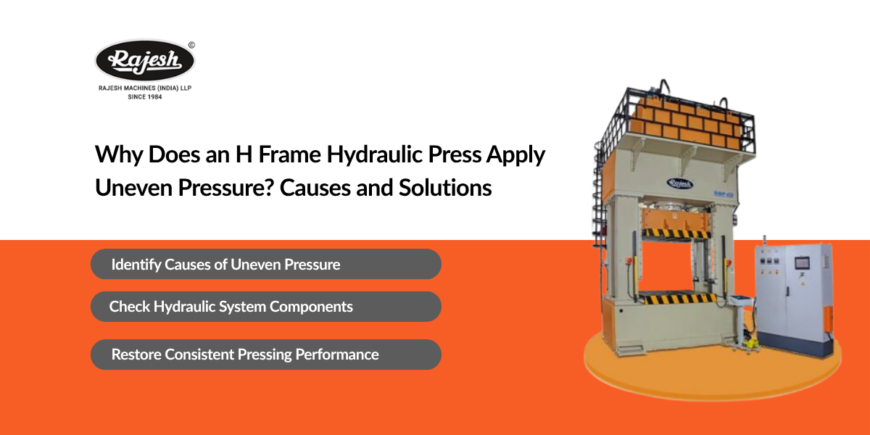
Is one side of your workpiece pressed deeper than the other? Are you getting different thicknesses even when the pressure gauge shows the expected reading? These issues can affect production quality and lead to wasted material.
The problem may not be with the hydraulic system itself. Uneven pressure can result from misaligned tooling, off-centre loading, poor platen alignment or wear in the press frame and other components.
In this guide, we look at the common reasons an H Frame Hydraulic Press may apply uneven pressure, along with the checks that can help identify the problem. We also explain when to call a qualified technician. The actual cause can only be confirmed after inspecting the machine.
It helps to separate two ideas:
A hydraulic press can show the correct pressure on its gauge and still produce uneven results. This can happen when the force is not distributed evenly across the workpiece. For example, if a part is loaded off-centre or the ram is misaligned, one side may receive more pressure than the other.
The pressure gauge only shows the hydraulic pressure in the system. It does not tell you whether the ram is level, the platen is parallel or the workpiece is positioned correctly. These factors also need to be checked when investigating uneven pressing.
Typical signs of uneven pressing include:
This is the simplest cause, and the first one to rule out.
If the workpiece or die is placed too far to one side of the press bed, the pressure may not be evenly distributed. This can cause one side of the part to be pressed deeper than the other.
For example, if the load is placed near the left edge of the bed, the left side of the part may end up thinner than the right. Placing the load in the correct position can help prevent this problem.
If the problem goes away when you re-centre the load, loading was the cause.
The ram (slide) and the table (platen) must stay parallel to each other. If they do not, contact is uneven.
When the ram is not parallel to the table, one side of the die meets the metal first. That side takes more load. You get inconsistent parts, faster tooling wear and more rework.
If re-centring the load does not fix the problem, ask a qualified technician to measure ram alignment and platen parallelism. The readings should be compared with the manufacturer’s stated tolerances for your model. Do not adjust alignment by guesswork.
On the Rajesh H Frame Hydraulic Press, the table and slide are made to be aligned with each other for accurate pressing. You can see the full range and technical parameters on the H Frame Hydraulic Press page.
Worn seals let oil pass where it should not.
Signs of internal leakage include trouble holding force, pressure loss during the press stroke and the ram slowly drifting down while holding.
With leakage, the press may not reach or hold its full force. The force on the workpiece can become weak or inconsistent. This can look like uneven pressing, especially during the hold part of the cycle.
Internal leakage cannot be confirmed by eye. A qualified technician should test the cylinder and inspect the seals before replacing anything.
The pump and valves control how much pressure the system builds and holds.
Common reasons include:
Any of these can cause low or unstable pressure, or slow and uneven ram movement.
On many presses, pressure gauges for the system, back and holding pressure sit near the oil tank for quick checks. Compare the readings with the values for your machine. If the pressure does not reach the set level, or will not hold, the pump and valves need a proper check.
Work on pumps and valves should be done only by a qualified technician. Hydraulic systems hold stored energy. They must be isolated and depressurised using the manufacturer’s procedure before any work starts.
Oil does more than transmit force. It also lubricates and cools the system.
Low oil level, dirty oil or air in the system can cause:
Use the oil grade and change interval recommended in your machine’s manual.
Even with a good hydraulic system, loose or worn parts can allow the ram to move off line.
Guides and gibs keep the ram travelling straight. When they wear, the ram can tilt, bind or move unevenly. This often shows up as inconsistent pressing at the same point in each stroke.
Worn or damaged tooling can also cause uneven results. Check that:
Replace worn tooling before you blame the machine.
The press is only as steady as the ground and frame it stands on.
If the foundation is uneven or the mounting bolts are loose, the frame can move under load. Alignment can change during operation. A press that was accurate on day one can slowly drift if its base is not stable.
Safety note: Stop using the machine if you see cracks, clear deformation, repeated pressure loss or uncontrolled ram movement. Arrange an inspection by a qualified person before running it again.
Follow a simple order. Start with the easy checks and move to the technical ones.
Note what you see. Which side is deeper? Does it happen every stroke or at random? Does it happen with one die or all dies? Does pressure drop? Notes like these help the technician find the cause faster.
Re-centre the load. Check die clamping, tooling wear and fasteners. These checks cost almost nothing and solve many cases.
Look at pressure readings, oil level and condition, and the date of the last service. Look for changes over time.
If the problem continues, call a qualified technician. Ask for:
Here is a quick guide to link symptoms with possible causes. These are possible causes only. They are not a diagnosis.
| What You Notice | Possible Cause | Suggested Check |
|---|---|---|
| One side of the part pressed deeper | Off-centre loading | Centre the workpiece and spread the load within rated limits |
| Uneven contact or thickness | Ram and platen misalignment | Have alignment and parallelism measured against manufacturer tolerances |
| Ram tilts, binds or moves unevenly | Worn or loose guides | Inspect guides, gibs and mounting parts |
| Pressure loss or ram drift | Cylinder seal leakage | Have a technician test for internal leakage and inspect seals |
| Pressure will not reach or hold its level | Pump or valve problem | Check pressure readings, pump, relief and directional valves |
| Jerky movement, noise or overheating | Low or contaminated oil | Check oil level and condition; look for contamination or air |
| Frame moves or alignment changes | Loose mounting or uneven foundation | Check foundation and fasteners |
| Visible damage or lasting alignment trouble | Overload or frame deformation | Stop use; arrange a structural inspection |
Most causes build up slowly. Regular care catches them early.
Use the manufacturer’s maintenance manual. Schedule oil and filter changes, seal and hose checks, guide inspections and bolt checks. Keep a log so you can spot trends.
Train operators to centre dies and loads. Never run the press beyond its rated capacity. Overloading is a common route to frame damage and lasting alignment problems.
Check oil level, colour and temperature often. Check alignment at set intervals and after any heavy overload or crash. Catching a small drift early costs far less than fixing damaged tooling or a worn cylinder later.Lorem ipsum dolor sit amet, consectetur adipiscing elit. Ut elit tellus, luctus nec ullamcorper mattis, pulvinar dapibus leo.
Uneven pressing usually has a clear cause once you check it step by step. Start with loading and tooling, then alignment, then the hydraulic system. Leave pressure adjustments and work on loaded components to qualified personnel who follow the manufacturer’s safety procedures.
If uneven pressing results persist despite routine checks, contact Rajesh Power Press to discuss your application and machine requirements. You can also review the H Frame Hydraulic Press specifications if you are considering a new machine.