The price of a C Frame Hydraulic Press Machine can vary from one supplier to another. Even if two machines have the same tonnage, their prices may differ depending on the specifications and features included.
For example, a basic 10-ton press with a small bed will cost differently from a 100-ton press equipped with a PLC control system and die cushion. Bed size, stroke length, motor capacity, controls and safety features all affect the final cost.
Checking prices online can also be confusing. Some B2B listings show only the base price, while others exclude GST, transportation, installation or tooling. You may also find prices listed as “price on request” or a broad range covering machines with different specifications.
Instead of comparing prices alone, check what each supplier includes in the quotation. Ask for a detailed, written quote based on your required tonnage, specifications and production needs. You can contact Rajesh Power Press to discuss your requirements and get a price for the machine that suits your work.
To explore the machine’s features and specifications, visit our C Frame Hydraulic Press page.
Capacity (tonnage) is the biggest factor. More tonnage needs a stronger frame, a bigger cylinder and a more powerful hydraulic system. All of these cost more.
But the rise is not a straight line. Doubling the tonnage does not simply double the price. Bed size, stroke and controls also change as the tonnage grows.
Small presses suit light work such as assembly, fitting, bush pressing and straightening of small parts. They have compact frames and smaller power packs. They usually cost the least and are often the first machine for a small workshop.
Medium presses handle general forming, punching and pressing of sheet metal and components. This is the most common range for fabrication shops. At this level, options like PLC controls and die cushions start to make a real difference to price.
Higher capacity means a heavier frame, a larger cylinder and a bigger motor and power pack. If you need a special bed size, deeper throat or custom stroke, the machine is built to order. Custom machines take longer to deliver and cost more than a standard model.
Always compare the whole specification, not just the tonnage. Here is what each item means for cost.
Choose the tonnage from your job, not from a guess. If you buy too little, the press will struggle and wear out. If you buy too much, you pay for capacity you never use. Work out the force for your hardest job, add a safety margin and confirm it with the manufacturer.
A longer stroke and larger daylight need a bigger cylinder and frame. Both raise the price.
A larger bed takes bigger dies and parts. A deeper throat lets you work further into a sheet. Both mean more steel and more machining.
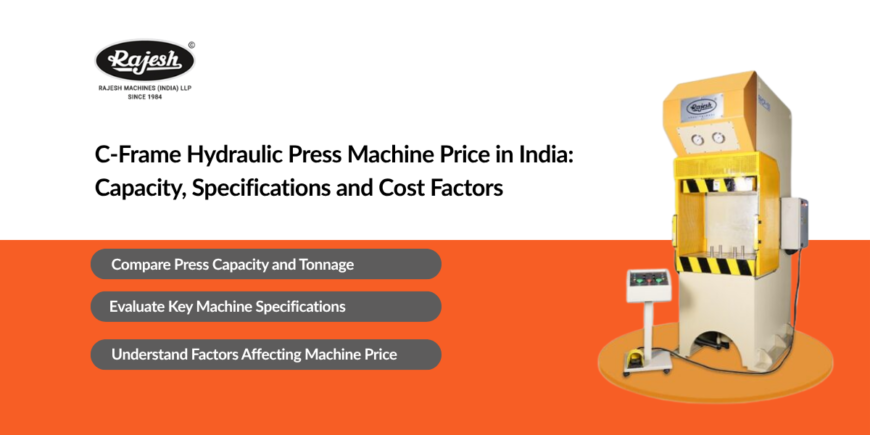
For example, one Rajesh 10-ton C-frame model, the RHCP-10, is listed with a 500 × 400 mm bed, 250 mm stroke and 10-inch throat. A model with a larger bed or deeper throat would cost more.
The motor and the hydraulic power pack decide how fast the ram moves and how steady the pressure is. A bigger motor and pump give faster cycles but add to cost and running power use. The quality of the pump, valves and hoses also affects how long the system lasts.
The control system is a major part of the price gap between two quotes.
A manual press is operated by the operator with a foot switch or control box. It is the simplest and usually the lowest-cost option. It works well for low to medium volume and jobs that change often.
Standard equipment on the Rajesh C Frame Hydraulic Press includes variable stroke adjustment with a limit switch, a front operator control box, a movable foot switch, a stroke counter and an operation and maintenance manual.
A PLC with an HMI (touch screen) lets you set and repeat cycles with more precision. It suits repeat jobs and higher volume. Other options include a quick die change system, a die loader, a pressure strip and a die cushion. Each option adds to the price, so choose the ones that save you real time or scrap.
Safety equipment is part of the cost. Options such as a photo safety curtain add protection for operators. Ask what comes as standard and what is optional. Do not remove safety items just to lower the price.
The machine price is only part of what you will spend. Add these before you decide.
The press does nothing without a die. Dies and fixtures can cost a lot, especially for complex parts. Check whether your existing tooling will fit the new press.
Presses are heavy. Budget for transport, unloading, foundation or levelling work, installation and commissioning. Ask whether these are included in the quote or charged separately.
Check your power supply and cabling. You may need a new connection or a larger cable. Also plan for operator training so your team can run the machine safely and well from day one.
Hydraulic oil, filters, seals and hoses wear over time. Ask for a list of common spares and how quickly the supplier can send them.
GST is charged on top of the base price unless the quote says it is included. Always confirm this in writing.
A cheap quote is not always a good deal. Here is how to compare properly.
Put the quotes side by side and check each line:
One supplier may include items that another leaves out.
Read the warranty terms. Find out what is covered, for how long and how fast the supplier responds. Ask where the service team is based and how spares are supplied.
Ask for the delivery time in writing. Confirm what is included: transport, installation, commissioning, training and GST. A written quotation should state all of this clearly.
The cheapest machine to buy is not always the cheapest to own. Think about the cost over the full life of the press.
Power use depends on motor size and how often the press runs. High-volume work uses more energy. Ask the supplier about typical power use for your type of job.
Regular upkeep keeps the machine reliable. Budget for oil changes, filter replacement and seal checks. Downtime costs money too. A press that stops your line for days can erase any saving from a low purchase price.
Over the years, seals, hoses and pumps may need to be replaced. A supplier with good parts supply and service support helps keep these costs predictable.
For most buyers, a standard press is the better value. It is quicker to deliver, easier to service and priced lower because it is built in a repeat design.
Choose a custom press when your job truly needs it. For example, you may need an unusual bed size, a deeper throat, special stroke or automation to match a production line. In that case, a custom build can save more through better output and less scrap than it adds in cost.
A simple way to decide: list what your job needs, then ask which items are standard and which need changes. Pay extra only for changes that your work actually needs.
If you are also comparing frame types, look at the H Frame Hydraulic Press. For bending work, see the CNC Press Brake.
The right price comes from the right match: the capacity your job needs, the specification your dies fit, and the controls and safety your team can use. Start from your application, then compare quotes line by line.
Looking for an accurate price? Share your required tonnage, application, workpiece dimensions and automation preferences. Contact Rajesh Power Press for a tailored quotation on a C-Frame Hydraulic Press Machine.