Core machines typically include a sheet metal cutting machine, hydraulic shearing machine, CNC press brake, power press, hydraulic press, rolling machine, and often an ironworker. The exact combination depends on the specific bus design and components being produced.

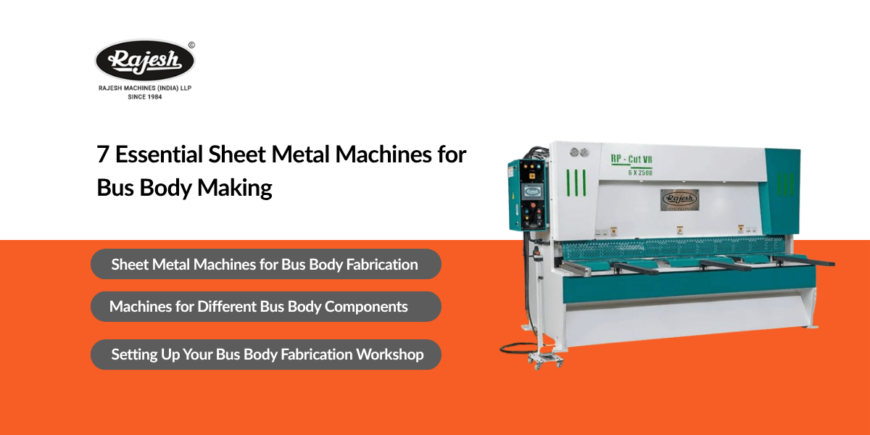
7 Essential Sheet Metal Machines for Bus Body Making
A bus body brings together a wide mix of sheet metal work.
Flat panels, curved roof sections, structural brackets, and reinforcement frames all need to fit together to create a strong, road-ready shell.
The right machinery setup makes a real difference. It affects panel fit, structural strength, production consistency, and overall build quality, especially when manufacturing multiple buses.
So, which sheet metal machines are essential for bus body manufacturing?
This guide covers the key machines used at different stages of the build and the factors to consider before investing in or expanding a fabrication workshop.
Lorem ipsum dolor sit amet, consectetur adipiscing elit. Ut elit tellus, luctus nec ullamcorper mattis, pulvinar dapibus leo.7 Important Sheet Metal Machines for Bus Body Fabrication
1. Sheet Metal Cutting Machine
Every bus body fabrication process starts with cutting sheet stock to the dimensions required for each component.
A sheet metal cutting machine is used for body panels, side panels, roof components, floor sheets, brackets, and other structural sheet parts.
The cutting method can vary depending on the job. Shearing, laser cutting, and other methods may be used based on sheet thickness, cut complexity, and production volume.
Accuracy at this stage is important. A poorly sized blank can create fit problems throughout the fabrication process.
2. Hydraulic Shearing Machine
For straight-line cuts on larger sheets, a hydraulic shearing machine is often an efficient choice.
Bus body manufacturers can use shearing to reduce full sheets to manageable sizes before panels or structural components move to bending or forming. It delivers fast cuts with clean, consistent edges.
Before choosing a machine, check:
- Sheet thickness capacity
- Cutting length for your largest panels
- Expected production volume
- Blade maintenance requirements
On high-throughput lines, shearing blades experience continuous wear, so regular maintenance is important for consistent cutting performance.
3. CNC Press Brake Machine
Bus bodies rely on many precisely bent components — side panels, roof sections, door components, floor supports, brackets, channels, and structural reinforcement pieces all need accurate bend angles for proper assembly.
A CNC press brake machine is therefore one of the key machines in this workflow.
The biggest advantage of CNC control is repeatability. A sheet metal bending machine with programmable back-gauges and bend-angle settings can produce the same bend, panel after panel.
This becomes especially important when manufacturing multiple bus bodies to the same specification, helping ensure consistent fit and assembly across every unit.
4. Power Press Machine
For repetitive stamping work such as brackets, mounting plates, small structural components, and formed parts, a power press machine can handle high-volume production efficiently.
Bus body manufacturing includes many smaller components that need to be produced repeatedly. A power press is well suited to this type of high-repetition operation, reducing the need for manual fabrication.
The press capacity should match the specific material, thickness, component design, and operation.
A press suitable for light bracket work may not be suitable for heavier stamping tasks elsewhere in the bus body.
5. Hydraulic Press Machine
When bus body manufacturing requires controlled pressing, forming, or shaping beyond what a press brake or power press can handle, a hydraulic press machine can fill that role.
Typical applications include forming body or structural components, straightening, and pressing or bending heavier-gauge parts.
A hydraulic press is not necessary for every bus body manufacturer. Its suitability depends on the components being produced and the production process.
Where deeper forming is required, compare purpose-built hydraulic press configurations with standard press setups before making a decision.
6. Rolling Machine
Not every bus body component is flat.
Roof sections, curved panels, and structural sections that require controlled curvature need a rolling machine to shape the sheet correctly.
Rolling becomes important wherever the bus design includes curved geometry instead of only flat panels.
When choosing a machine, consider the sheet thickness, width, required curvature radius, and production volume.
A rolling machine designed for narrow trim pieces may not have the capacity to handle full roof-section widths.
7. Ironworker Machine
Rather than a primary production machine, an ironworker machine works as supporting fabrication equipment.
Depending on its configuration, an ironworker can perform punching, shearing, notching, and cutting.
This makes it useful for workshops handling different fabrication tasks that may not justify a dedicated machine for every operation.
For smaller bus body workshops or businesses handling mixed job types, an ironworker can fill gaps between the more specialized machines used in standard production.
Machine Comparison at a Glance
How to Choose Sheet Metal Machinery for Bus Body Manufacturing
Once you know which operations your components need, machine selection comes down to a handful of practical factors:
Material type — mild steel, stainless steel, aluminium, or other alloys each behave differently under cutting, bending, and forming, which affects both machine and tooling choice.
Material thickness — thicker sheets generally demand greater machine capacity and stronger tooling to hold accuracy without excessive wear.
Component size — large bus panels need machines with sufficient working width, bed size, and cutting or bending capacity to handle them in as few passes as possible.
Production volume — a small workshop building a handful of units a year has different equipment needs than a high-volume bus body manufacturer running continuous production.
Required accuracy — components needing consistent dimensions and repeatable bends generally benefit from CNC-controlled equipment over manual or semi-automatic alternatives.
Automation level — deciding between manual, semi-automatic, and CNC machinery should reflect your actual production requirements rather than defaulting to the most automated option available.
Machine capacity — check tonnage, cutting length, bending length, maximum sheet thickness, throat depth, stroke, and working area against your component specifications before purchasing.
Tooling compatibility — the machine needs to work with the dies, punches, blades, and other tooling your specific operations require.
Common Mistakes When Selecting Bus Body Fabrication Machinery
- Buying machines by category rather than by component requirement. Working backward from “we need a press brake” without first mapping which components actually need bending, and to what accuracy, tends to result in mismatched capacity.
- Underestimating sheet size and machine working width. Bus panels and roof sections are large — a machine sized for smaller general fabrication work may not accommodate full panel dimensions.
- Overlooking curved components. Workshops without rolling capability sometimes discover mid-project that a roof section or curved panel simply can’t be produced with the equipment on hand.
- Assuming one machine setup fits every bus design. Component geometry and material vary across bus models, so machinery that worked for one production run may need reassessment for the next.
- Treating supporting equipment as optional. Multi-function machines like ironworkers are easy to skip in initial planning, but they often fill practical gaps that specialized machines don’t cover efficiently.
Final Checklist for Choosing Bus Body Manufacturing Equipment
- [ ] Bus body components and their required fabrication operations identified
- [ ] Material type and thickness confirmed for each component category
- [ ] Component sizes checked against machine bed, working width, and capacity
- [ ] Production volume and required output established
- [ ] Accuracy and repeatability requirements defined
- [ ] Automation level (manual, semi-automatic, CNC) matched to production needs
- [ ] Machine capacity specs (tonnage, cutting/bending length, throat depth, stroke) reviewed
- [ ] Tooling compatibility confirmed for dies, punches, and blades
- [ ] Curved or rolled components accounted for separately from flat-panel machinery
- [ ] Supporting equipment (such as an ironworker) considered for mixed fabrication tasks
Setting Up Your Bus Body Fabrication Workshop
Bus body manufacturing pulls together cutting, shearing, bending, punching, pressing, and rolling operations across a wide range of component types — so machine selection works best when it starts from your actual components and production volume rather than a generic equipment list.
Rajesh Machines manufactures across this range, including power press machines, hydraulic press equipment, CNC press brakes, shearing machines, and rolling machines, which gives bus body manufacturers and fabrication companies the option to build a workshop suited to their specific component mix.
For manufacturers comparing options, it’s worth reviewing machine capacity and tooling compatibility directly with power press manufacturer in India or your equipment supplier before finalizing a setup.
FAQs
-
What machines are required for bus body manufacturing?
-
Which machine is used to bend bus body sheets?A CNC press brake machine is the primary tool for bending bus body panels, brackets, channels, and structural components, offering repeatable bend angles across production runs.
-
Which machine is used to cut sheets for bus body fabrication?Sheet metal cutting machines handle initial blanking, while a hydraulic shearing machine is typically used for straight-line cuts on larger sheets before they move to bending or forming stages.
-
Can a power press be used for bus body components?Yes, power presses are commonly used for repetitive stamping operations involving brackets, mounting plates, and other small structural components produced in quantity.
-
Which press brake is suitable for bus body manufacturing?Suitability depends on the panel sizes, material thickness, and bend lengths involved in your specific components — a press brake needs sufficient bed length and tonnage to handle your largest panels accurately, which varies between manufacturers and bus designs.
-
What factors should be considered when selecting bus body fabrication machinery?Material type and thickness, component size, production volume, required accuracy, automation level, machine capacity specifications, and tooling compatibility all factor into the decision — no single machine setup fits every bus body manufacturer.