EV components can use materials such as aluminum, steel, and stainless steel. The choice depends on the component's strength, weight, corrosion resistance, and design requirements.

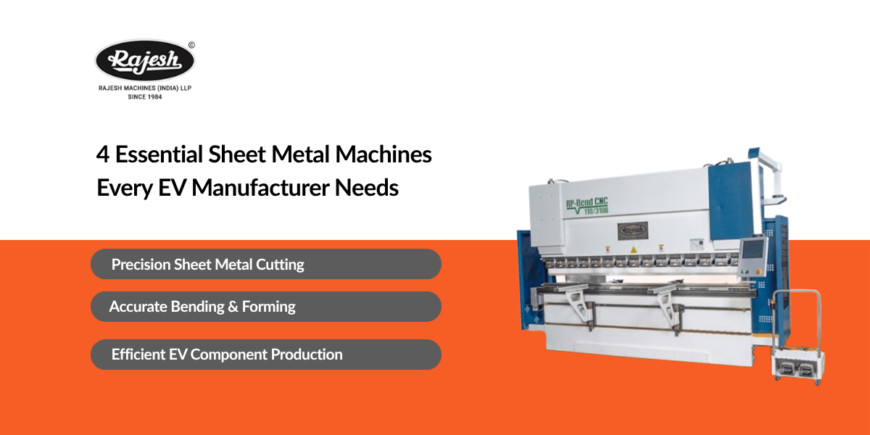
4 Essential Sheet Metal Machines Every EV Manufacturer Needs
Electric vehicle production runs on sheet metal.
Battery enclosures, motor housings, chassis brackets, and structural panels are among the many load-bearing or protective components that can start as flat sheet metal.
For EV manufacturers, two-wheeler and three-wheeler makers, battery pack assemblers, and auto ancillary units, choosing the right sheet metal machinery directly affects component accuracy, production speed, and consistency.
This guide walks through four machines that form the backbone of most EV sheet metal fabrication lines, what each machine does, and where it fits into the production process.
Machine selection depends on your component design, material grade, thickness, production volume, and level of automation. Think of this guide as a starting framework, not a one-size-fits-all recommendation.
1. Sheet Metal Cutting Machine
Before any forming or fabrication begins, raw sheet stock needs to be cut to the dimensions a specific component calls for.
A sheet metal cutting machine handles this first step, trimming coils or flat sheets into blanks sized for the next stage of production.
In EV production, cutting accuracy matters more than it might seem.
Battery tray blanks, panel sections, and bracket stock need to be cut to tight tolerances before moving to punching or bending. A poorly sized blank can create alignment problems downstream that careful bending cannot fix.
Cutting accuracy also affects material yield, which becomes a real cost factor when running high volumes of thin-gauge sheet for two-wheeler or three-wheeler components.
Rajesh Machines builds cutting equipment alongside its shearing and fiber laser lines, helping manufacturers match the cutting method to their material and production volume from straight-line shearing for high-throughput blanking to laser cutting for more complex profiles.
2. CNC Press Brake Machine
Cut and punched blanks still need to become three-dimensional parts, and that’s the job of a CNC press brake machine. Press brakes bend flat sheet along precise lines to form the angles, flanges, and profiles that give components their final shape.
A CNC press brake sees heavy use across different EV component types.
Battery enclosure walls need clean, repeatable bends to seal properly against dust and moisture. Mounting brackets may require multiple bend angles in sequence, while structural panels and chassis reinforcements depend on bend accuracy for proper vehicle assembly.
A CNC bending machine with programmable back-gauges and bend-angle control helps manufacturers hold tight tolerances, even when switching between component types on the same line.
Bend accuracy also affects the next stage. A component that is off by even a degree or two can cause misalignment during welding or fastening.
Catching these problems late in assembly can be costly, making accurate bending an important part of consistent EV component production.
3. Hydraulic Press Machine
Some EV components need more forming force than punching or bending alone can deliver — particularly deeper-draw shapes, thicker-gauge material, or parts that combine forming and piercing in a single stroke. A hydraulic press machine is built for this.
Battery tray bases and motor housing components often require deep-draw forming to create a recessed or cupped shape from a flat blank. This is where a deep draw hydraulic press is typically preferred over a standard press brake setup.
Heavier structural components may need the rigidity and tonnage range of an H-frame hydraulic press to maintain consistent force across the full bed area.
Hydraulic presses also offer better control over stroke speed and pressure than mechanical alternatives. This is useful when working with the mixed material thicknesses common in EV assemblies.
Rajesh Machines’ hydraulic press range includes C-type configurations for lighter-duty applications, helping manufacturers cover different production requirements without needing a separate machine for every tonnage range.
4. Shearing Machine
While cutting machines handle initial blanking, a dedicated shearing machine is useful for fast, accurate straight-line cuts.
It can trim sheet to final size, square edges before punching or bending, and cut stock down from bulk coil.
The biggest advantage of shearing is throughput. For EV manufacturers running high production volumes, especially in two-wheeler and three-wheeler segments, a hydraulic shearing machine can process straight cuts faster than laser or plasma alternatives.
Shearing is typically positioned early in the workflow, right after coil decoiling or bulk sheet delivery. It prepares the material before it reaches punching or press brake stations.
Choosing the Right Setup for Your Production
There’s no universal machine list that fits every EV manufacturer needs. The right combination depends on:
- Component design — Deep-drawn parts need hydraulic pressing capacity, while flat brackets may only need cutting, punching, and bending.
- Material and thickness — Battery-grade aluminum and higher-gauge steel behave differently under the same tooling.
- Production volume — High-volume two-wheeler runs benefit from CNC-driven repeatability, while lower-volume prototyping may not need full automation.
- Automation requirements — CNC press brake systems can reduce manual intervention and improve repeatability where required.
- Required accuracy — Tighter tolerances for enclosures and structural parts often justify higher-spec CNC machinery.
Rajesh Machines manufactures power presses, hydraulic presses, press brakes, shearing machines, rolling machines, fiber laser machines, and ironworkers.
This helps EV manufacturers and component suppliers build a line around their specific production needs.
If you’re planning a new EV component line or adding capacity, start by matching your component drawings against these five factors before approaching power press manufacturers in India or hydraulic press suppliers for quotes.
FAQs
-
What materials are commonly used for EV sheet metal components?
-
How do I decide between laser cutting and shearing for EV components?Laser cutting is useful for complex profiles and detailed shapes, while shearing is well suited to fast straight-line cuts. The choice depends on the component design and production requirements.
-
How can manufacturers reduce sheet metal waste in EV production?Efficient nesting, accurate cutting, proper blank sizing, and suitable cutting methods can help reduce material waste and improve sheet utilization.
-
What safety measures are important when using sheet metal machinery?Operators should use appropriate PPE, follow machine safety procedures, inspect tooling regularly, and receive proper training before operating cutting, punching, bending, or pressing equipment.