The main advantage is consistent, programmable precision. A CNC press brake automatically controls the back gauge position, ram stroke, and bending sequence for every job — eliminating the manual adjustments that cause variation on conventional machines. The result is tighter angular tolerances, lower rejection rates, faster changeovers between jobs, and the ability to handle complex multi-bend components reliably. For high-mix production or quality-critical applications, the difference in output consistency is significant.

- by Rjm_rajkot
- Blog
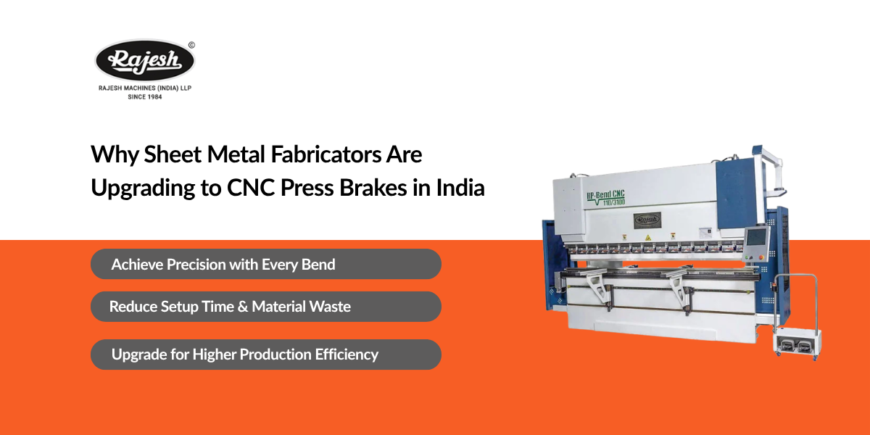
Why Sheet Metal Fabricators Are Upgrading to CNC Press Brakes in India
Something shifted in Indian sheet metal fabrication over the last few years. It did not happen overnight, and it did not make headlines. But if you have been in this business long enough, you have probably seen it in your own order book. Customers are asking for tighter tolerances. Delivery timelines are getting shorter. A competitor two towns over just installed a CNC press brake and is now bidding on contracts you used to win easily.
We have been manufacturing sheet metal machinery from Rajkot since 1984. We talk to fabricators across India every week — from small job shops in Coimbatore and Ludhiana to mid-scale units in Pune and Faridabad supplying automotive OEMs. And the conversations have changed. A few years ago, the question was ‘Do I need a CNC press brake?’ Today, it is ‘When should I upgrade, and which machine do I choose?’
This article answers both. Here are seven real reasons why Indian sheet metal fabricators are making the move to CNC press brakes — and what it actually means for your workshop when you do.
1. Customers Are Demanding Tighter Tolerances and Not Accepting Anything Less
This is the most common thing we hear from fabricators who call us about upgrading. Their customer — often an auto OEM, an electrical panel buyer, or an export client — has started rejecting parts that previously passed inspection. Not because the parts are worse. Because the customer’s own quality bar has gone up.
A conventional hydraulic press brake with manual adjustments simply cannot hold the angular consistency that CNC delivers over hundreds of bends. The operator adjusts the backstop by feel, checks the angle with a protractor, and compensates manually for springback. Over a long production run, the variation accumulates. On tight tolerance components — enclosure panels, structural brackets, elevator parts — that variation shows up in rejections.
The Rajesh CNC Press Brake uses Cybelec CybTouch proportional valve technology with Y1 and Y2 independent hydraulic cylinders. This means both ends of the ram move in perfect synchronisation throughout every stroke, maintaining angular consistency across the full bending length regardless of whether you are working near the centre of the bed or close to one end. That is the mechanical reason why CNC holds tolerances that manual machines cannot.
2. Labour is Getting More Expensive and Skilled Operators Are Harder to Find
The economics of sheet metal fabrication in India have changed. Daily wages for skilled press brake operators are significantly higher than they were five years ago. Finding someone who can set up a conventional brake for a complex multi-bend component, run it accurately through a production run, and catch errors before they become scrap — that person is valuable and increasingly expensive to find and retain.
CNC press brakes shift the skill requirement. An operator with basic training can load a pre-programmed bending sequence, run the job, and produce consistent output without the years of manual setting experience that conventional machines demand. The knowledge lives in the controller — the Cybelec CybTouch 8 PS or 12 PS in our machine — rather than entirely in the operator’s hands.
This does not mean the operator becomes irrelevant. Setup, material handling, and quality checking still need experience. But the margin for operator error on the actual bending operation is dramatically reduced when the controller is managing backstop position, ram speed, bending angle, and crowning automatically. For workshops struggling with skilled labour availability, that shift matters considerably.
3. Faster Job Changeovers Mean More Production Hours in Every Shift
On a conventional hydraulic press brake, changing from one component to the next means resetting the backstop manually, adjusting the stroke depth, swapping tools if needed, running test bends, measuring, adjusting again, and only then starting the production run. On a complex job with multiple bends, that setup can take 45 minutes or more. For a workshop running several different components in a single shift, that time adds up fast.
CNC press brakes store bending programmes. Once a component is set up and the programme is saved, calling it back up for the next run takes seconds. The backstop moves automatically to the correct position. The ram stroke is set. The bending sequence steps the operator through each bend in order. What previously took 45 minutes of manual setup can be done in under 10 minutes on a CNC machine with a saved programme.
For job shops handling high-mix, lower-volume production — multiple customer components in a single day — this changeover advantage directly translates into more productive hours per shift, more jobs completed per day, and better throughput without adding another machine or another shift.
4. Rejection Rates Drop and That Has a Direct Effect on Your Margins
Rejection is a cost that many workshops underestimate because it is spread across the production floor rather than appearing as a single line in the accounts. Scrap material, rework time, delayed deliveries, and the occasional customer penalty for non-conforming parts add up to a significant hidden drain on margins.
The majority of press brake rejections on conventional machines come from two sources: inconsistent backstop positioning across a production run, and variable operator judgment on bend angle and springback compensation. Both of these are structural problems with manual operation not operator incompetence. Good operators on manual brakes still produce variation. The machine architecture makes it inevitable.
CNC eliminates most of this variation by removing the manual adjustment from the repetitive bending operation. The Rajesh CNC Press Brake’s proportional valve system controls ram travel with precision on every stroke. The back gauge returns to the programmed position on every cycle. When the programme says 90 degrees, the machine bends 90 degrees — consistently, across a run of 500 identical parts. The reduction in rejection rate on complex multi-bend components can be substantial, and over a year of production it shows up clearly in material cost and throughput.
5. Complex Components Are Now Achievable — Without Outsourcing
Many Indian fabricators currently outsource their complex multi-bend components — or turn away those contracts entirely — because their conventional press brake cannot produce them reliably enough. A component requiring four or five sequential bends with tight dimensional relationships between each bend is genuinely difficult on a manual machine. The compounding of small errors at each bend step adds up to a finished part that is out of tolerance.
CNC press brakes handle multi-bend sequences in a fundamentally different way. The Cybelec CybTouch 12 PS controller on the Rajesh CNC Press Brake stores the full bending sequence for a component, steps the operator through each bend in order, automatically repositions the back gauge for each step, and manages the ram parameters for each individual bend in the sequence. Offline 2D programming is available so the programme can be prepared before the material reaches the machine.
For fabricators currently outsourcing complex components, bringing that work in-house on a CNC brake has a direct effect on margins and turnaround time. For those turning away contracts, it opens order books. Both outcomes have a tangible effect on the business within months of installation.
6. The Make in India Opportunity Rewards Workshops That Can Meet Export Standards
The Indian manufacturing sector is shifting in a direction that rewards fabricators who can demonstrate consistent quality, traceability, and the ability to produce to international specifications. Government procurement, PLI scheme-driven supplier development, and export orders all carry quality requirements that put pressure on conventional fabrication methods.
CNC press brakes produce output that is documentable and repeatable. The bending parameters for any component are stored in the controller. A customer or auditor asking about process capability gets a concrete answer — the machine holds this tolerance, the programme produces this sequence, the deviation on the last 500 parts was within these limits. That is not a claim available from manual operation.
Fabricators supplying automotive OEMs in Pune or Chennai are already familiar with this requirement. But the same trend is extending down the supply chain to smaller fabricators, and into new sectors — renewable energy structure fabrication, elevator components, medical equipment housings. The workshops that can demonstrate CNC-controlled consistency are winning those contracts. The ones that cannot are being asked to upgrade before the next order cycle.
7. The Cost of Not Upgrading Is Greater Than the Cost of the Machine
This is the one that takes time to sink in. When a fabricator asks us whether a CNC press brake investment is justified, we sometimes turn the question around: what is it costing you every month to stay on the machine you have?
Lost orders because your bend tolerance is not tight enough. Rework and scrap on complex components. Extra time spent on manual setup for every job changeover. The skilled operator you are paying above-market wages to because the machine depends on their hands and eyes. The contract you could not bid on because you knew your machine could not hold the spec.
Those costs are real. They are just spread across the business in a way that makes them harder to see than a single machine invoice. The fabricators who have upgraded to CNC press brakes consistently tell us the same thing after six to twelve months of operation: they wish they had done it sooner. Not because the machine was cheap — it was not — but because the business impact showed up faster than they expected.
The Rajesh CNC Press Brake Range — Built for Indian Fabrication Conditions
We manufacture our CNC press brake range from our Rajkot facility, and we have been supplying sheet metal machinery to Indian workshops since 1984. The machines in our CNC range are built with the specific demands of Indian fabrication in mind — voltage stability, dust environments, mixed-skill operator teams, and the need for reliable after-sales support without waiting weeks for a service visit.
Rajesh CNC Press Brake — Key Specifications
- Bending capacity range: 30 ton / 1500mm up to 500 ton / 6100mm — covering compact job shop machines to large industrial bending applications
- Model range: RP-Bend CNC 30T/1500 through RP-Bend CNC 500T/6100 — extensive range for precise capacity matching to your production
- CNC Controller (Standard): Cybelec CybTouch 8 PS — 7″ colour touchscreen, 3-axis control, EasyBend page for single bends, offline 2D software available, USB data transfer, wireless tele-maintenance
- CNC Controller (Advanced): Cybelec CybTouch 12 PS — 4-axis control (X-R back gauge), automatic bend sequencing option, full bending sequence programming for complex multi-bend components
- Hydraulic system: Y1 and Y2 independent hydraulic cylinders with proportional valve technology — ensures precise synchronisation of both ends of the ram throughout every stroke
- Back gauge: X-axis (CybTouch 8 PS) or X-R two-axis (CybTouch 12 PS) — automatic positioning for every bend in a sequence
- Crowning system: Manual crowning system — compensates for beam deflection under load, maintaining consistent bend angles across the full length of the workpiece
- Tooling: Mechanical upper and lower tool clamping, standard set of top and bottom tools included
- Also available: CNC Press Brake HD Series — for heavier, more demanding bending applications requiring additional rigidity and capacity
What You Get Standard on Every Rajesh CNC Press Brake:
- Cybelec CybTouch colour touchscreen controller — intuitive, programme-based operation
- Y1, Y2 independent hydraulic cylinders with proportional valve technology
- Automatic back gauge (X-axis or X-R two-axis depending on model)
- Manual crowning system for consistent angles across full bending length
- Mechanical upper and lower tool clamping
- 2 front gauge supports + 2 back gauge fingers
- Standard set of top and bottom tools
- Online help and interactive warnings on controller
- USB port for programme backup and transfer
- Wireless tele-maintenance capability
Which Indian Fabricators Are Upgrading Most and Why
The upgrade to CNC is happening across Indian sheet metal manufacturing, but some sectors are moving faster than others.
Electrical Enclosure and Panel Manufacturers
This is one of the highest-adoption sectors. Electrical panel enclosures require multiple bends on each panel, consistent corner angles, and tight dimensional control for component fitment. Customers — switchgear OEMs, infrastructure project managers, industrial equipment makers — have become strict on quality. Fabricators in this sector who upgraded to CNC report dramatically lower rejection rates and faster throughput on multi-bend enclosure panels.
Automotive Sheet Metal Suppliers
Tier-2 and Tier-3 suppliers to automotive OEMs in Pune, Chennai, and NCR are under the most direct quality pressure. OEM incoming quality inspection is rigorous. A conventional press brake’s variability is no longer acceptable on structural brackets, door frame components, or body-in-white parts. CNC is increasingly a prerequisite for maintaining or growing automotive supply contracts.
Elevator and Lift Component Fabricators
Elevator doors, guide channels, structural brackets, and cabin panels require precise, repeatable bending on mild steel and stainless. Dimensional tolerance is critical for mechanical fitment. This sector has seen significant CNC upgrade activity from fabricators who want to move up from commodity work to supply established elevator OEMs.
Agricultural Equipment and General Engineering Job Shops
Even general engineering job shops handling mixed fabrication work are finding CNC worthwhile — primarily for the changeover time advantage. A job shop running ten different customer components in a day gets compounding benefit from programmed setups. The first month’s output improvement often surprises even experienced shop owners who thought they were already running efficiently.
What About Operator Training? — Addressing the Real Concern
We hear this from almost every fabricator considering the upgrade. ‘My operators have been running a manual brake for years. Will they be able to handle a CNC machine?’ It is a fair concern, and we take it seriously rather than dismissing it.
The honest answer is that CNC press brakes are designed to be operated by people, not just programmers. The Cybelec CybTouch interface was designed for workshop use — large touchscreen, simple page layout, clear display, EasyBend page for straightforward single bends, and on-line help built into the controller. Most operators with conventional press brake experience are running basic CNC programmes within a week of training.
Rajesh Machines provides full commissioning and operator training on installation. We set the machine up at your facility, demonstrate its operation, and train your team on day-to-day operation and basic programming before we leave. We also provide ongoing technical support. The learning curve is real but it is shorter than most buyers expect — and the machine’s guided operation actually reduces errors during that initial period, not increases them.
The Upgrade Is Happening — The Question Is When Your Workshop Joins It
The shift to CNC press brakes in Indian sheet metal fabrication is not a future trend. It is happening right now, in workshops across Pune, Coimbatore, Faridabad, Rajkot, and hundreds of other manufacturing centres. The fabricators making the move are winning contracts from those who have not. Their rejection rates are down. Their throughput is up. Their ability to take on more complex work is expanding their customer base.
We do not believe every workshop needs to upgrade immediately or that CNC is the right answer for every situation. If your work is straightforward, your volumes are stable, and your customers are happy with current quality — your existing machine may serve you well for a while longer. But if you are feeling any of the pressures described in this article — tighter customer tolerances, skilled operator constraints, complex components you cannot currently produce reliably — the calculation deserves an honest look.
The Rajesh CNC Press Brake range starts at 30 ton for compact operations and extends to 500 ton for heavy industrial bending. We manufacture from our Rajkot facility and supply across India with full installation, commissioning, and after-sales support. If you would like to discuss which model suits your production, our team will give you a straight answer based on your actual work — not a sales script.
Contact the Rajesh Machines team for a free consultation:
View the full CNC press brake range.
Frequently Asked Questions
-
What is the main advantage of a CNC press brake over a conventional hydraulic press brake?
-
Which Rajesh CNC Press Brake model is right for my workshop?The right model depends on your material thickness, bending length, and production type. Our range runs from 30 ton / 1500mm (compact, suitable for lighter sheet metal and shorter bending lengths) to 500 ton / 6100mm (for heavy plate and long workpieces). For most sheet metal fabrication units producing enclosures, brackets, and panels in mild steel or stainless up to 4-5mm, models in the 40T to 160T range at 2500mm to 3100mm cover the majority of work. Contact the Rajesh Machines team with your material spec and we will advise the right model.
-
How long does it take for operators to learn CNC press brake operation?Most operators with conventional press brake experience are running basic CNC bending programmes within 3–7 days of training. The Cybelec CybTouch controller is designed for workshop use — large touchscreen, simple interface, EasyBend mode for straightforward operations. Rajesh Machines provides full commissioning and operator training on installation. Complex multi-bend programming takes longer to master but basic production operation is accessible quickly. The controller's guided operation actually reduces errors during the learning period.
-
What is proportional valve technology in a CNC press brake and why does it matter?Proportional valve technology controls hydraulic flow with precision — rather than simple on/off valve operation, proportional valves modulate the exact flow rate to each cylinder throughout the stroke. In a press brake, this means the Y1 and Y2 independent cylinders on both sides of the ram move in precise synchronisation, maintaining consistent ram parallelism throughout every bend. The practical result is angular accuracy that does not vary between bends at different positions along the bed — critical for consistent output on long or complex workpieces.
-
What is the difference between the CybTouch 8 PS and CybTouch 12 PS controller?Both are Cybelec CNC controllers with 7-inch colour touchscreens and intuitive interfaces. The CybTouch 8 PS controls 3 axes and includes X-axis back gauge — suitable for most standard sheet metal bending work. The CybTouch 12 PS controls 4 axes, includes X-R two-axis back gauge, automatic bend sequencing option, and is the right choice for complex multi-bend components where precise back gauge positioning across multiple steps is critical. Both come with offline 2D software capability, USB data transfer, and wireless tele-maintenance.
-
Does Rajesh Machines provide after-sales service for CNC press brakes?Yes. Rajesh Machines provides full after-sales service support across India for our CNC press brake range. This includes commissioning and operator training on delivery, ongoing technical support, and spare parts availability. Our service team covers the major manufacturing regions across India. The Cybelec controller also supports tele-maintenance via wireless connection, allowing remote diagnostics in many cases without a physical site visit. Contact us for specific service coverage in your region.
-
What sectors in India are upgrading to CNC press brakes most rapidly?The fastest-adopting sectors in India are electrical enclosure and panel fabrication, automotive Tier-2/Tier-3 sheet metal suppliers, elevator and lift component manufacturers, and general engineering job shops handling high-mix production. The common driver across all sectors is increasing customer quality expectations — tighter tolerances, lower rejection tolerance, and the need for consistent, documentable output that manual press brakes cannot reliably deliver.
-
Is a CNC press brake worth the investment for a small or medium-scale Indian fabrication unit?For most small to medium fabrication units experiencing customer quality pressure, skill labour challenges, or complex multi-bend component requirements — yes, the investment is justified. The payback comes through reduced rejection rates, faster changeovers, and the ability to win higher-value contracts. The Rajesh CNC Press Brake range includes compact models starting at 30 ton / 1500mm that are appropriately sized for small workshops. Contact the Rajesh Machines team to evaluate the ROI case for your specific production volume and component mix.