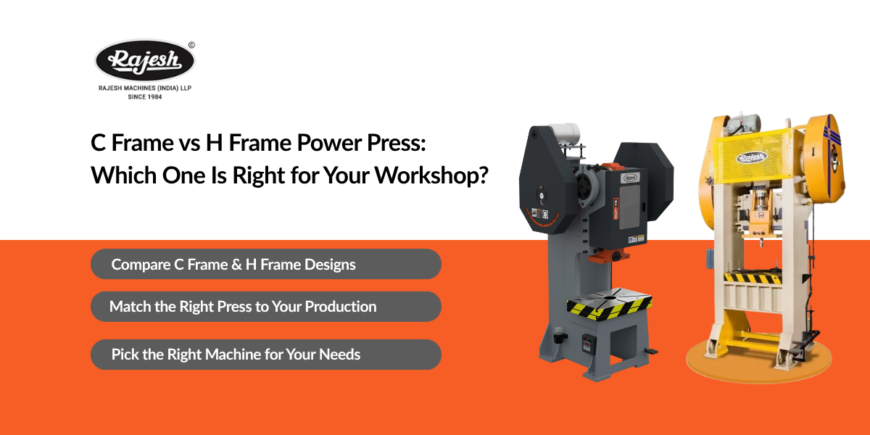
The C frame has an open, three-sided design that gives operators easy access from the front and both sides — ideal for fast loading, coil feeding, and frequent die changes on light to medium work. The H frame uses a closed, twin-column structure that resists deflection under high tonnage, making it the better choice for heavy-duty blanking, deep drawing, coining, and OEM-level precision production.

- by Rjm_rajkot
- Blog
C Frame vs H Frame Power Press: Which One Is Right for Your Workshop?
We have been making power press machines in Rajkot for a long time now, and one thing we hear from buyers almost every time — whether they are running a small sheet metal shop or supplying parts to a bigger plant — is that nobody told them the difference before they bought. They just picked what looked right, or went with what the neighbour had. Sometimes it worked out. Sometimes it did not. That is exactly why we put this together. Not to confuse you with technical language, but to help you walk in knowing what to ask for.
So here is the short version first, for those who want it: if you need fast cycle times, easy three-side access, and a compact machine for light to medium work between 10 and 100 ton, a C frame power press is almost certainly your answer. If you handle heavy-duty jobs, thick materials, or high-tonnage work where the frame must not flex even slightly under load, you want the H frame. And if neither of those sentences fully describes your shop, keep reading — the full picture is below.
The Core Difference: It All Starts with the Frame Shape
Everything about how these two machines perform traces back to one thing — the shape of the frame. A C frame power press is shaped like the letter C. The front is open, which leaves three sides of the working area clear and easy to reach. An H frame power press uses a closed, symmetrical structure supported by two columns on either side, much like the letter H standing upright.
That single design choice ripples through everything else. The open C shape gives operators easy access and faster loading — you can feed material from the front, left, or right. The closed H shape resists bending under load, which is exactly what you want when you are pushing serious tonnage through thick plate. One is not better than the other in any universal sense. They are built for different kinds of work.
C Frame Power Press: The Workhorse of Most Indian Workshops
Walk into most sheet metal shops across Gujarat, Maharashtra, Punjab, or Tamil Nadu and there is a good chance you will find a C frame press running. It is the most common machine in our range, and that is not an accident. It suits a wide variety of operations, handles different materials well, and fits into tight floor spaces without complaint.
What Makes the C Frame Design Strong
Our C frame power press is fabricated from IS-2062 graded rolled steel plates that are stress-relieved before final machining. That stress-relieving step is one most buyers never ask about, but it matters more than it sounds. It removes internal tension from the steel, so the frame holds its accuracy over years of production instead of slowly drifting out of alignment.
Inside, a heavy-duty seasoned cast iron table and slide deliver stable, repeatable strokes. The crankshaft is forged from special alloy steel and runs in phosphor-bronze bushes — which keeps friction low and extends service life considerably. A precision-balanced cast iron flywheel stores and releases energy smoothly, and a single-shot lubricator feeds oil to every bearing point in one stroke. Practically, that means less daily maintenance and more productive hours.
What Operations Does the C Frame Handle Best?
The open front makes the C frame ideal for jobs where you load and unload quickly, or feed sheet or coil material from the side. Most blanking, piercing, bending, and forming work on mild steel and other ductile metals falls well within its range. Specifically:
- Blanking and piercing — cutting flat shapes and punching holes in sheet metal
- Bending and forming — shaping lighter to medium gauge sheet metal components
- Coining — precision surface pressing for electrical fittings, hardware, and similar components
- Assembly pressing — pushing inserts, bushings, or fasteners into position
- High-volume bulk production — fast cycle times on small to medium components
If your shop runs repeatable parts in volume and you need quick access to the die area, the C frame is almost always the right starting point.
Rajesh C Frame Power Press — Key Specs
- Capacity range: 10 ton to 250 ton
- Frame material: IS-2062 graded rolled steel plates, stress-relieved — interlocked design with no welds at load support points
- Table and slide: High-grade seasoned cast iron, precision-aligned for consistent output
- Crankshaft: Special alloy steel, ground finish, running in phosphor-bronze bushes
- Flywheel: Precision-balanced cast iron for smooth, high-speed operation
- Lubrication: Single-shot lubricator feeding all bearing points
- Also available: C Frame Pneumatic Press — heavy-duty and quiet, popular in aeronautical, automobile, and precision assembly applications
See the full C frame power press range and model specs here!
H Frame Power Press: When Heavy Work Demands a Stiffer Machine
There is a point in every growing workshop where the jobs get heavier, the materials get thicker, and the C frame starts reaching the edge of its comfort zone. That is when the H frame earns its place. It is not the machine for everyone, but for the workshops it suits, nothing else comes close.
What Makes the H Frame Design Strong
The H frame’s twin-column structure spreads load evenly across both sides of the machine. We build ours from solid steel with proper cross ribbing, which means almost no flex under heavy pressure. Less flex means the ram travels straight down without the slight angular drift — called frame deflection — that can creep into an open-frame design when tonnage gets high.
That might sound like a small detail, but it is not. Frame deflection affects die alignment. Misaligned dies wear unevenly and produce components that drift out of spec over time. The H frame’s rigid structure keeps dies parallel under full load, which extends die life and keeps part quality consistent across long production runs. Our pneumatic H frame version uses IS-2062 stress-relieved steel and is engineered specifically for zero weld failures at load support points — a detail that matters when the machine runs heavy cycles day after day.
What Operations Does the H Frame Handle Best?
- Heavy blanking and punching — processing thicker steel plate and high-strength alloys
- Deep drawing — forming cup or box shapes where the ram must travel deep and straight
- Heavy forming — shaping structural components under sustained high tonnage
- Coining and sizing — precision operations that demand rigid, zero-deflection support
- Progressive die work on large beds — multi-stage stamping where die alignment is critical throughout
- OEM supply runs — high-volume production where dimensional consistency across thousands of parts is non-negotiable
Rajesh H Frame Power Press — Key Specs
- Capacity range: 50 ton to 250 ton
- Frame: Solid steel with cross ribbing — balanced stress distribution, no deflection, no vibration under load
- Table and ram: Precision-machined for excellent alignment under full operating load
- Durability: High efficiency, low maintenance construction built for sustained heavy-duty schedules
- Also available: H Frame Pneumatic Press — IS-2062 stress-relieved frame, zero weld failures at load support points
See the full H frame power press range and model specs
C Frame vs H Frame Power Press: Side-by-Side Comparison
Factor | C Frame Press | H Frame Press | What It Means for You |
|---|---|---|---|
Frame design | Open C shape — 3-side access | Closed H shape — 2 columns | C frame easier to load; H frame more rigid |
Tonnage range | 10 ton to 250 ton | 50 ton to 250 ton | Match to your heaviest job |
Rigidity under load | Good for light to medium work | Superior — minimal deflection | H frame for heavy, precision work |
Die area access | Excellent from three sides | Front and rear only | C frame wins for frequent die changes |
Floor footprint | Compact | Larger | C frame better for tight shops |
Cycle speed | Fast — suits high volume | Steady — suits heavy runs | C frame for bulk output |
Best operations | Blanking, piercing, light forming | Deep drawing, heavy blanking, coining | Pick by your dominant operation |
Rajesh range | 10T to 250T — Mechanical and Pneumatic | 50T to 250T — Mechanical and Pneumatic | Both built in Rajkot, Gujarat |
Which One Is Right for Your Workshop? Run Through These 5 Questions
Forget the spec sheets for a minute. Answer these five questions based on your actual production, and the right machine usually becomes obvious.
Question 1 — How often do you change dies or switch between jobs?
- You change jobs frequently, run small batches, or use multiple die setups: C frame’s three-side access makes this fast and practical.
- You run long consistent runs on the same job with minimal changeovers: The H frame’s slightly slower setup is not a disadvantage for you.
Question 2 — What sector are you producing for?
- Electrical components, hardware, kitchen utensils, two-wheeler parts, agricultural hand tools: C frame is designed for exactly this work.
- Automotive OEM supply, tractor bodies, heavy machinery structural parts: H frame delivers the rigidity and consistency OEM buyers demand.
Question 3 — How much floor space can you give to the press?
- Compact workshop, limited floor area: C frame’s smaller footprint is a real practical advantage.
- Dedicated press bay with room to work: H frame fits comfortably, and the rigidity benefits are worth the larger footprint.
Call us today and we will work through it with your actual job list.
Real Workshop Scenarios: Who Buys Which Machine
Here is how it actually plays out across the manufacturers we supply across India.
Workshops That Typically Choose the C Frame
- Auto component shops running two-wheeler brackets, connector housings, and pressed fittings — fast cycle time and easy coil feeding suit them well
- Electrical panel fabricators pressing enclosure panels, DIN rail brackets, and hardware fittings in light to medium gauge with frequent job changes
- Hardware and fastener manufacturers punching, blanking, and coining small metal components at high volume
- Kitchen utensil and houseware producers aluminium and stainless forming where access and speed matter more than brute tonnage
- Agricultural hand tool makers forming sickles, weeding tools, and implement parts from mild steel sheet
Workshops That Typically Choose the H Frame
- Automotive Tier-2 OEM suppliers stamping structural brackets, suspension parts, and chassis components where dimensional tolerances are tight
- Tractor and farm implement manufacturers pressing heavy frames, plough bodies, and structural components from thick plate
- Industrial equipment component makers producing pressed parts for earthmoving, construction, or material handling equipment
- Heavy electrical equipment fabricators transformer cores, distribution panel housings, and switchgear components
- Job shops on contract manufacturing serving heavy-sector OEMs where machine rigidity directly protects the quality reputation of the shop
We have watched plenty of growing shops start on a C frame and add an H frame a few years later as their work scaled up. There is nothing wrong with running both. Each handles the jobs the other is not ideal for.
The Full Rajesh Power Press Range — Both Machine Types, One Manufacturer
One thing that works in your favour when you buy from Rajesh Machines is that you are not locked into a single option. We build the complete spectrum from our Rajkot facility — mechanical and pneumatic variants of both frame types, hydraulic presses, press brakes, shearing machines, and more. The full list:
- C Frame Mechanical Power Press — 10 to 100 ton, ideal for punching, blanking, bending, and forming
- C Frame Pneumatic Press — precision assembly, aeronautical, and automobile sector applications
- H Frame Pillar Mechanical Power Press — 50 to 200 ton, heavy-duty stamping and forming
- H Frame Pillar Pneumatic Press — IS-2062 stress-relieved frame, zero weld at load support points, heavy-precision operations
- Hydraulic Power Press Range — C Frame Hydraulic, H Frame Hydraulic, Four Column — deep drawing, forming, and precision operations
- Cross-Shaft Precision Press, Press Brake Machines, Shearing Machines, Rolling Machines — for shops that need a complete sheet metal fabrication line
Browse the full power press range. See hydraulic press options. Explore press brakes and shearing machines.
Why Indian Manufacturers Come Back to Rajesh Machines
Over more than three decades, we have learned that a power press is only as good as the steel and engineering behind it. Both our C frame and H frame machines share the same foundations: IS-2062 graded steel, proper stress-relieving, seasoned cast iron components, alloy steel crankshafts running in phosphor-bronze bushes, and lubrication systems that protect the machine for the long haul.
Every machine also comes with a solid standard equipment package — flywheel and gear guard, oil cups, knockout system on larger models, die clamps, and standard safety features. Optional additions include pneumatic clutches with photo safety curtains, auto lubrication, and stroke counters for shops that want to run more automated.
Our after-sales service network runs across major manufacturing hubs in India. Spare parts for every model in our range are kept ready — crankshafts, clutch components, flywheels, brake systems. When something needs attention, we want you back in production fast, not waiting weeks for a part to arrive.
And honestly, the thing buyers mention most when they refer us to someone else is not the machine spec — it is that we told them the truth about which press they needed. We have told buyers to go with the C frame when they came in asking about the H frame. We will tell you the same if that is the right call for your work. That kind of advice is what turns a one-time machine purchase into a ten-year relationship.
The Right Machine Is the One That Matches Your Work
There is no trophy for buying the bigger or more rigid press. The smart choice is the machine that fits the parts you make, the tonnage you run, and the floor space you have. C frames reward speed, access, and versatility. H frames reward power, rigidity, and precision under heavy load. Many shops, in the end, find a place for both.
If you would like help choosing the right machine for your production — or if your job list does not cleanly fit one category — talk to us. We will look at your parts, your volumes, your floor plan, and your growth direction, then tell you plainly which press earns its keep for your specific situation.
Reach out through our contact page and we will get back to you quickly.
Frequently Asked Questions (FAQs)
-
What is the main difference between a C frame and an H frame power press?
-
Which power press is better for a small or medium-scale workshop in India?For most small and medium-scale Indian workshops, the Rajesh C Frame Power Press is the right starting machine. Its compact footprint, fast die-change capability, and compatibility with a wide range of operations — automotive parts, hardware, electrical components, agricultural tools — make it highly practical and productive. The H frame becomes the right choice when your work regularly needs over 100-ton capacity or involves heavy-gauge materials where frame rigidity is critical.
-
Can a C frame power press handle heavy blanking operations?Yes, within its designed tonnage range. The Rajesh C Frame Power Press is available up to 100 tons, which covers a very broad range of blanking, punching, and forming on mild steel and ductile metals. For operations consistently requiring above 100 tons — or deep drawing of thicker materials where strict dimensional accuracy matters — the H frame's superior rigidity makes it the more reliable choice.
-
What tonnage range do Rajesh C frame and H frame presses cover?Our C frame power press covers 10 to 100 ton across our standard range. Our H frame pillar power press covers 50 to 200 ton. Both machine types are available in mechanical and pneumatic variants. Our team can advise on the exact model for your part size, material, and operation.
-
Does the H frame press take up much more floor space than the C frame?Yes, the H frame has a larger footprint because of its two-column construction and wider bed. For shops with a dedicated press bay or adequate floor area, this is not a practical issue. For compact workshops with limited floor space, the C frame's smaller footprint is a genuine advantage. We can provide exact machine dimensions for any model so you can plan your floor layout before committing.
-
Are pneumatic press versions available for both frame types?Yes. Rajesh Machines manufactures both C frame and H frame machines in pneumatic versions. The pneumatic H frame is assembled from IS-2062 stress-relieved steel and engineered for zero weld failures at load support points — an important reliability feature for sustained heavy-cycle operation.
-
Which power press is right for automotive component manufacturing?It depends on the type of automotive component. For two-wheeler parts, connector housings, brackets, and pressed sheet metal parts in light to medium gauge, the C frame is the most practical and cost-effective choice. For Tier-2 OEM supply of structural brackets, suspension components, and chassis parts — where tight tolerances and heavy tonnage are routine — the H frame delivers the rigidity and dimensional consistency that OEM customers require.
-
Does Rajesh Machines make other press machinery besides power presses?Yes. Alongside our full power press range, we manufacture hydraulic presses, press brakes, shearing machines, and rolling machines — so workshops can source a complete sheet metal fabrication line from one trusted manufacturer in Rajkot, Gujarat. Single-point service and spare parts support across the full line is an advantage many of our customers rely on.