Work out the load for your heaviest job using cutting length, thickness and material strength. Add extra for stripping force, tooling and shock load. Also confirm where in the stroke the press gives its rated force. Share your part details with the manufacturer for a final recommendation.

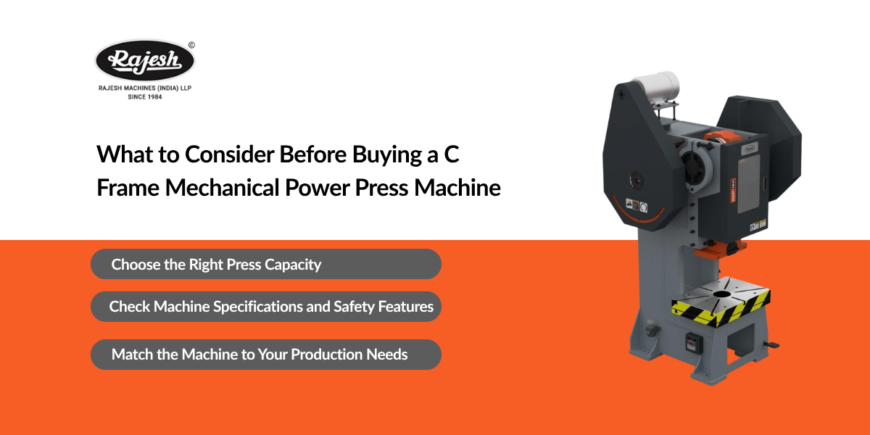
What to Consider Before Buying a C Frame Mechanical Power Press Machine
Buying a C Frame Mechanical Power Press Machine involves more than comparing tonnage and prices. The wrong choice can lead to production delays, limited die space, inconsistent performance, and safety challenges for operators.
Before making a purchase, it’s important to evaluate your production requirements, material thickness, die dimensions, machine capacity, safety features, and long-term operating costs. This guide covers the key factors to consider before buying a C Frame Mechanical Power Press Machine, helping you choose a machine that meets your production needs. To explore available options, visit our C Frame Mechanical Press page.
Why Choosing the Right C Frame Mechanical Power Press Machine Matters
A C Frame Mechanical Power Press is a long-term investment, so choosing the right machine takes more than comparing quotes.
Two common mistakes buyers should avoid when choosing C Frame Mechanical Power Press:
- Choosing the machine based on tonnage alone.
- Making the decision based only on the lowest price.
If the machine cannot handle your regular jobs, you may face extra wear and production issues. On the other hand, paying for more capacity than you need can increase your initial and running costs. Look at the type of work you do, the dies you use and how often the machine will run before making a decision.
1. Define Your Production Requirements
Start with your work, not the machine. Write down what the press will do.
Identify the Type of Metalworking Operations
A C Frame press is commonly used for punching, blanking, piercing and light forming of sheet metal. Each job puts a different load on the machine. Punching and blanking give a sudden shock when the metal breaks through. Forming needs force over a longer part of the stroke.
List every job you plan to run, even the rare ones. Your heaviest job usually decides the machine size.
Assess Material Type and Thickness
Different metals need different force for the same cut. Stainless steel needs more than mild steel at the same thickness. Note the thickest and hardest material you expect to run, not just the average.
Estimate Production Volume and Cycle Requirements
Ask yourself two things:
- How many parts do you need per shift?
- Will you feed by hand or use a feeder?
A few hundred parts a day is very different from several thousand. Higher volume puts more wear on the clutch and brake.
2. Check the Required Press Capacity and Tonnage
Most buyers spend the most time here, and most mistakes happen here.
Understand Rated Press Capacity
Rated tonnage is the force a press can deliver at a set point in the stroke. The manufacturer defines that point. On a mechanical press, the force is not the same all the way down. It is highest near the bottom of the stroke.
So do not assume the full tonnage is available at any height. Ask the manufacturer where the rated capacity applies. Then check it against your forming depth.
Match Tonnage to Your Material and Operation
For punching and blanking, you can estimate the force like this:
Force = cutting length × material thickness × shear strength
Here is an example. You want to blank a round disc of 100 mm diameter from 2 mm mild steel. Mild steel has a shear strength of about 300 N/mm².
- Cutting length (the edge of the disc): about 314 mm
- Force: 314 × 2 × 300 = about 188,400 N
- That is roughly 19 tonnes
This is only the cutting load. You also need extra capacity for stripping force, tool wear, material variation and shock load. Use the shear strength from your own material certificate. Then confirm the final size with the manufacturer.
For a more detailed breakdown, read our guide to mechanical power press tonnage calculation to understand how to estimate cutting force and determine the appropriate press capacity for your application.
Allow for the Requirements of Your Tooling
Some dies do several jobs in one stroke. A progressive die is one example. The forces from each station add up. Add the load of every station before you choose the capacity.
3. Evaluate Key Machine Specifications
Once you know the capacity, check the size and drive details. Ask for these figures in writing. Compare them with the manufacturer’s specification sheet instead of relying on estimates.
Stroke Length and Strokes per Minute
- Stroke length is how far the slide travels. A longer stroke gives more room for tall parts and feeding.
- Strokes per minute is how fast the press runs. A faster rate gives more parts per hour, but it also puts more load on the clutch, brake and die.
If you run mixed jobs, look for an adjustable stroke.
Shut Height and Bed Dimensions
Shut height is the distance from the bed to the slide when the slide is at the bottom of its stroke. Your die must fit within the range the press allows.
Also check the bed and bolster size. A die that only just fits is hard to set up and clamp.
Motor Power and Energy Requirements
Check the motor rating and the power supply it needs. Make sure your plant supply matches. Also ask about the flywheel and drive, because they affect how well the press handles repeated loads.
Tooling and Die Compatibility
Bring your die drawings when you speak to the supplier. Check the shank size, the bolster layout and how you will clamp the die. If you already own tooling, confirm it fits before you order. It is far cheaper to find a mismatch on paper.
4. Consider the Advantages and Limitations of the C Frame Design
The open front of a C frame is why people choose it. It also sets some limits.
Accessibility for Loading and Unloading
The open front gives easy access to the die area. Operators can load sheet or blanks and take out finished parts without reaching over a closed frame. This saves time when you feed by hand or change setups often.
Workpiece Size and Operation Requirements
C frame presses suit small and medium parts and general sheet metal work. For very large panels or heavy work, another frame style may fit better. If you want to compare, look at the H Frame Hydraulic Press.
Frame Deflection and Application Suitability
Because one side is open, a C frame can flex slightly under heavy load. This is normal, and the design allows for it. It matters most when you need very tight alignment between punch and die, or when you work close to the machine’s maximum load. If your parts need tight tolerances at high load, talk to the manufacturer before you decide.
You may also be choosing between mechanical and hydraulic. Mechanical presses are usually preferred for fast, repeat blanking and punching. Hydraulic presses give steady force through the stroke, which suits deeper forming. The C Frame Hydraulic Press is worth a look if your work leans that way.
5. Review Machine Safety Features
Plan for safety before you buy. Do not leave it until after delivery.
Guarding and Operator Protection
Ask which guards come as standard and which are optional. Fixed guards, interlocked guards and light curtains each protect in a different way. The right choice depends on how you feed the parts.
Clutch, Brake and Emergency Stop Systems
The clutch and brake start and stop the slide. Ask which type is fitted and how it is maintained. Check that the emergency stop is easy for the operator to reach and that the press stops reliably when it is pressed.
Applicable Safety Standards and Operator Training
Ask which machinery safety standards the press is designed to. Ask for the documents that support it. Do not accept a general claim without paperwork. Good training matters as much as good guards, so ask if operator training is included.
6. Calculate the Total Cost of Ownership
The purchase price is only the first part of the cost.
Initial Purchase Price
Compare quotes on equal terms: same capacity, same specification, same standard equipment and same safety package. A lower quote often leaves out items that another supplier included.
Installation and Operating Costs
Count these as well:
- Foundation work and transport
- Installation
- Power use
- Lubrication
- Tooling changes
Over several years, they add up.
Maintenance, Spare Parts, and Downtime
Downtime is the cost people forget most. If one worn part stops your line for two weeks because spares are slow, the saving on the price is gone. A slightly higher price with reliable parts and service often costs less in the end.
7. Check Maintenance and After-Sales Support
Routine Maintenance Requirements
Ask for the maintenance schedule. Usual tasks include lubrication, checking the clutch and brake, inspecting guards and checking bolts and alignment. A clear schedule is a good sign. Mechanical presses last long, but only when they are looked after.
Availability of Spare Parts and Technical Support
Ask which wear parts the supplier keeps in stock and how fast they can ship them. Ask who you call when something goes wrong.
Warranty and Service Response
Read the warranty terms. Note what is covered, for how long, and how fast the supplier responds to service calls. A written promise is worth more than a verbal one.
8. Compare Manufacturers Before Making a Decision
Verify Technical Specifications
Ask for a specification sheet and match it against the quote. Confirm capacity, stroke, shut height, bed size and motor details. If anything is unclear, ask for it in writing.
Ask About Testing and Demonstration
If you can, see the machine running, or run a trial with your own die and material. A trial shows what a brochure cannot: how the press sounds under load, how easy it is to set up and how the parts turn out.
Review Delivery, Installation, and Training
Confirm the delivery time, who installs the machine and who trains your operators. Agree on this before you order.
Experience matters when choosing a supplier.
Rajesh Machines (India) LLP is one of the leading Power Press Manufacturers in India, with experience in press machinery manufacturing since 1984. Our company holds CE and ISO 9001:2015 certifications. You can also check our industry experience and ask for relevant certification documents.
9. Common Mistakes to Avoid When Buying a C Frame Mechanical Press
- Buying on tonnage alone. Stroke, shut height, bed size and safety also matter.
- Choosing on price alone. The cheapest quote can cost the most once downtime and spares are counted.
- Ignoring the rated point in the stroke. Full capacity is only available at a set point.
- Forgetting your dies. Check the fit before you order.
- Treating safety as optional. Agree guards and controls upfront.
- Not planning for growth. If your work may get heavier, allow for it.
- Skipping the trial. If possible, see the press run your real job.
Frequently Asked Questions
-
How do I choose the right tonnage for a C Frame Mechanical Power Press Machine?
-
What operations can a C Frame Mechanical Press perform?It is commonly used for punching, blanking, piercing, notching and light forming of sheet metal. What suits you depends on part size, material and load.
-
What specifications should I check before buying a power press?Check rated capacity, stroke length, strokes per minute, shut height, bed and bolster size, motor power and the safety equipment supplied. Ask for all of these in writing.
-
Is a C Frame Mechanical Press suitable for high-volume production?It can be, especially for fast blanking and punching of small to medium parts. High volume puts more load on the clutch, brake and tooling. Share your target output with the supplier, and think about a feeder for automatic runs.
-
What affects the price of a C Frame Mechanical Power Press Machine?Capacity, bed size, stroke, clutch and brake type, safety equipment and optional extras all affect the price. Installation, training and support terms matter too. Contact the manufacturer for a quote based on your needs.
-
How often does a mechanical power press require maintenance?It depends on how much you use it and on the manufacturer's schedule. Daily checks and lubrication are usual. Clutch, brake, guards and bolts need regular inspection. Follow the maintenance manual that comes with the machine.
Choose the Right C Frame Mechanical Power Press Machine for Your Production Needs
The right press matches the job. That means enough capacity at the right point in the stroke, a bed and shut height that suit your dies, a proper safety package and a supplier who stays responsive after delivery.
Looking for a C Frame Mechanical Power Press Machine for your production requirements? Contact Rajesh Power Press to discuss your application and machine specifications. You can also browse our full range of power press machines, or see related sheet metal forming equipment such as the CNC Press Brake and the Hydraulic NC Press Brake.