Power presses are used for components such as brackets, mounting plates, support plates, sheet metal covers, fenders, guards, and other stamped or formed parts.

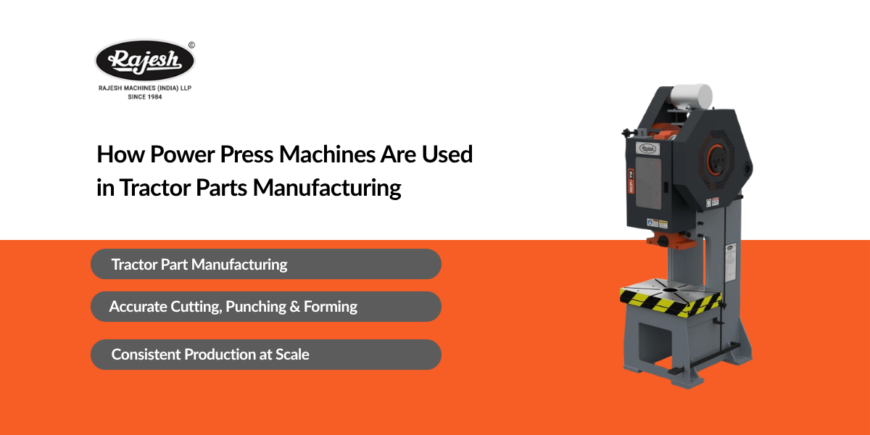
How Power Press Machines Are Used in Tractor Parts Manufacturing
Tractor manufacturing involves hundreds of metal components. Many of these parts require accurate cutting, punching, bending, and forming before assembly. Power press machines play an important role in these operations by producing consistent components at production scale.
From brackets and mounting plates to sheet metal covers and support components, power presses help manufacturers shape metal with controlled force and repeatable results.
For tractor parts manufacturers, selecting the right press capacity, die, stroke, and operating speed is important for maintaining production quality and efficiency.
Why Are Power Press Machines Used in Tractor Parts Manufacturing?
Tractor components often require repeated metalworking operations. Performing these operations manually takes more time and creates greater variation between parts.
A power press uses mechanical force to perform operations such as:
- Blanking
- Punching
- Bending
- Forming
- Piercing
- Embossing
- Notching
With a suitable die and machine configuration, manufacturers produce multiple components with consistent dimensions.
For manufacturers looking for industrial equipment, power press machines from Rajesh Machines are designed for various sheet metal working and pressing applications.
What Tractor Parts Are Made Using Power Press Machines?
Power presses are used for producing a wide range of sheet metal and fabricated tractor components.
1. Mounting Brackets
Tractors use numerous brackets to mount and support mechanical and electrical components. Power presses help manufacture these brackets through blanking, punching, and bending operations.
Accurate hole positions and bend angles are important because brackets need to align correctly during assembly.
2. Support Plates
Support plates are used in different tractor assemblies. A press machine helps cut the required profile and produce mounting holes with repeatable dimensions.
3. Sheet Metal Covers
Tractor manufacturers use formed sheet metal for various covers and protective components. Press forming helps create the required shape while maintaining production consistency.
4. Fenders and Body Components
Some tractor body and fender components require forming and bending of sheet metal. The appropriate press and die arrangement helps manufacturers produce these shapes repeatedly.
5. Linkage and Mounting Components
Three-point linkage systems and other tractor assemblies contain several fabricated metal parts. Power presses support operations such as punching and forming for these components.
6. Engine and Transmission Support Components
Certain brackets, plates, guards, and mounting components around engine and transmission assemblies are manufactured from sheet metal. Power presses provide a controlled method for producing these parts.
How Does a Power Press Manufacture Tractor Parts?
The manufacturing process depends on the component design and material. A typical process involves several stages.
Step 1: Sheet Metal Preparation
The manufacturer selects sheet metal based on the component’s design, required strength, thickness, and application.
The sheet is then prepared for the pressing operation.
Step 2: Blanking
Blanking cuts the required shape from a larger sheet. The blank becomes the starting piece for further forming operations.
Step 3: Punching and Piercing
Holes and openings are produced using a punch and die. These holes are often required for bolts, fasteners, shafts, or mounting points.
Step 4: Bending
The blank is bent to create the required angle or profile. Multiple bends might be required depending on the component design.
Step 5: Forming
Some tractor components require deeper shapes or contours. Forming dies help transform flat sheet metal into the required three-dimensional profile.
Step 6: Inspection
The finished component is checked for dimensions, hole positions, bend angles, surface condition, and other specifications before moving to the next manufacturing stage.
What Factors Should You Consider When Selecting a Power Press?
Choosing a press based only on tonnage is not enough. Tractor parts manufacturers should evaluate several machine and production requirements.
Press Capacity
The machine needs sufficient capacity for the material, component design, die arrangement, and operation being performed.
Using an undersized machine could affect production and machine life.
Material Thickness
The thickness and type of sheet metal influence the force required for punching, blanking, bending, or forming.
Component Size
The size of the component determines the required working area, die dimensions, and machine specifications.
Stroke Length
Stroke length influences how the machine performs the intended operation. Production requirements and material specifications should guide the selection.
Die/Tooling Compatibility
The press needs to accommodate the required die size and configuration. Die design also influences component accuracy and production efficiency.
Production Volume
A machine selected for low-volume production might not meet the requirements of continuous high-volume manufacturing. Manufacturers should consider expected output before selecting the machine.
Power Press vs Hydraulic Press for Tractor Parts
Both power presses and hydraulic presses are used in metal component manufacturing, but they work in different ways.
A power press uses a mechanical system to apply force. It is commonly used for repeated operations such as punching, blanking, and bending metal.
A hydraulic press uses hydraulic pressure to apply force. It provides smooth and controlled pressing, making it suitable for forming and heavy pressing applications.
Manufacturers can consider hydraulic press machines when their applications require controlled hydraulic force and pressing.
The right choice depends on the material, component design, type of operation, production volume, and forming requirements.
Benefits of Power Press Machines in Tractor Parts Manufacturing
Power presses offer several advantages for repetitive tractor component production:
- Consistent production: Properly configured dies help produce repeatable components.
- Faster operations: Repetitive punching, blanking, and forming operations become more efficient.
- Reduced manual work: Machine-based pressing reduces dependence on manual forming.
- Multiple applications: One machine type supports operations such as punching, blanking, bending, and forming.
- Suitable for batch production: Power presses are useful when manufacturers need repeated production of the same component.
- Better process control: Defined dies and machine settings help maintain dimensional consistency.
Why Choose the Right Press Machine Manufacturer?
A press machine is a long-term production investment. Manufacturers should evaluate machine construction, capacity, operating requirements, available configurations, after-sales support, and suitability for the intended application.
Rajesh Machines manufactures industrial press machinery for different metalworking requirements. Its range includes power presses and other sheet metal machinery used across manufacturing applications.
The machine should always be selected according to the actual component, material, production volume, and pressing operation rather than choosing a machine based only on general capacity.
Conclusion
Power press machines are an important part of tractor parts manufacturing. They support repetitive operations such as blanking, punching, bending, and forming, helping manufacturers produce consistent sheet metal components at production scale.
The correct machine depends on factors such as material thickness, component size, required force, die configuration, stroke, operating speed, and production volume.
For tractor parts manufacturers, evaluating these factors before purchasing a press helps ensure the machine matches the intended manufacturing process and long-term production requirements.
Frequently Asked Questions
-
What tractor parts can be manufactured using a power press?
-
What operations can a power press perform?Common operations include blanking, punching, piercing, bending, forming, embossing, and notching.
-
How do I choose a power press for tractor parts?Consider the material type and thickness, component dimensions, required pressing force, die size, stroke, production volume, and specific operation.
-
Is a power press better than a hydraulic press for tractor parts?Neither is universally better. Power presses suit many repetitive stamping and punching operations, while hydraulic presses suit applications requiring controlled hydraulic force and certain forming operations.