The price of a CNC press brake in India depends on six key factors: tonnage capacity, bed length, CNC controller specification, machine series (standard CNC or HD Series), manufacturer reputation and service network, and optional features. Entry-level machines on trade portals start lower, but industrial-grade CNC press brakes from established Indian manufacturers with proper after-sales support represent a more considered investment. Contact the Rajesh Machines team with your material spec and tonnage requirement for an accurate quotation for your specific production.

- by Rjm_rajkot
- Blog
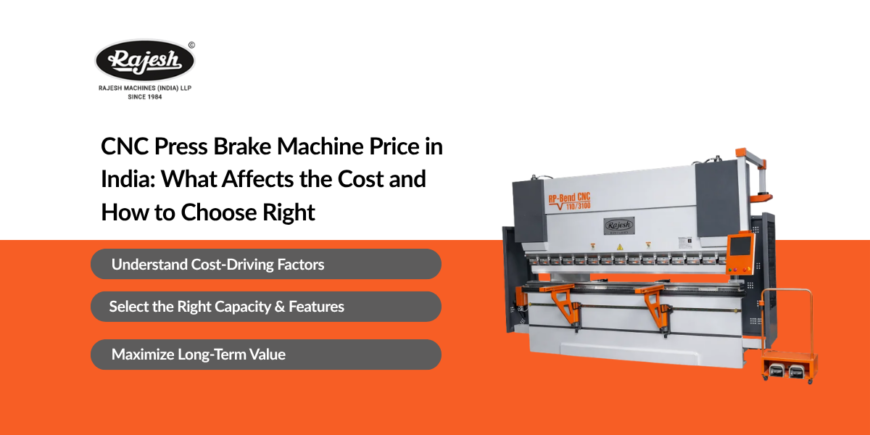
CNC Press Brake Machine Price in India: What Affects the Cost and How to Choose Right
The first question almost every buyer asks when they start looking at CNC press brakes is a simple one. How much does it cost? It is a fair question. And the honest answer — which most articles do not actually give you — is that the price of a CNC press brake in India depends heavily on what you are buying.
We have been manufacturing press brakes and sheet metal machinery from Rajkot since 1984. We talk to buyers every week who have received three different quotations and cannot figure out why the numbers are so far apart. Sometimes it is because the machines are genuinely different in specification. Sometimes it is because one of those machines has no real after-sales support behind it. And sometimes it is because a buyer is being quoted a machine that is too big or too sophisticated for what their workshop actually needs.
This guide will not give you a price list — because an honest price for a CNC press brake depends on your specific tonnage, bed length, and production requirements, and quoting a number without knowing those things does not help you. What we will give you is a clear understanding of what drives the price, what is worth paying for, and what you can skip — so that when you do get a quotation, you can evaluate it properly.
Why CNC Press Brake Prices Vary So Much in India
If you have searched for CNC press brake prices online or browsed trade portals, you have probably seen a very wide range of numbers. Entry-level listings start low. Quotes from established Indian manufacturers are higher. Imported machines from established global brands are higher still. That spread is not random — it reflects genuine differences in what these machines are made of and what backs them up.
The cheapest CNC press brake is usually cheap for a reason. Either the frame is lighter than it should be for sustained industrial use, or the hydraulic components are lower grade, or the CNC controller is a basic unit that limits what you can programme, or — and this is the one that matters most — there is no meaningful after-sales service behind the machine. When it breaks down at 11 PM before a deadline, the price you paid looks very different.
The most expensive machines are not always the right machines either. Buying a 300-ton HD Series press brake for a workshop that bends 3mm mild steel panels is over-specification that does not pay back. The right machine is the one that matches your actual production requirements — not too light, not over-built — from a manufacturer who will be there when you need them.
The 6 Factors That Actually Drive CNC Press Brake Price in India
Understanding these six factors gives you the tools to evaluate any quotation you receive — including ours.
Factor 1 — Tonnage Capacity
Tonnage is the single biggest driver of press brake price. More tonnage means a heavier frame, larger cylinders, a bigger hydraulic system, and more steel throughout the machine. The price difference between a 40-ton machine and a 200-ton machine at the same bed length is very significant — tonnage accounts for roughly 40 to 60 percent of the price variation you see across a range.
The most common mistake Indian buyers make is over-specifying tonnage. They think bigger is safer, or they want capacity for future work that may or may not materialise. The right approach is to calculate the tonnage you actually need — based on your material thickness, material type, and longest bend length — and buy that capacity with a reasonable margin, not double it. A machine running at 70 to 80 percent of its rated capacity performs better and lasts longer than one run at 40 percent.
Factor 2 — Bed Length (Working Length)
Longer beds cost more because they require more structural material to maintain rigidity over the full length, and because the hydraulic system needs to hold the ram parallel across a greater span. A 2100mm bed and a 4400mm bed at the same tonnage are meaningfully different in price.
Again, buy for your actual plate sizes. If your longest workpiece is 2000mm, a 2500mm bed gives you comfortable working room. A 4400mm bed adds cost without adding productive value for your current work. If your plate sizes change in the future, you can address that with the next machine.
Factor 3 — CNC Controller Specification
The controller is the brain of the machine — and it has a significant effect on both capability and price. Entry-level machines often come with basic NC controllers that handle simple positional settings. Mid-range machines use 3-axis CNC controllers like the Cybelec CybTouch 8 PS, which manages the Y-axis ram and X-axis back gauge automatically, stores bending programmes, and handles multi-bend sequences with offline 2D software capability. Advanced machines use 4-axis controllers like the Cybelec CybTouch 12 PS, which adds R-axis back gauge control and automatic bend sequencing — critical for complex components with multiple bends requiring precise back gauge repositioning at each step.
The CybTouch 8 PS is the right controller for most Indian sheet metal fabricators. The CybTouch 12 PS earns its additional cost specifically when you regularly produce complex multi-bend components where automatic sequencing and two-axis back gauge control save significant setup and production time. If your work is mostly straightforward single or double bends, the 12 PS is additional capability you may not need.
Factor 4 — Machine Build — Standard CNC vs HD Series
For most sheet metal fabrication work — enclosures, panels, brackets, structural components in mild steel and stainless up to moderate thickness — the standard Rajesh CNC Press Brake delivers everything the job requires. The frame is well-built, the hydraulic system is appropriately specified, and the Cybelec controller handles the programming requirements comfortably.
The HD Series exists for a specific reason. When your production involves heavy plate bending, large structural sections, sustained high-tonnage work, or very long workpieces, the standard frame’s rigidity approaches its practical limits. The HD Series uses a heavier frame construction, operates at up to 275 bar hydraulic pressure, and has a wider table for large workpiece support. It costs more than the standard CNC at equivalent tonnage — and that difference is justified when the work genuinely demands it. When it does not, the standard machine is the right investment.
Factor 5 — Manufacturer Reputation and Service Network
This is the factor that trade portal listings do not show you — and it is often the most important one over the life of the machine. A CNC press brake is a 15 to 20 year investment if it is well-built and well-maintained. The manufacturer who built it needs to be able to support it for at least that long — spare parts, service engineers, technical support, and controller software updates.
Buying from an Indian manufacturer with an established facility, four decades of experience, and a genuine service network across India means that support is there when you need it. Buying the cheapest option from a supplier who imports machines and has no service infrastructure behind them means that the first significant breakdown — and it will come — leaves you stranded. The savings on purchase price get spent quickly on downtime, emergency part sourcing, and production delays.
Factor 6 — Optional Features and Configuration
Standard CNC press brakes come with a defined equipment set — controller, proportional valve system, back gauge, tool clamping, standard tooling. Optional features like special tooling configurations, additional back gauge axes, or custom bed arrangements add cost. These additions are genuinely useful when the work demands them. They add unnecessary cost when they do not.
Our advice is to specify what you need for your current production and the realistic near-term work you are planning. Optional features can often be added later as your production evolves. Starting with a well-specified base machine and adding capability as needed is a smarter investment approach than buying maximum configuration upfront.
CNC Press Brake Price Factors — Quick Reference
Price Factor | Lower End | Higher End | Price Impact | What to Remember |
|---|---|---|---|---|
Tonnage | 30–60 ton | 200–500 ton | 40–60% of variation | Match to your heaviest job — not your dream spec |
Bed length | 1500–2100 mm | 4400–6100 mm | Significant | Longer beds cost more; buy for your actual plate sizes |
CNC Controller | 3-axis (CybTouch 8) | 4-axis (CybTouch 12) | Moderate | 4-axis earns back cost fast on multi-bend complex jobs |
Machine build | Standard CNC | HD Series (heavier frame) | Moderate | HD Series for heavy plate; standard for most fab work |
Manufacturer | Generic/entry | Indian manufacturer with 40yr track record | Significant | After-sales support protects your total investment |
Optional features | Standard config | Conical bending, special tooling | 10–25% add-on | Only spec what your production genuinely needs |
Standard CNC vs HD Series — Which One Are You Paying For?
Both the Rajesh CNC Press Brake and the Rajesh CNC Press Brake HD Series run on the same Cybelec controller platform and use the same proportional valve, Y1/Y2 independent cylinder architecture. Here is how to decide which is the right machine for your investment:
Feature | Rajesh CNC Press Brake (Standard) | Rajesh CNC Press Brake HD Series |
|---|---|---|
Bending force range | 30 ton to 500 ton | 80 ton to 290 ton |
Working length | 1500 mm to 6100 mm | 2100 mm to 6100 mm |
Frame construction | Standard welded steel frame | Heavier frame — greater rigidity for thick plate |
Hydraulic pressure | Standard operating pressure | 275 bar max — designed for sustained heavy-duty use |
Table width | Standard bed width | 80 mm to 220 mm — wider table support for large workpieces |
Controller options | CybTouch 8 PS / CybTouch 12 PS | CybTouch 8 PS / CybTouch 12 PS |
Proportional valve | Yes — Y1 Y2 independent cylinders | Yes — Y1 Y2 independent cylinders |
Best suited for | General sheet metal fab, enclosures, panels, brackets, light-medium plate | Structural steel bending, heavy plate forming, automotive heavy components, long workpieces |
Right buyer | Most small-medium Indian fabrication units | Fabricators regularly working above 80 ton on thick or wide material |
See full Standard CNC specs:
See full HD Series specs:
What Is Included in the Rajesh CNC Press Brake Standard Equipment?
When you get a quotation from us, the standard equipment on every Rajesh CNC Press Brake machine includes:
Standard Equipment on Every Rajesh CNC Press Brake:
|
There are no hidden add-ons in that list. When you ask for a quotation, that is what the base machine includes. Any optional features we propose — conical bending attachments, special tooling — will be clearly itemised separately.
What to Watch Out For When Comparing Quotations
If you are comparing quotations from multiple suppliers, here are the things that explain price differences and that you should ask about directly:
Controller brand and model
Ask specifically which controller is on the machine. Cybelec (Swiss) and Delem (Dutch) are the established premium controller brands used on quality machines. Cheaper or unfamiliar controller brands are often a sign of cost-cutting elsewhere in the machine too. Check whether offline programming software is available and whether the controller supports wireless tele-maintenance — both matter over the machine’s working life.
Proportional valve specification
Proportional valve technology is what makes a CNC press brake hold angular consistency across the bed. Ask whether the machine uses proportional valves. Some cheaper machines use simpler valve configurations that give less precise ram control. This is a direct quality indicator.
Frame material and stress-relieving
The frame is the machine’s foundation. It should be fabricated from quality structural steel and stress-relieved before final machining — stress-relieving removes internal tension that would otherwise cause the machine to slowly lose accuracy under sustained production load. Ask your supplier what material their frames are built from and whether the frame is stress-relieved.
After-sales service coverage
This is the question most buyers forget to ask until they need the answer. Ask: where is your nearest service engineer? What is typical response time for a breakdown? Do you stock spare parts in India or do they need to be imported? Who do I call if the controller has a software issue? A supplier who cannot answer these questions confidently is a supplier who will not be there when you need them.
What is not in the quotation
Standard machine quotations typically exclude freight and installation. Ask whether commissioning and operator training are included. Ask whether foundation work is required and who is responsible for it. These items are not attempts to hide cost — they vary by location and installation — but you need to know what you are budgeting for beyond the machine price.
Is a CNC Press Brake Worth the Investment for an Indian Fabrication Unit?
We get asked this question often, and our answer is consistent: for most Indian sheet metal fabricators who are currently running conventional or NC press brakes, the CNC upgrade pays back faster than buyers expect.
The payback comes from three directions. First, reduced setup time on every job changeover — a saved 30 to 40 minutes per setup, across multiple setups per shift, adds up to hours of productive bending time every week. Second, lower rejection rates — the angular consistency that CNC delivers on multi-bend components reduces scrap and rework that conventional machines produce structurally. Third, the ability to take on more complex contracts — components that you previously could not produce reliably, or had to outsource, can now be produced in-house at better margins.
Most fabricators who upgrade to a Rajesh CNC press brake and use it properly across two shifts see a payback period of two to four years. For units running three shifts or handling high-complexity work, the payback is often faster. The machine then continues to earn for another decade or more.
How to Get the Right Quote from Rajesh Machines
When you contact us for a CNC press brake quotation, the more specific you can be about your production, the more accurately we can recommend the right machine. Useful information to have ready:
- Your most common material: mild steel, stainless, aluminium — and typical thickness range
- Your longest bend length: this determines the minimum bed length you need
- Your heaviest bending operation: material thickness × bend length × tensile strength determines tonnage requirement
- Your production type: high-volume repetitive, mixed short-run, complex multi-bend components, or a combination
- Your floor space: approximate available footprint for the machine
With that information, our team can recommend the right model from our CNC or HD Series range, specify the correct controller, and give you a quotation that reflects what your production actually needs — not the most expensive option, and not an under-specified machine that will limit you within a year.
Contact the Rajesh Machines team for a quotation: rajeshpowerpressindia.com/contact-us/
The Rajesh CNC Press Brake Range at a Glance
We manufacture two CNC press brake lines from our Rajkot facility:
Rajesh CNC Press Brake — Standard Series
- Bending force: 30 ton to 500 ton
- Working length: 1500 mm to 6100 mm
- Controller: Cybelec CybTouch 8 PS (3-axis) or CybTouch 12 PS (4-axis)
- Best for: General sheet metal fabrication — enclosures, panels, brackets, automotive components, elevator parts, structural sections in light to medium gauge
Full specs and model chart: rajeshpowerpressindia.com/products/hydraulic-cnc-press-brake-machine/
Rajesh CNC Press Brake HD Series
- Bending force: 80 ton to 290 ton
- Working length: 2100 mm to 6100 mm
- Hydraulic pressure: 275 bar maximum — designed for sustained heavy-duty bending
- Controller: Cybelec CybTouch 8 PS or CybTouch 12 PS
- Best for: Heavy plate bending, structural sections, large workpieces, automotive heavy components, fabricators regularly working above 80 ton
Full HD Series specs and model chart: rajeshpowerpressindia.com/products/hydraulic-cnc-press-brake-hd-series/
Also consider: Rajesh NC Press Brake rajeshpowerpressindia.com/products/hydraulic-nc-press-brake/ — a stepping-stone option for fabricators not yet ready for full CNC investment
Before You Request a Quote — A Quick Checklist
- Have you calculated your required tonnage based on material type, thickness, and longest bend length?
- Have you measured your longest workpiece to determine your minimum bed length requirement?
- Have you decided between standard CNC and HD Series based on your typical plate thickness and tonnage?
- Have you considered which controller suits your work — CybTouch 8 PS for standard fab, CybTouch 12 PS for complex multi-bend components?
- Have you asked about after-sales service coverage and spare parts availability in your region?
- Have you budgeted for installation, commissioning, and operator training in addition to the machine price?
If you can answer all six of those questions, you are ready to have a productive conversation with our team — and you will be in a strong position to evaluate whatever quotations you receive.
The Right CNC Press Brake Is the One That Fits Your Work
Price matters. Of course it does. But the CNC press brake that fits your production profile, is correctly specified for your tonnage and bed length, runs on a quality controller, and has a manufacturer behind it who will be there in three years — that machine is the right investment, regardless of whether it is the cheapest quote you received.
We have been building sheet metal machinery in Rajkot for over 40 years. We are not the cheapest option in the Indian market and we are not trying to be. We are trying to build machines that earn their keep on your shop floor for the next 15 to 20 years, and to be the manufacturer you call when something needs attention.
If you would like a quotation for the right CNC press brake for your specific production, contact our team. Tell us what you make, what material you work with, and how your shop runs — and we will give you an honest recommendation.
Contact Rajesh Machines for a CNC press brake quotation: rajeshpowerpressindia.com/contact-us/
View the full press brake range: rajeshpowerpressindia.com/press-brakes/
Frequently Asked Questions
-
What is the price of a CNC press brake in India?
-
What is the difference between the Rajesh CNC Press Brake and the HD Series — and why does it affect price?The standard Rajesh CNC Press Brake covers 30 ton to 500 ton at working lengths from 1500mm to 6100mm — ideal for most general sheet metal fabrication work. The HD Series (80 ton to 290 ton, 2100mm to 6100mm) uses a heavier frame construction and operates at up to 275 bar hydraulic pressure, making it the right machine for heavy plate bending, structural sections, and sustained high-tonnage applications. The HD Series costs more at equivalent tonnage because of the heavier build. If your work regularly involves thick plate and high tonnage, that difference is justified. If your work is general sheet metal fabrication in mild steel and stainless up to moderate thickness, the standard CNC is the right specification.
-
Which Cybelec controller should I choose — CybTouch 8 PS or CybTouch 12 PS?The CybTouch 8 PS (3-axis) is the right choice for most sheet metal fabrication work — it handles Y-axis ram control, X-axis back gauge, multi-bend programme storage, offline 2D software, and wireless tele-maintenance. The CybTouch 12 PS (4-axis) adds R-axis back gauge control and automatic bend sequencing, making it the right choice specifically for complex multi-bend components where precise back gauge repositioning across multiple steps is critical. If your work is mostly straightforward bending with occasional multi-bend jobs, the 8 PS is sufficient. If you regularly produce complex components with 4 or more sequential bends requiring precise back gauge movement at each step, the 12 PS earns its additional cost quickly.
-
Why are some CNC press brake quotes much cheaper than others?Price differences between CNC press brake quotations typically reflect differences in frame quality and steel specification, hydraulic component grade (proportional valve quality matters significantly), CNC controller brand and capability, and — most importantly — the after-sales service infrastructure behind the machine. The cheapest machines often cut costs on frame weight, use lower-grade hydraulic components, or have no meaningful service network in India. These savings on purchase price are usually recovered (and exceeded) by the manufacturer when service issues arise. Always ask specifically about controller brand, valve specification, and service coverage — not just the machine price.
-
Does Rajesh Machines provide installation and training with the CNC press brake?Yes. Rajesh Machines provides full commissioning and operator training on installation at your facility. We set up the machine, verify its operation, and train your operators on day-to-day operation and basic programming before we leave. Ongoing technical support is available, and the Cybelec controller supports wireless tele-maintenance for remote diagnostics in many cases. Ask us specifically about service coverage in your region when you request a quotation.
-
What other machines does Rajesh Machines manufacture that work alongside a CNC press brake?Rajesh Machines manufactures a complete sheet metal fabrication line — CNC Press Brakes (standard and HD Series), NC Press Brakes, Hydraulic Shearing Machines (NC Swing Beam and Hydraulic Guillotine), 3 Roll and 4 Roll Hydraulic Rolling Machines, Power Press Machines (C-Frame and H-Frame), Hydraulic Presses, and more. Fabricators who build their production line around Rajesh machines benefit from consistent build quality, compatible specifications, and single-point after-sales support across the full line.